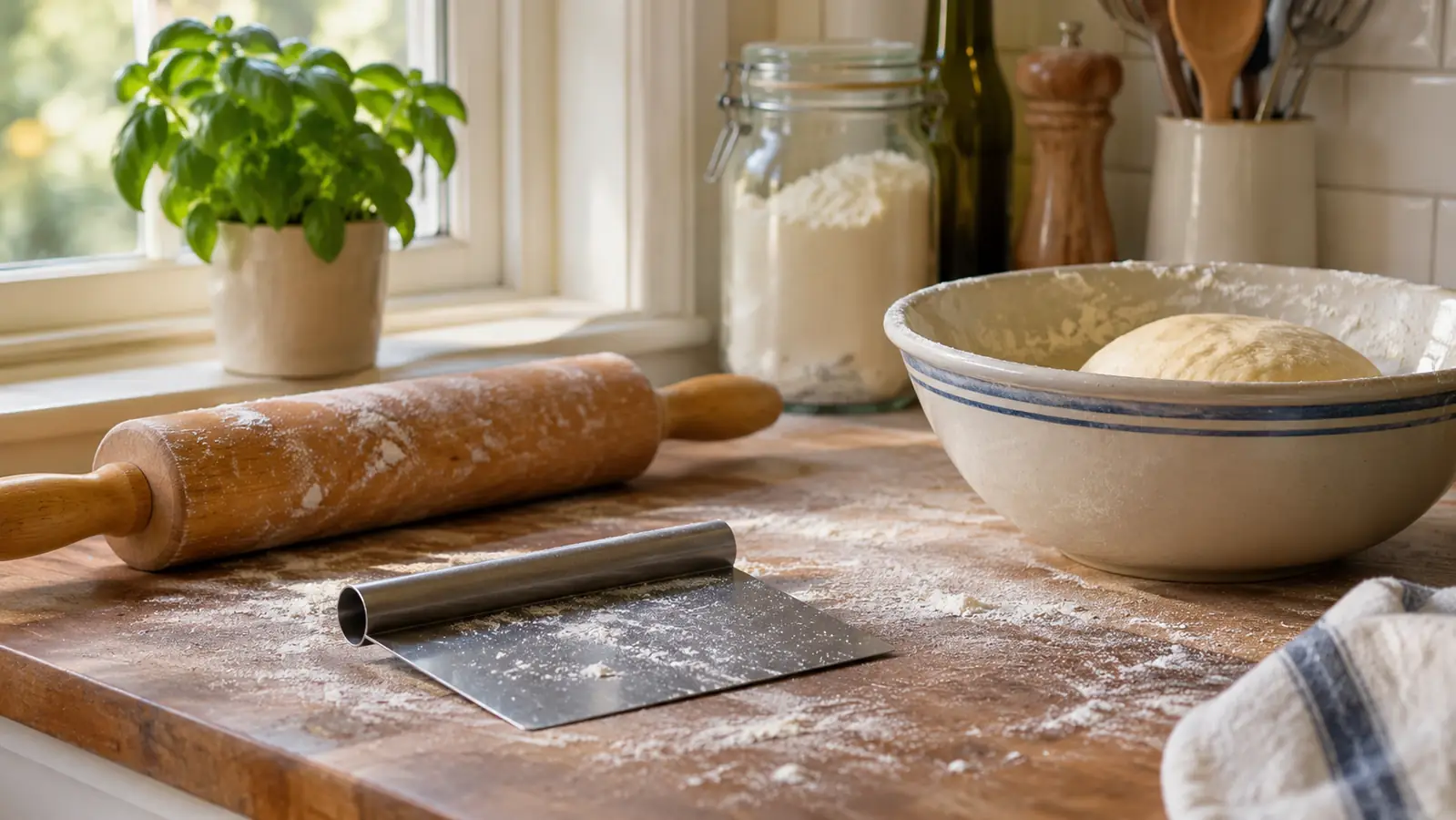
The drawer under my oven holds a rolling pin, two spatulas, and a bench scraper that does more work than either of them. I baked without one for the first twenty years of my baking life. In the hotel pastry kitchen we kept a stack of plain stainless scrapers on the bench and I picked one up every ten minutes without thinking about it. When I left that kitchen at thirty-one and moved into a Baltimore rowhouse with six feet of counter, I went a year and a half without replacing it. The loss showed up in small ways. Flour paste in the corners of the board. Dough that stretched out of shape when I tried to move it with my hands.
About eighteen months ago I bought the OXO Good Grips scraper, the one with the six-inch stainless blade and the soft handle, and it has hung on a hook by the stove ever since. It cost less than a decent spatula and it comes off the hook more often. Here is what it actually does in a home kitchen, in the order I reach for it, and where it stops being the right tool. The OXO is not magic and it will not replace a knife, but it earns its spot ten times over.
The tool that comes off the hook more often than the spatula
Six-inch stainless blade, one-inch markings, a handle that still grips when your hands are covered in butter. This is the one I keep by the stove.
Amazon See today's price on Amazon →It Cleans a Floured Counter in Two Passes
After rolling out pie dough, my board is a mess of dried flour, butter smears and scraps. A wet rag makes paste and pushes it into the grain. The scraper does not. Hold the blade low, almost flat, and push the whole mess into a pile in one long stroke, then scoop it into the bin with the second. Thirty seconds, no paste, no damp board that has to dry before I can roll the next round. This is the reason mine never goes back in a drawer.
It Divides Dough Without Sawing It
Dinner rolls need twelve even pieces. A knife drags through yeasted dough and seals the cut edges into a seam that never quite rises right. The scraper goes straight down in one clean press. The rectangular blade gives you a full-length cut instead of a point, so the piece releases from the dough instead of tearing away from it. I press, lift, and the piece is already the right shape. Twelve pieces, twelve clean faces, and the rolls come out of the oven the same size for once.
It Lifts Rolled Dough Without Stretching It
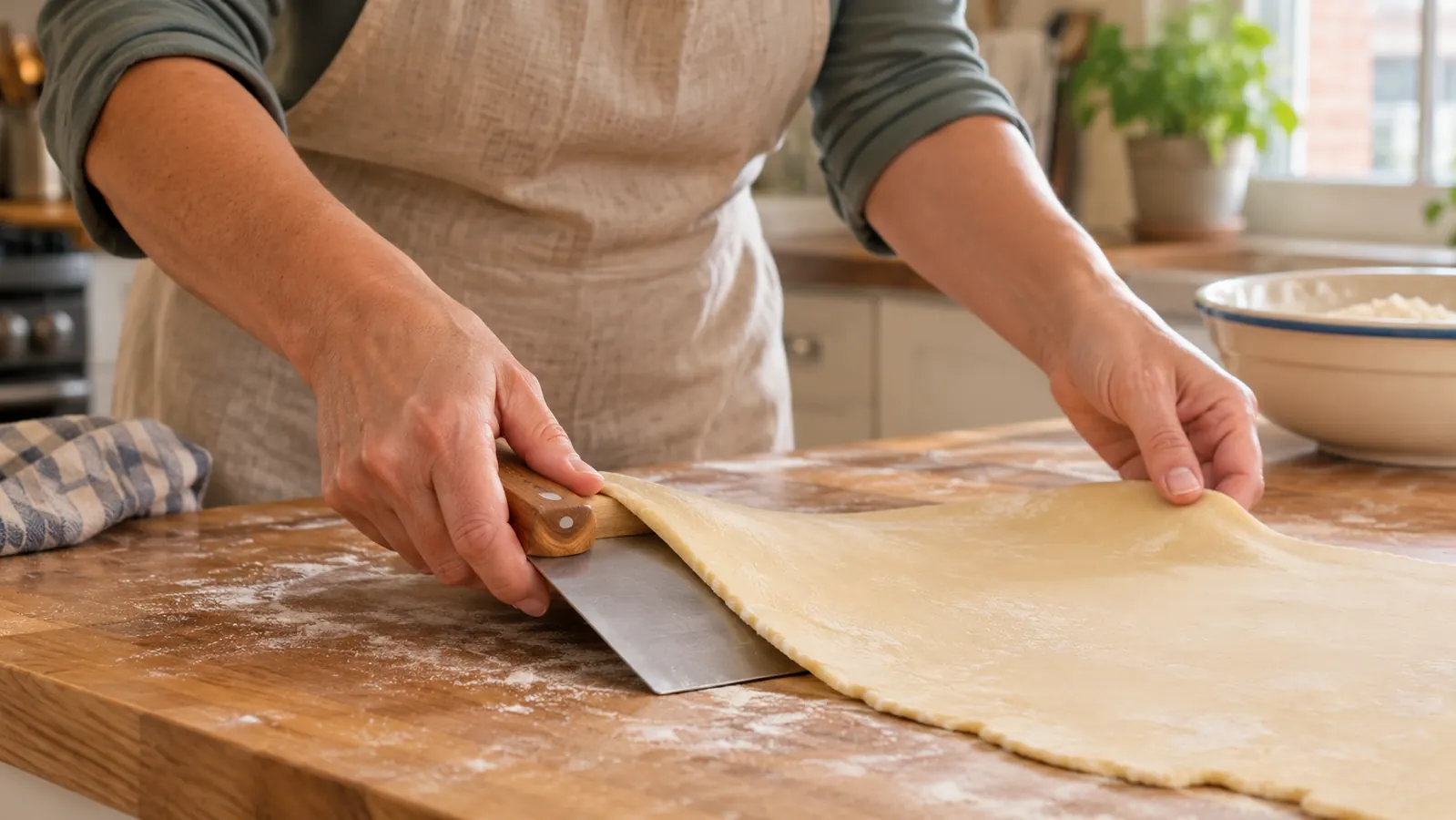
This is the one I did not appreciate until I stopped doing it. Slide the flat of the blade under a sheet of rolled dough and you can move it to the pan, fold it, or cut a lattice without the dough stretching out of shape. Fingers leave dents and pull. A rolling pin lifts but drops. The scraper slides under a thin sheet of pie dough and the sheet stays exactly the size you rolled it. My Thanksgiving apple pie got neater the year I started doing this, and the lattice strips stopped shrinking.
It Cuts Cold Butter Into Flour Faster Than Your Fingers
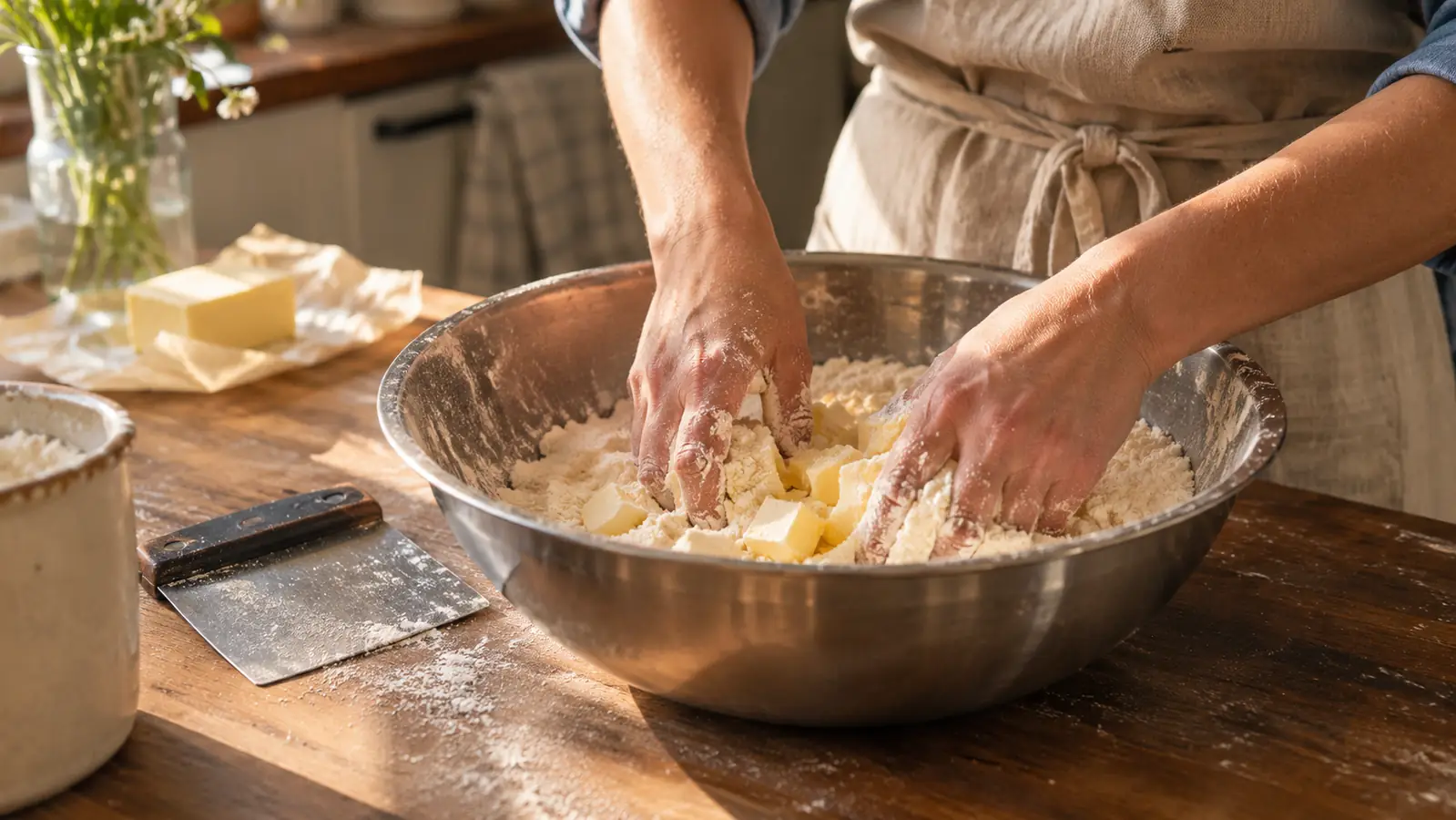
Cold cubed butter drops into the flour and your fingertips warm it before it ever breaks down. The scraper chops through the bowl in short downward strokes, turning cubes into flat shards, and shards are what you want in a pie crust. Fewer warm fingertips means flakier pastry. I chop for about thirty seconds, then finish with my hands, and the mixture is right before the butter has a chance to soften. The blade is stainless, so it does not mind the salt or the acid in the flour.
The One-Inch Markings Replace a Ruler
The blade is marked in one-inch increments, which sounds like a gimmick until you are squaring a block of dough or spacing cuts on a batch of bars. I use the markings to size biscuit dough, to check that a rolled sheet is the right width for the pan, and to space scored lines on sugar cookie cutouts at Christmas. It saves the step of finding a ruler with floury hands. They are markings, not a precision instrument, so read them in good light and do not expect a machined edge.
It Squares a Pan of Brownies Evenly
Brownies for the church bake sale have to cut evenly or the tray looks picked over before anyone touches it. Press the blade straight down through the cooled slab, wipe the blade between cuts, and every square comes out the same. The scraper also lets me press and level the batter in the pan before baking, which is how the top comes out flat instead of domed on one side. One tool, both ends of the job, and the tray looks deliberate.
It Keeps the Board Clear While You Work
On six feet of counter I cannot afford clutter. As I chop nuts or break up chilled dough, the scraps accumulate, and a scraper lets me push them into a bowl with the side of the blade without stopping what I am doing. When the bake is over, the same motion sweeps everything into the bin at once. Paul does the dishes in this house and he has stopped asking me where the wet rag keeps going. There is less to wipe because the board is already clear.
It Handles Nuts and Chocolate Without a Second Tool
The blade is a chopper, which the name says and which I forget constantly. A handful of walnuts, a bar of chocolate, a pile of cold butter for a crumble: a few firm downward chops on the board and it is done, no blade to wash and no cutting board to dig out. The blade shape is rectangular and flat, so the pieces stay put instead of spraying across the counter. It is not a chef's knife and it will not mince garlic well, but for rough chopping it saves a step.
The Handle Still Grips With Buttered Hands
The soft, non-slip grip is the part I would have called marketing before I owned one. After twenty minutes of working with butter, my hands are slick and a plain stainless scraper becomes a hazard. The handle stays put, and the wide top edge gives your palm something to press against when the dough is stiff. It sits comfortably in a smaller hand too, which matters because my sister Karen borrows it whenever she bakes at her place.
It Hangs on a Hook Instead of Eating Drawer Space
The whole tool is a little over six inches long and under two inches tall, thin enough to disappear. Mine hangs on a hook by the stove, so it takes up a hook and nothing else. In a rowhouse kitchen where the pantry cabinet holds every tool I own, a utensil that does not need drawer space is worth more than one that does. If I ever had to move it into the drawer, it would sit flat against the side and I would not notice it was there.
What I'd Skip
Two honest limits. It will not replace a knife for fine work, so do not buy it expecting to mince shallots or trim a chicken. And the markings are stamped shallow, which means low light and floury hands make them hard to read, so keep a real ruler in the drawer if you are squaring something that has to be exact. A curved bowl scraper is still a separate tool for getting the last of the batter out of a mixing bowl; the flat blade will not follow the curve. Mine has not rusted, the handle has not loosened, and it has been through the dishwasher more times than I can count. The blade has dulled a little at the corners, which is normal for eighteen months of daily use. None of that changes the verdict. It is a small, cheap, unglamorous tool that does four jobs I used to do badly with my hands.
I went a year and a half without one and did not know what I was missing. It cost less than a decent spatula and it comes off the hook more often.
Six inches of stainless that replaced a ruler, a knife and a wet rag
The OXO Good Grips scraper: one-inch markings on a six-inch blade, a non-slip handle, and a hook by the stove with its name on it.
Amazon See today's price on Amazon →