
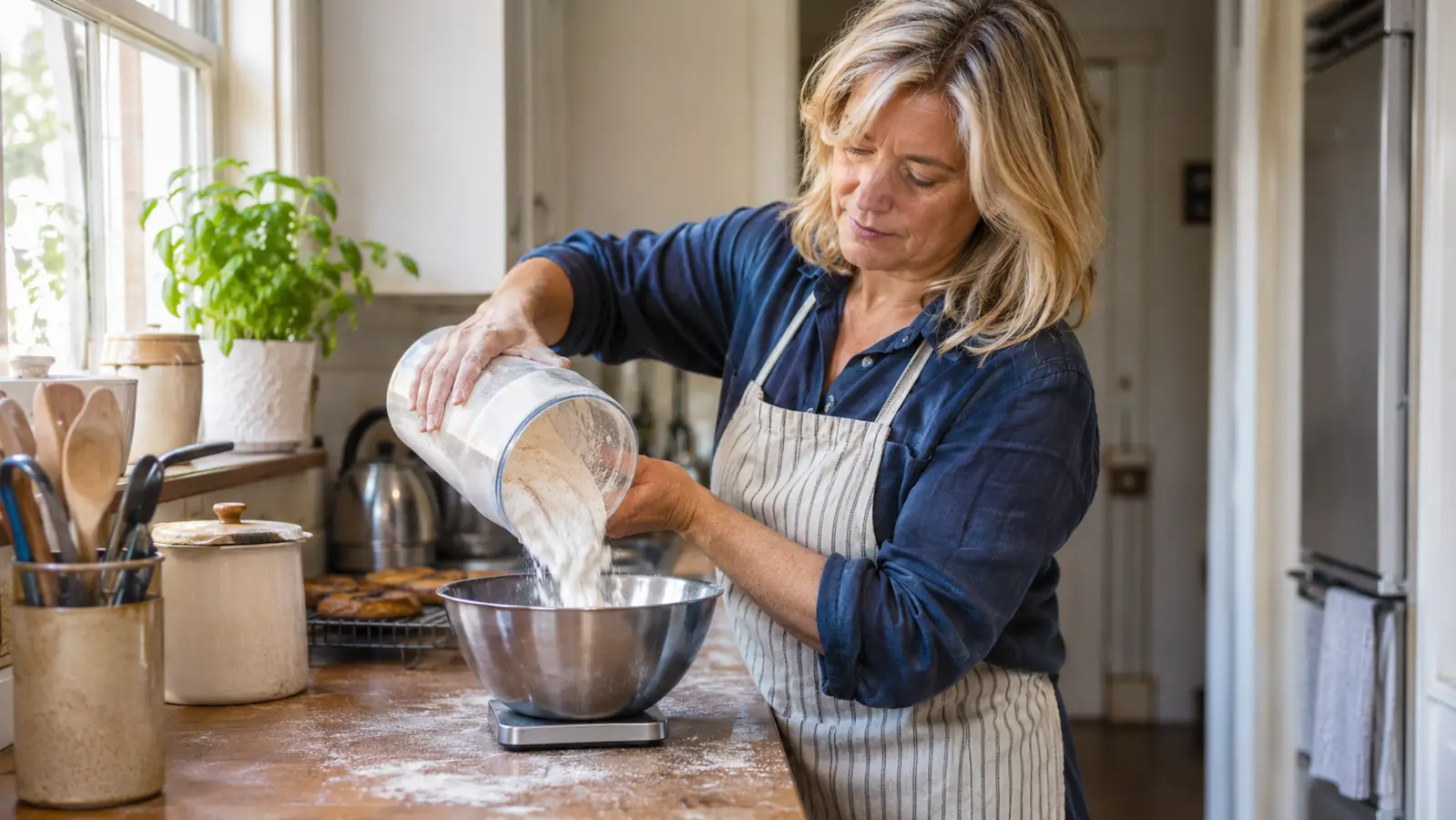
Flour is the quietest variable in home baking. Nobody tastes it, nobody adjusts for it, and yet it decides whether your cookies spread into lace or hold a soft center. Scoop a cup straight from the bag and you can pack in close to a third more than the person who wrote the recipe had in mind. Sift it and you can come in light. The recipe says one cup either way, and your oven has no idea what you meant.
I baked with measuring cups for twenty years before I bought the Etekcity digital kitchen scale about two years ago. That is not an exaggeration for effect. I trained in pastry, spent seven years in a hotel pastry kitchen where every formula was weighed in grams on a big counter scale, and then came home and went straight back to cups because that was what my own recipes used. The scale was the first thing I bought when I decided my home baking should agree with itself from one weekend to the next. It has lived flat in the pantry cabinet ever since, and it is the tool I reach for more often than any other in a kitchen with roughly six feet of counter.
The Quick Verdict
Two years of near-weekly baking and it still reads to the gram. The tare button and the 1 g readout are the reason to own it. The fluid-ounce setting is the one thing I ignore.
Amazon Check Today's Price →Weigh the flour once and your cookies stop surprising you
The Etekcity scale weighs up to 11 lb in 1 g steps, tares back to zero with a bowl already on the platform, and stores flat in a cabinet you already use. It is the smallest change in the kitchen and the one that shifts the most.
Amazon Check Today's Price on Amazon →How I've Used It
The scale came into the house on a Saturday, and the first thing I weighed was a cup of all-purpose flour, scooped the way I had been scooping it for two decades. One hundred and forty grams. I did it again, more carefully, and got a hundred and twenty-six. That spread is the entire argument. A recipe written at 125 g per cup and baked with my scooped 140 g cups was running about twelve percent heavy on flour every single time, which is more than enough to turn a tender sandwich bread into something closer to a brick and to make a cookie dough that crumbles instead of spreads.
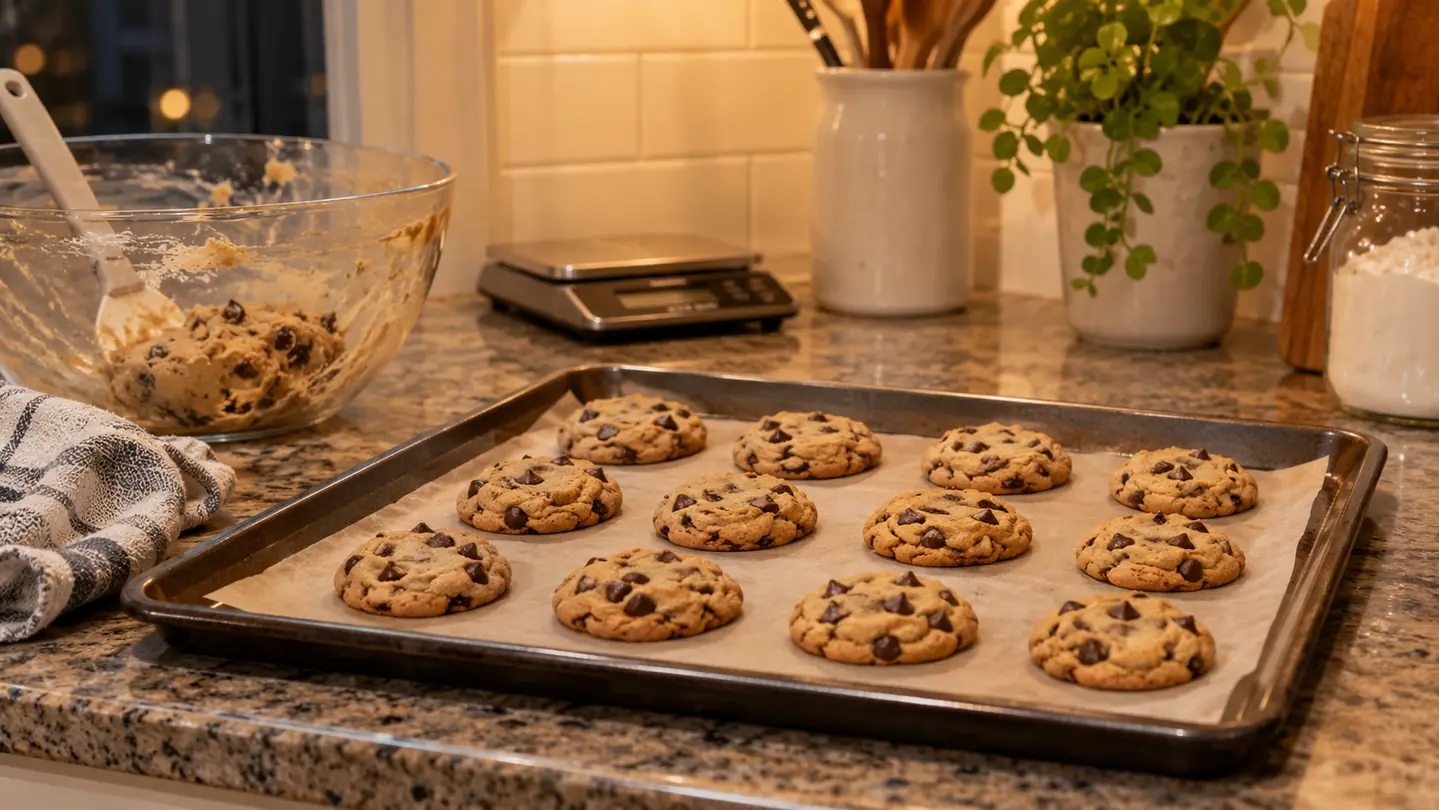
That first real test was a batch of chocolate chip cookies on a Sunday afternoon, using a recipe I had made from cups since college. I weighed the flour at 125 g per cup instead of my usual scoop, and the dough came out noticeably softer than I was used to, almost slack under the spatula. I nearly added flour back to firm it up. I am glad I did not, because the cookies baked with a chewier center and spread to a consistent width instead of the ragged, uneven tray I had been pulling out of the oven for years without questioning it.
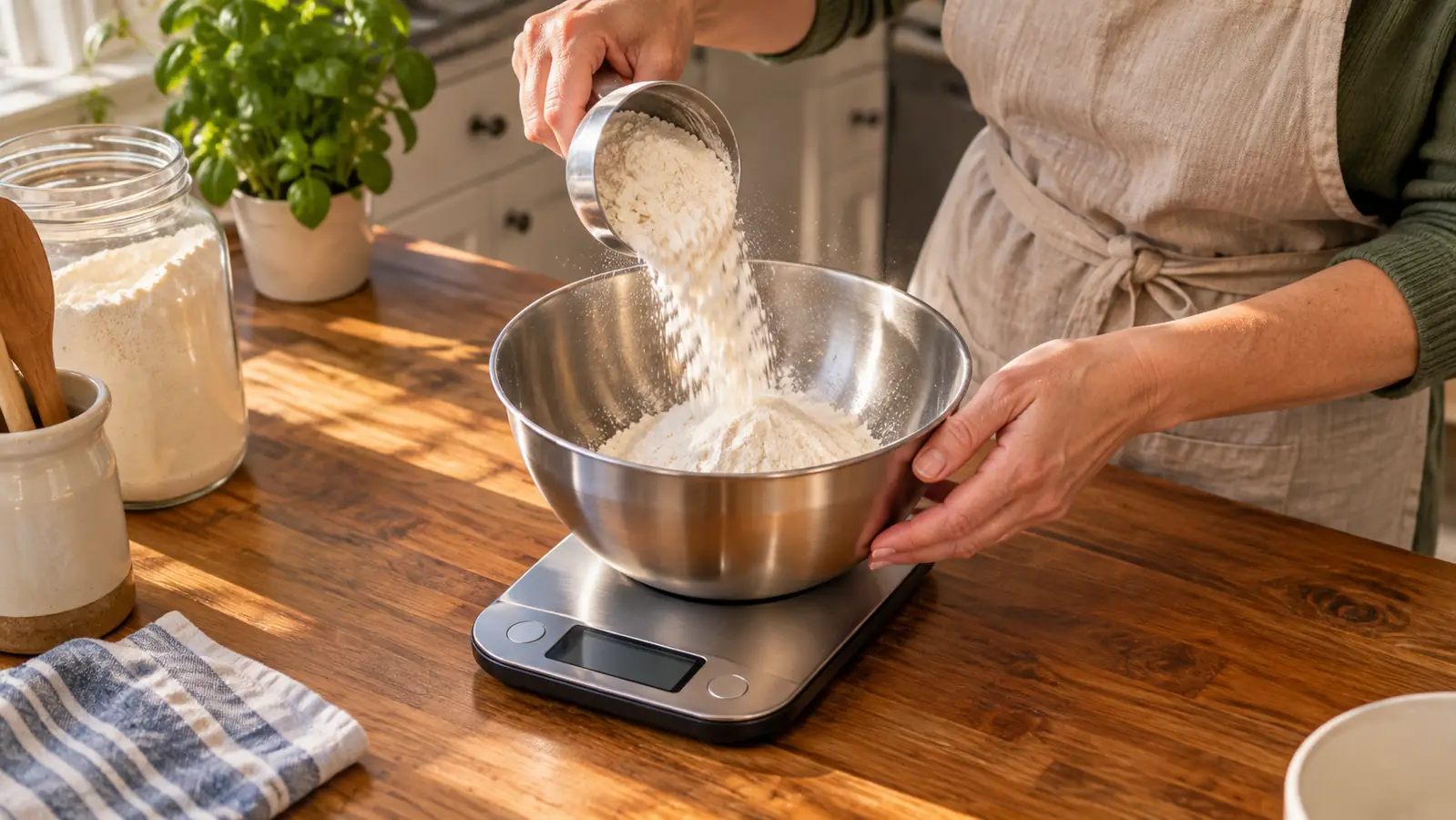
Since then the routine has not changed. Bowl on the platform, press tare, flour in until the readout hits the number, press tare again, sugar, tare, butter. It is a two-button process and I do it without looking at the buttons anymore. Pancakes on a Sunday. Cookie dough on a Wednesday night when the church bake sale is the next morning. Sandwich bread and dinner rolls most months, apple pie at Thanksgiving, sugar cookie cutouts at Christmas, brownies for the bake sale table, and a layer cake for my niece Maddie's birthday every year since she turned one. All of it goes through the scale now, including the parts I used to eyeball.
Two years in, I have changed the batteries once. It arrived with two AAA batteries already installed, so it worked the moment I set it on the counter, which sounds like a small thing until you have driven to the store for batteries on a Saturday morning with butter already softening on the counter.
Storage decided as much as anything. In the hotel kitchen the scale had a permanent home on a stainless prep table and never moved. At home it has to earn its square footage, and a narrow galley kitchen does not hand out counter space to anything that only gets used twice a week. This one stands on its edge in the pantry cabinet between the flour canister and the stack of nesting bowls. Out, used, wiped, back in the cabinet. I have never once left it on the counter because there is nowhere on the counter for it to live.
The Tare Button Is the Reason to Own One
Most people who dismiss a kitchen scale have only used one to weigh a single thing: the bag of flour, the block of butter. That is the least useful version of the tool. The tare button resets the display to zero with whatever is already sitting on the platform, so the mixing bowl never counts toward your numbers. Put the bowl down, tare, add flour, tare, add sugar, tare, add butter. One bowl, one spatula, no measuring cups to wash and no half-cup measure sitting in the sink for three days because you kept meaning to deal with it.
Tare is also what makes the scale worth the space for things that are genuinely irritating by volume. A tablespoon of honey measured by eye is a sticky guess. Forty grams of honey is forty grams of honey. Same for peanut butter, molasses, and anything that clings to the side of a cup. You set the jar on the platform, tare, scoop out what you need, and read the negative number as it counts down. Written out it sounds fussy. In practice it takes about four seconds and saves you a measuring cup and a small internal argument about whether that really was a full tablespoon.
What the Scale Changed About My Bread
Bread is where the difference stops being subtle. A yeasted dough is a ratio, and a ratio only works if the numbers underneath it are real. When I started weighing flour at 125 g per cup instead of scooping to 140, my sandwich bread stopped needing the extra splash of water I had been adding for years without understanding why. The dough was less thirsty because it had less flour in it. Nothing else changed. Same flour, same yeast, same 30-inch electric oven in the same Baltimore rowhouse kitchen, same hands.
I keep the numbers in a notebook now, which sounds like more work than it is. My sandwich bread formula weighs out at 500 g of flour, 320 g of water, 9 g of salt and 7 g of instant yeast, and the whole weighing step takes about four minutes before the dough has even come together. The dinner rolls use the same dough divided twelve ways. I write the total dough weight in the corner of the page each time, and it lands within ten grams of the last batch. That is not skill on my part. That is the scale doing its job quietly while I stand there with flour on my sleeves.
Dinner rolls got more consistent for a duller reason: even portions. I weigh the whole batch of dough, divide by twelve, and pinch off twelve pieces of the same weight. They proof at the same rate and brown at the same rate, so there is no roll on the tray that is done twenty minutes before its neighbor. The same trick works for cookie dough. A scoop heaped by eye varies by ten or fifteen grams from one ball to the next. A scoop leveled on the scale does not. Cookies of one weight spread to one width, and the whole tray comes out looking like it came from a single batch rather than an afternoon of guessing.
Two Years In: What Held Up
The platform is 304 food-grade stainless steel, and it wipes clean with a damp cloth, which matters more than it sounds in a kitchen where flour goes everywhere and a spilled cup of sugar is a weekly event. I have never had to scrub it. The backlit LCD is readable in the dim light of a winter morning before the kitchen lights are on, and the readout holds steady while you pour rather than flickering and forcing you to stop mid-stream. The unit button cycles through grams, ounces, pounds and ounces, fluid ounces and milliliters. In two years I have used exactly two of those: grams for everything that matters, and ounces when a recipe from an older American cookbook insists.
The one habit I would pass along is wiping the platform immediately after anything with butter or honey on it. Flour brushes off with the side of your hand. Butter sits there and sets. A damp cloth takes two seconds and keeps the stainless from building a dull film around the edges of the readout, and after two years of near-weekly use this one still looks like it did the week it arrived. Beyond that the maintenance is a battery change every couple of years and remembering that the scale is in the cabinet before you start a recipe, not after the butter is already creamed.
The Etekcity has not needed anything from me beyond that first set of batteries. No drifting, no dead spots on the platform, no mornings where it reads zero with nothing on it. I keep a cheap 100 g calibration habit instead: when a recipe calls for exactly 100 g of something, I set the empty bowl down first and check that it reads zero before I start. It always has.
What I Liked
- Tare resets to zero with a bowl already on the platform, so one bowl handles a whole formula
- The 1 g readout holds steady while you pour, which makes hitting 125 g exactly very easy
- 11 lb capacity covers a full batch of dough or a pot of something without switching tools
- Stainless platform wipes clean with a damp cloth, no scrubbing dried flour paste
- Backlit LCD is readable in low kitchen light at six in the morning
- Flat and compact enough to stand upright in a pantry cabinet instead of holding counter space
- Runs on two AAA batteries and went two years before needing a change
Where It Falls Short
- A wide mixing bowl covers the display, so you tilt the bowl back to read the number while pouring
- The scale itself is light at 200 g, and a tall bowl on a compact platform can feel less than solid
- The fluid-ounce and milliliter settings assume water, so they are close to useless for anything denser
- The platform is too small for a half sheet pan, so cookie dough gets portioned in two or three batches
The scale did not make me a better baker. It made my results repeatable, and after two years I genuinely cannot tell the difference between those two things.
Where It Falls Short
The honest complaint is the display, and it comes from the same design choice that makes the scale so easy to store. The platform is compact. A wide mixing bowl sits over the readout, so you have to tilt the bowl back toward you to watch the number climb while you pour. I have learned to add flour in two passes and check between them. If you weigh into a shallow bowl, a saucepan or a small container, you will never notice this. If you weigh into a big bread bowl, you will notice it every single time.
I over-poured once because of it, and once was enough. I was adding bread flour to a dough in my biggest bowl, watching the rim of the bowl instead of the readout, and put in about thirty grams more than the formula called for. I caught it in time, added a little water to compensate, and the loaf was fine. But it was a reminder that the display is the entire point of the tool and the bowl is sitting right on top of it. Small bowls, or two passes, or both.
The fluid-ounce and milliliter settings are the other thing I would not lean on. They are a volume conversion rather than a measurement of what is in the bowl, so they assume the density of water. A cup of milk is close enough for most purposes. A cup of honey is not remotely close. For anything thicker than a thin liquid, use grams and forget the rest.
Capacity is 11 lb, or 5 kg. That covers every batch of dough and every cake I make in this kitchen. It does not cover a full stockpot if you are weighing a large batch of something for a long cook. I have never hit the ceiling with it, but I came close once with a double batch of bread dough in my biggest bowl, and I would not want to stand at the limit with a bowl that already hides the display.
Who This Is For
This is for the home baker who has noticed that the same recipe comes out differently on different days and wants to know why before buying another pan, another flour or another oven thermometer. It is for anyone baking bread, where a five percent error in flour is the difference between a dough that behaves and a dough that fights back for an hour. It is for anyone baking in a small kitchen, because it stores flat and asks for nothing. And it is for the person who has been putting off buying a scale because it seemed like the fussy option. Two years in, this is the least fussy thing in my kitchen. It is also useful if you portion by weight rather than by recipe: cookie dough, pizza dough balls, burger patties, a tray of brownies cut into twelve even squares.
Who Should Skip It
Skip it if you bake by feel and your results are already where you want them. A scale will not improve a pie crust you have made by hand for thirty years and love. Skip it if you only ever bake from a box, where the measuring was done for you before the box shipped. Skip it if you want a scale that does more than weigh: this one reads weight and it tares, and that is the whole list. It does not store recipes, it does not convert a formula for you, and it will tell you nothing except how much is sitting on the platform. And skip it if you regularly weigh large batches into a tall stockpot, because the compact platform and the 11 lb ceiling will frustrate you and a bigger counter scale is the honest answer.
Two years, one battery change, the same cookies every time
If your baking is inconsistent and you cannot say why, weigh the flour before you change anything else. The Etekcity scale handles 11 lb in 1 g steps, tares between ingredients so one bowl does the whole job, and stores flat when you are done.
Amazon Check Today's Price on Amazon →