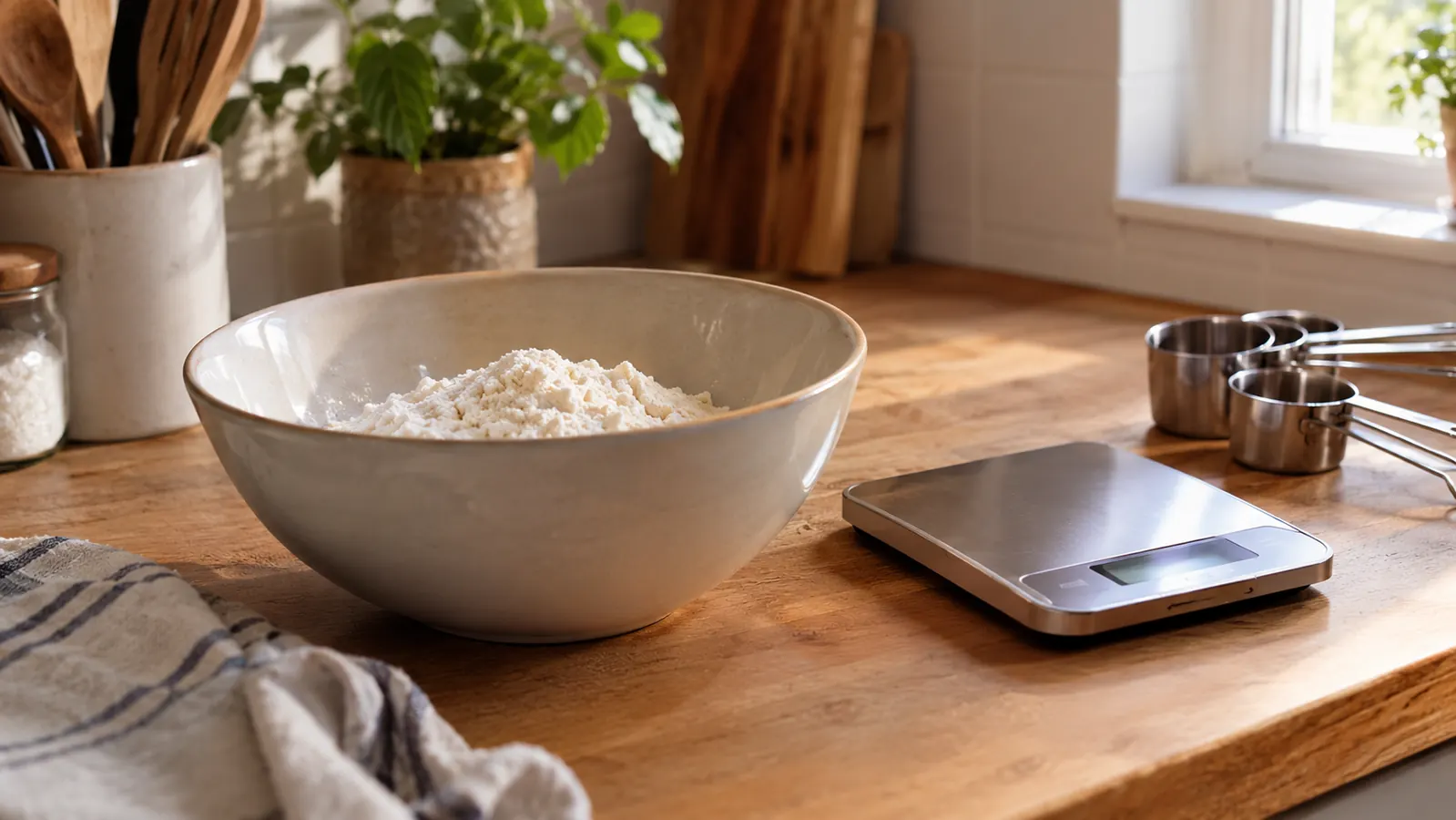
Twenty years of baking with measuring cups taught me a lot, and some of it was wrong. I went through a pastry program at twenty-four, spent seven years in a hotel pastry kitchen, and then came home to a galley kitchen in Baltimore where the counter is six feet long and the oven is a single 30-inch electric. I scooped and leveled for all of it. Then about two years ago I bought an Etekcity digital kitchen scale, mostly to portion bread dough, and the first batch of chocolate chip cookies I weighed instead of scooped came out so much better that my husband Paul asked what I had changed. Nothing. That is the whole point. Nothing changed except how I measured.
Here is the short answer before the long one. For flour, sugar, butter, and anything where the ratio decides whether the bake works, the scale wins and it is not close. For a quarter teaspoon of salt, a pinch of yeast, a splash of vanilla, or a cup of rice on a Tuesday night, the cups are faster and I still use mine. If you bake a boxed mix four times a year, keep your cups and put your attention elsewhere. If you bake bread, cookies, pie crust, or layer cakes more than once a month, a scale will change your results more than any other tool on the counter.
| Etekcity Digital Kitchen Scale | Dry Measuring Cups | |
|---|---|---|
| Flour accuracy | 1 g increments up to 11 lb, so 120 g is 120 g every time | The same cup can hold 120 g or 145 g depending on how it was filled |
| Scaling a recipe | Doubling or halving is arithmetic on the readout | Half of a third of a cup is a guess |
| Tiny amounts | 1 g increments are too coarse for a quarter teaspoon of yeast or salt | A quarter teaspoon is a quarter teaspoon, immediately |
| Power and upkeep | Two AAA batteries, pre-installed, changed once in two years here | Nothing to power and nothing to fail |
| Cleaning | Wipe the stainless platform with a damp cloth, no soaking | Most sets go in the dishwasher |
| Storage | Compact and 200 g, stores flat in a pantry cabinet | A nested set takes a drawer |
| Even portions | Tare the bowl and divide by weight for identical rolls | Not possible without a scale |
| Liquids | Weigh milk or water in grams and skip the meniscus | A glass cup is the fastest way to move a cup of stock |
| Learning curve | Needs recipes in grams and about a week of practice | Everyone already knows how to use them |
| Old family recipes | Each one needs converting once, then it is done | Written in cups already, no conversion |
Where Etekcity Wins
The first thing that changed was repetition. A cup of all-purpose flour is not a fixed amount. Depending on whether you scooped from a freshly opened bag or a settled one, whether you dipped the cup or poured into it, one cup can land anywhere between about 120 and 145 grams. That is a twenty percent swing in the flour before you have done anything else, and it explains a lot of cookies that spread too thin on a humid day. Weighing removes the variable. One hundred twenty grams is one hundred twenty grams in July and in January, and the Etekcity reads in 1 g increments up to 11 pounds, so nothing in my normal baking comes close to the ceiling.
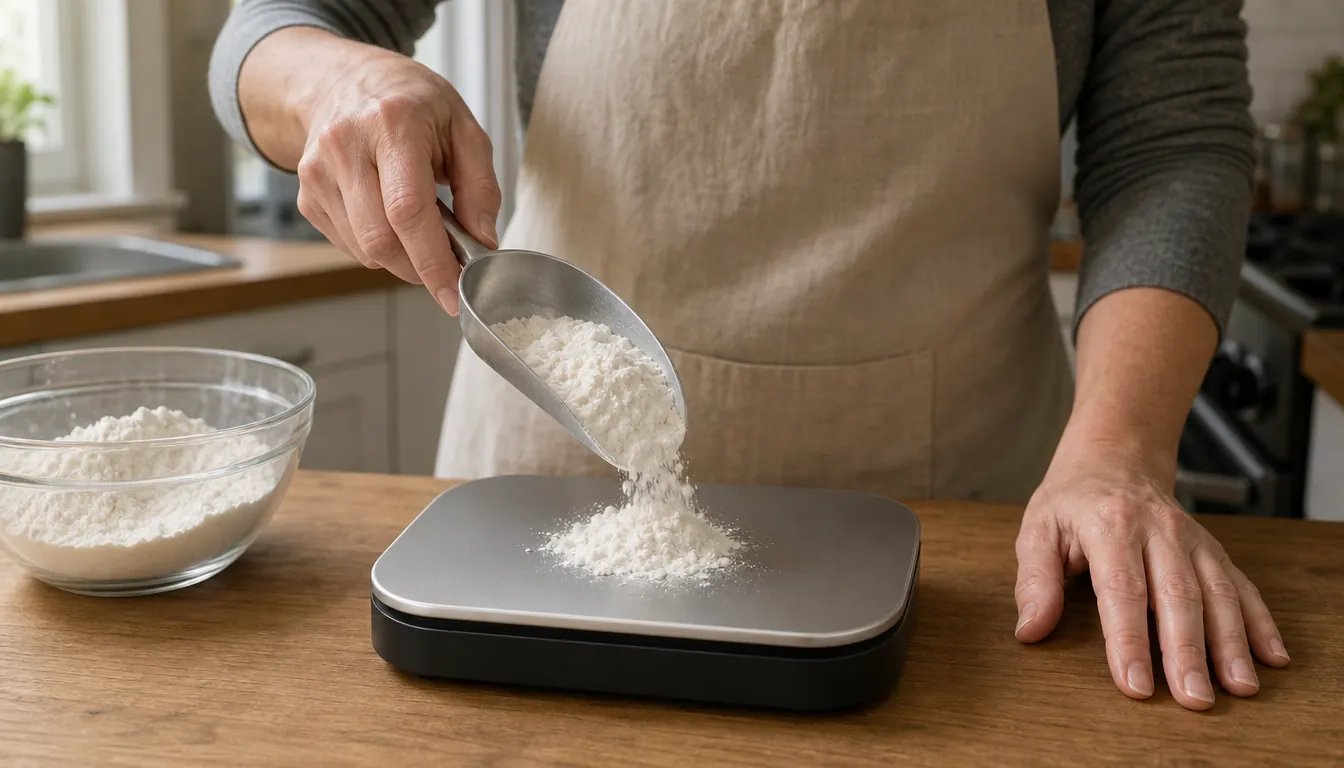
Bread is where it stops being a preference. Dough is a ratio of water to flour, so if the flour moves twenty percent from batch to batch, the dough moves with it. The same recipe gives me a soft sandwich loaf one week and a tight, dry one the next, and I spend the whole rise trying to fix it with extra water. With the scale, my sandwich bread and dinner rolls come out the same every time, which is the only way I can tell whether a change I made was an improvement or just noise. The tare function does the quiet work. I set the bowl on the platform, tare to zero, add flour, tare again, add water, and never dirty a second bowl. Paul, who does the dishes in this house, noticed that before he noticed the bread.
Portioning is the other place the Etekcity earns its space. Cookie dough balls at 30 g each bake evenly, and 30 g is a number I can hit without thinking now. Dinner rolls at 65 g give me twelve rolls from the same dough every time, which matters when Karen and Maddie are coming for Sunday dinner and I want the basket to look deliberate. The scale is compact enough to live flat in the pantry cabinet, which is the only reason it survives in a kitchen with six feet of counter. It weighs 200 g, it runs on two AAA batteries that came in the box, and I have changed them once in two years. The backlit LCD is readable at 5:30 in the morning, which is when most of my weekend baking happens.
Where Measuring Cups Win
The cups win on everything small. My scale reads in 1 g increments, which is exactly right for 240 g of flour and useless for 3 g of instant yeast or a quarter teaspoon of fine salt. Below about 5 g the resolution is too coarse and the margin too wide, so I still measure yeast, baking powder, baking soda, salt, and spices with spoons. If a recipe calls for a quarter teaspoon of almond extract, a spoon is the correct tool and no scale will improve on it. That is a limit of the instrument, not a flaw, and pretending otherwise is how people end up with dense bread and no idea why.
The cups also win on familiarity, and on the recipes most of us inherit. The apple pie I make every Thanksgiving is written in cups, and so is every church bake sale bar recipe I own. Converting one means weighing each ingredient once and writing the gram number on the card, which I have done for about a dozen recipes, but it is real work and it changes a recipe I already trusted. Cups go in the dishwasher. They need no batteries and no wipe-down between additions. Maddie, who turned ten this year, can measure a cup of flour without being told how, and there is value in a tool a child can use on her own. For a single cup of stock or a cup of rice on a weeknight, a cup is simply faster.
Weigh the flour once and see if the second batch behaves
The Etekcity digital kitchen scale reads to 1 g up to 11 lb, tares back to zero between additions, and stores flat in a cabinet. Two AAA batteries come in the box.
Amazon Check Today's Price on Amazon →How Weight and Volume Actually Behave in a Bowl
Flour is the clearest example and the one worth understanding. A cup measures volume, and flour is roughly half air. Sift it and a cup weighs about 110 g. Spoon it in and level it and you get closer to 120 g. Dip the cup straight into the bag and pack it against the side and you can hit 145 g. All three are a cup of flour by the recipe, and all three behave differently in the oven. That is why pastry kitchens weigh, and it is not snobbery. It is the only way a recipe written by one person produces the same result in somebody else's kitchen.
Liquids are the other half of the argument. Water weighs 1 g per milliliter, so 240 mL of water is 240 g, and weighing it means no meniscus to read at eye level with the cup on the counter. Milk and cream are slightly heavier than water, and the scale handles them the same way. Honey and molasses are the ones that converted me completely. Weighing them into a bowl on a tared scale means nothing sticks to a cup and nothing gets scraped out with a spatula for two minutes. The scale will also read in ounces, pounds and ounces, fluid ounces, and milliliters, which is handy when a recipe comes from an American blog. I still weigh in grams and convert once.
If you want to move a handful of recipes over, keep the conversions short. All-purpose flour at 120 g per cup, granulated sugar at 200 g, packed brown sugar at 220 g, butter at 227 g per stick, and water at 240 g per cup will get you through most of what you bake. Write the numbers directly on the recipe card. After two or three rounds you stop converting and just read the card in grams, and the card becomes more useful than it was before. That is the part nobody explains. The scale does not only make you more accurate, it makes your own recipes portable. A card in grams works in any kitchen, with any brand of flour.
A cup of flour is not a fixed amount. It is a record of how tightly somebody packed it.
The Two-Week Switch I Recommend
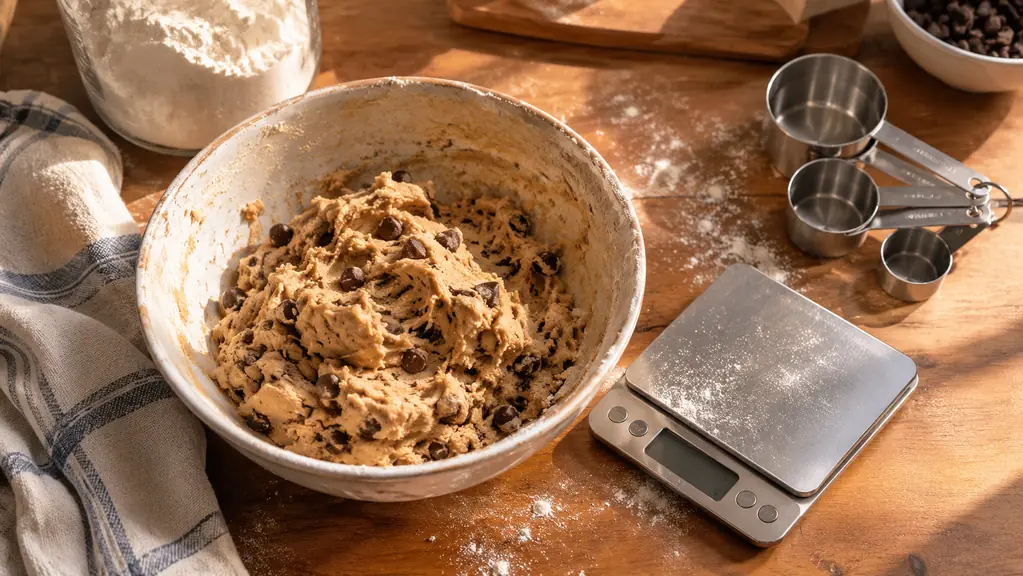
Pick one recipe you make often. Chocolate chip cookies are the right starting point because you already know what they should look like, and because the dough is forgiving enough that a mistake will still be edible. Weigh every ingredient once and write the gram number beside the cup amount on your card. Bake one batch the old way and one the new way in the same week, same oven, same pans, same butter. If the weighed batch browns more evenly at the edges and holds its shape better, you have your answer and you did not have to take anyone's word for it. Most people I have walked through this see a difference in the first batch, and it is usually the spread.
Keep the cups. That is not a courtesy, it is practical. Spoons and cups still handle salt, yeast, leavening, spices, and extracts, and the quarter teaspoon does not need improving. Keep the scale where you can reach it without moving anything, because a tool that lives behind three pots will not get used. In my kitchen it stands on edge in the pantry cabinet next to the flour, flat and out of the way. Leave a small dish beside it if you portion dough often, so the tare weight does not end up on your fingers. And do not weigh a cup of stock you are adding to a pot on a Tuesday. The point is better baking, not more steps.
What I Liked
- 1 g increments up to 11 lb, which covers a full batch of dough
- Tare function means one bowl from the first scoop of flour to the finished dough
- Five readouts: grams, ounces, pounds and ounces, fluid ounces, milliliters
- Compact and 200 g, so it stores flat in a small kitchen
- 304 food-grade stainless steel platform wipes clean with a damp cloth
- Two AAA batteries come in the box
Where It Falls Short
- 1 g resolution is too coarse for yeast, salt, and spices under about 5 g
- Wipe clean only, so it does not go in the dishwasher
- You need recipes written in grams, or a conversion list you trust
- Batteries will eventually need replacing, unlike a set of cups
Who Should Buy Which
Buy the scale if you bake bread, cookies, pie crust, or cake more than once a month and your results are inconsistent in ways you cannot explain. Buy it if you scale recipes up and down, if you portion dough, if you want your own recipes to work the same way twice, or if your kitchen storage is a drawer and a pantry cabinet rather than open counter. The Etekcity is small, it reads to 1 g, and it has more than 178,000 ratings on Amazon at 4.6 stars, which is not proof it suits you, but it does suggest the design holds up to daily use. It is the first tool I would replace if mine disappeared.
Stay with cups, or keep them as your main tool, if you bake a few times a year from a box or from one trusted recipe, if everything you make is already written in cups and working, or if you mostly cook rather than bake. There is no prize for weighing a cup of rice. And be honest about what a scale will not do. It will not fix a recipe with too much butter in it, an oven that runs 25 degrees cold, or dough you left in the mixer too long. It removes one variable, the biggest one in baking, and then the rest is still on you.
The tool that makes your second batch match your first
1 g increments up to 11 lb, tare between every addition, five units, and a stainless platform that wipes clean. It stores flat in a cabinet and the batteries are already in the box.
Amazon Check Today's Price on Amazon →