

Eighteen months ago I hung a bench scraper on a hook beside my stove and stopped scraping dough off the counter with the side of my hand. The tool is the OXO Good Grips Multi-Purpose Scraper & Chopper, a stainless steel rectangle with a soft, non-slip grip and 1 inch markings running down the blade. I bought it myself, online, after years of using plain unbranded stainless scrapers in a hotel pastry kitchen. At home in my Baltimore rowhouse I had never owned one. My kitchen is a narrow galley with about six feet of counter, so every tool has to earn its hook. This one did, and not because it is fancy. It is a flat piece of steel with a handle, and that is exactly the point.
I bake most weekends and some weeknights. Chocolate chip cookies, apple pie at Thanksgiving, plain yeasted sandwich bread and dinner rolls, sugar cookie cutouts at Christmas, brownies for the church bake sale. Paul, my husband, does the dishes and tastes everything. My niece Maddie turns ten this year and gets a layer cake from me every birthday. None of that is restaurant work. It is home baking in a small kitchen, with one standard 30 inch electric oven and a pantry cabinet where the tools live. The scraper has become part of how I move dough, clean the counter, and cut bars. Here is what 18 months of near daily use has taught me.
The Quick Verdict
A plain, well-shaped bench scraper that has stayed on my hook for 18 months. The 6 inch blade and 1 inch markings do real work. The tradeoff is that it is not the only cutting tool a busy baker will reach for.
Amazon Check Today's Price →The tool I reach for before the rolling pin comes out
If you divide dough, lift rolled pastry, or cut brownies in the pan, this is the scraper I have used for 18 months. The blade is stainless steel, the grip is soft and non-slip, and the 1 inch markings save me from hunting for a ruler.
Amazon See the OXO scraper on Amazon →How I've Used It
I keep the OXO on a hook to the right of the stove, within arm's reach of my six feet of counter. That spot tells you how often I use it. A tool that lives in a drawer might come out once a week. This one comes off the hook several times in a single baking session: to scrape flour and butter bits into a pile, to divide a bowl of bread dough, to lift a rolled pie crust, to cut brownies while they are still in the pan. It is manual, so there is nothing to plug in or switch on. That sounds obvious, but a bench scraper's whole value is being ready the second your hands are sticky.
I bought it about 18 months ago. Before that I had no bench scraper at home. In the hotel pastry kitchen I used plain unbranded stainless scrapers, the kind with no grip and no markings, and I got used to their size. The OXO is shorter than those well-worn tools, with a 6 inch blade, but the handle changes how it feels. My hand stays relaxed when I am scraping a counter for the third time in an hour. The 1 inch markings are the part I did not expect to use as much as I do. When a recipe says cut dough into 12 pieces, I can mark roughly and keep them even instead of eyeballing.
Daily use in my kitchen does not mean commercial volume. It means a batch of cookies on a Tuesday, a loaf of sandwich bread on a Saturday, brownies for the church bake sale on a Thursday night. On those days the scraper may only do three or four jobs. On a pie day it does more. I have used it to cut cold butter into flour, to fold and turn a shaggy dough, to lift a rolled crust off the counter without stretching it, and to scrape dried flour paste off the counter after Paul has wiped down the bowl. It has not chipped, bent, or come loose at the grip. That is a low bar, but it is the bar a working tool has to clear.
The Blade, the Grip, and the Markings
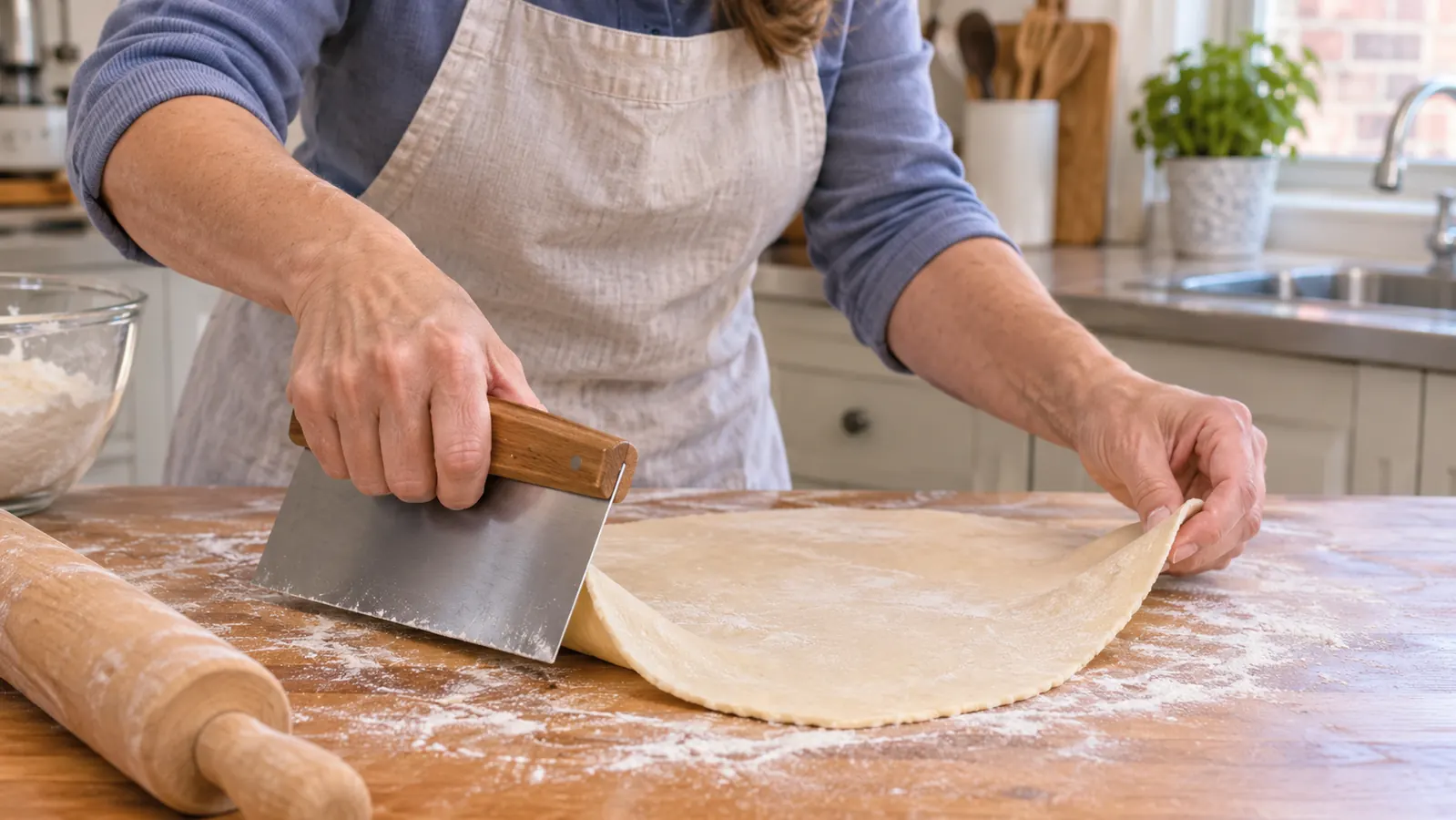
The blade is stainless steel, rectangular, and 6 inches long. OXO lists the full tool at 6.25 inches long, 4 inches wide, and 1.75 inches tall, at 0.37 kg. In my hand that translates to a compact scraper that hangs flat against the wall and fits in the narrow gap beside my flour jar. The 1 inch markings are stamped into the blade, so they do not rub off when I scrub it. I do not treat it as a ruler for fine pastry work. I use the markings for rough portioning: scoring a sheet of brownies into squares, marking dough for rolls, checking that a rolled crust is roughly the size I want before I move it.
The grip is the reason I chose this one over another plain metal scraper. It is soft, comfortable, and non-slip, which matters when your hands are dusted with flour or damp from washing a bowl. A bare steel spine can dig into your palm when you press down hard to scrape a stubborn patch of dough. The OXO handle spreads that pressure. It also adds a little bulk, and that is the tradeoff. If you learned on an all-metal scraper and like the feeling of steel against your palm, this will feel like more tool than you need. I noticed the bulk for the first week. After that I stopped noticing it, which is the best thing I can say about a handle.
Does the chopper part of the name hold up? I use the straight edge to cut dough and to section pie crust, which is what the listing promises. I have also used it to chop a few soft vegetables when I was already at the counter and did not want to pull out a board. It is not a knife. For nuts, garlic, or anything hard, I reach for a chef's knife. The blade shape is rectangular, not curved, so it wants to be used with a straight push or a scrape, not a rocking chop. That is not a flaw. It is the shape doing its job.
What It Does to Dough and Counter
The job I care about most is dividing bread dough. My plain yeasted sandwich bread and dinner rolls start as a sticky mass in a bowl. I turn it out, press it flat, and use the scraper to cut it into portions. The 6 inch blade is long enough to cut through a batch of roll dough in one firm push if the dough is not too high. For a double batch, I make two or three passes. A longer blade would cover more ground, but it would also be harder to store in my kitchen. For home batches, the 6 inch blade is a fair compromise.
The second job is lifting. Rolled pie crust is fragile. If I try to lift it with my hands, I stretch it, and a stretched crust shrinks in the pan. I slide the scraper under the dough, lift one edge, and use my other hand to guide it. The flat rectangular blade supports more of the dough than a knife would. The same move works for cutout cookies before they go to the sheet pan. It is also the tool I use to scrape the counter clean after rolling. One pass gets the flour and butter bits into a pile, and a second pass gets the sticky film that a cloth would just smear around.
Cutting bars is the quiet daily job. Brownies and lemon bars are easiest to cut while they are still in the pan, but a knife drags through the sticky edges and pulls the top crust. A bench scraper presses straight down. I use the 1 inch markings to score the top first, then cut through. The same method works for sheet cake and for cutting a pan of rolls apart after baking. I do not use it on a hot sheet pan straight from the oven unless I am cutting something sturdy. The grip is comfortable, but I still let the pan cool for a few minutes. That is habit, not a product limitation.
Where It Lives in a Small Kitchen
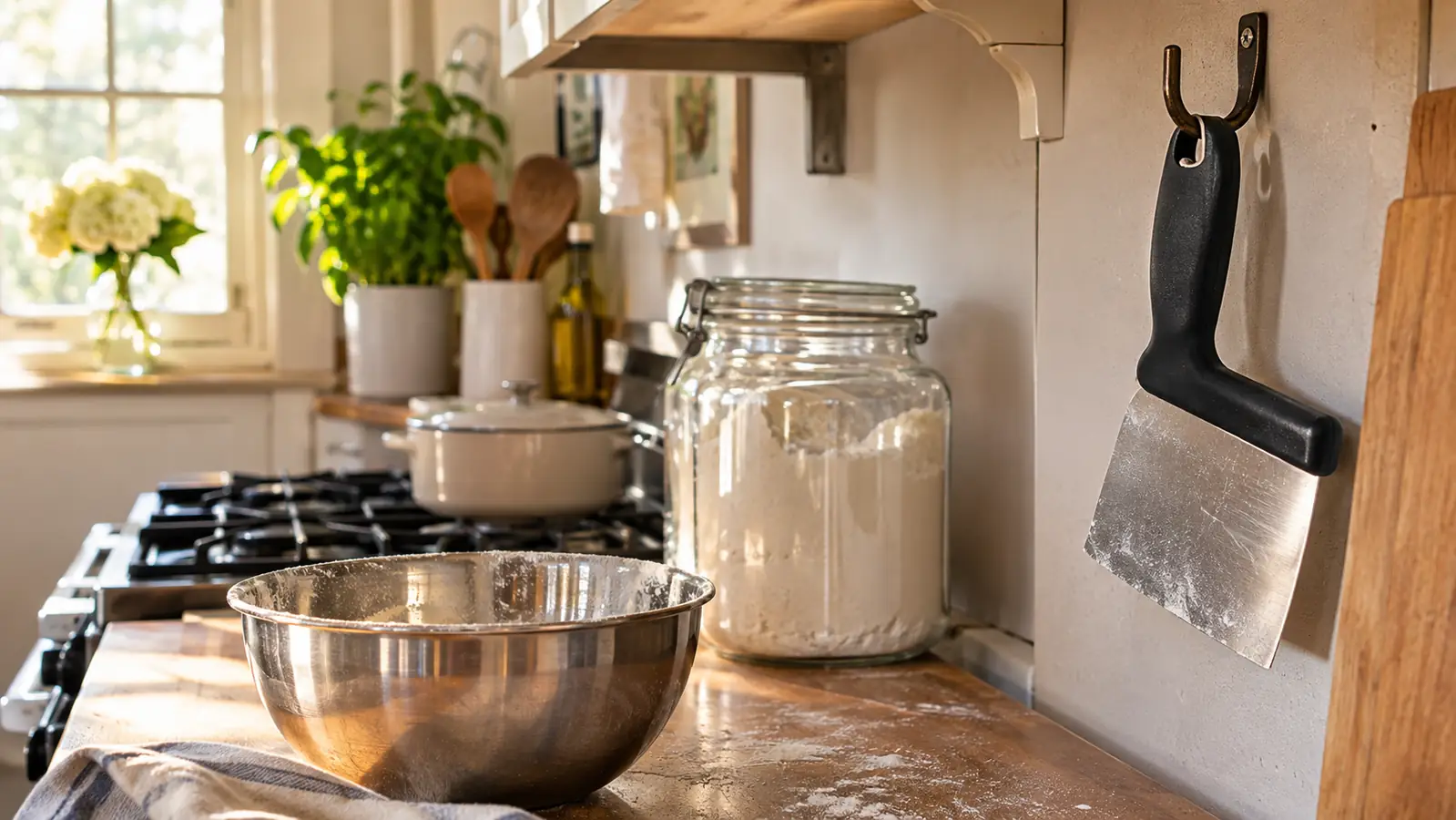
My kitchen is a Baltimore rowhouse galley, about six feet of counter, one standard 30 inch electric oven, and a pantry cabinet where the tools live. Counter space is tight, so I am ruthless about what stays out. The OXO hangs on a hook by the stove. At 6.25 inches long and 1.75 inches tall, it does not swing into the backsplash or catch on a pot. The soft grip gives me something to hook. In a kitchen where the drawer is already full of measuring cups I keep for rice and a rolling pin I use for pie, a hook is the right storage. It is also a reminder to use the tool, which sounds silly until you have owned a scraper that lived in a drawer and never came out.
Cleaning is simple. I wash it by hand with the rest of the tools and dry it on the hook. Paul does the dishes in our house, and he has never complained about it. The stainless blade does not hold onto flour the way a textured surface would, and the grip dries quickly enough that I can put it away. I have not put it in the dishwasher, not because the listing forbids it, but because I want the grip to stay comfortable and I do not mind thirty seconds at the sink. If you are a dishwasher person, check the manufacturer's care instructions before you buy. I cannot tell you how it will hold up in yours.
What 18 Months of Use Has Changed
After 18 months, the tool looks used. The steel has lost its showroom shine, and the markings are still legible. I have not seen rust, a loose grip, or a bent blade. The edge has not needed sharpening because I do not use it as a knife. What has changed is my habits. I reach for the scraper before I reach for a knife when I need to move dough. I use it to clean the counter instead of a damp cloth when the mess is dry flour and butter. I use the markings to portion brownies instead of guessing. A tool that changes your habits is doing more than sitting in a drawer.
The limitations have not changed either. It is still a 6 inch blade, so a very large batch of dough takes a few passes. It is still a bench tool, so it does not replace a chef's knife for chopping. It is still a handled scraper, so it feels different from the all-metal scrapers I used in the hotel kitchen. None of those limitations has made me want to replace it. They have made me clear about what it is for. If you bake bread once a week and keep a sheet pan in rotation, the limits will rarely come up. If you bake several loaves at a time or prep a lot of vegetables, you may want a longer blade or a second tool.
How It Compares to the Plain Scrapers I Knew
The scrapers in the hotel kitchen were plain stainless rectangles with no grip and no markings. They were longer than the OXO, and they were treated as disposable workhorses. I liked them because they were simple. When I started looking for a scraper for home, I wanted the same flat blade but with a handle that would not dig into my hand during a long pie day. The OXO gave me that. The markings were a bonus. The shorter blade was the compromise.
I have not owned another bench scraper at home, so I cannot give you a side-by-side test. What I can tell you is that the OXO has filled the role I bought it for. It divides dough, lifts pastry, scrapes the counter, and cuts bars. It hangs by the stove and comes off the hook several times a week. If you already own a plain metal scraper and it works, you do not need to replace it. If you are buying your first one and you want a soft grip and markings, this is a sensible place to start. The OXO is not a status tool. It is a bench tool that happens to be comfortable.
What I Liked
- The 6 inch stainless blade with 1 inch markings handles real portioning work, from brownie squares to roll dough
- The soft, non-slip grip stays comfortable during repeated scraping and cutting
- The flat rectangular blade lifts rolled pastry and scrapes flour and butter off the counter cleanly
- Compact enough to hang by the stove in a small kitchen, so it actually gets used
Where It Falls Short
- The 6 inch blade is shorter than the long scrapers I used in a professional kitchen, so a large batch of dough takes more passes
- The soft grip adds bulk for anyone who prefers an all-metal scraper against the palm
- The 1 inch markings are for rough portioning, not for precise pastry measurements
- It is not a chef's knife, so hard chopping still belongs elsewhere
The 1 inch markings are the difference between eyeballing a batch of brownies and cutting twelve squares that actually match.
Who This Is For
Home bakers who divide dough, scrape counters, lift rolled pastry, or cut bars in the pan. If you bake bread once a week, make pie at the holidays, or keep a sheet pan of brownies in rotation, the OXO earns its hook. It is also a good first bench scraper because the grip is comfortable and the 1 inch markings help you learn to portion by sight instead of guessing. I would hand it to a beginner without hesitation.
Who Should Skip It
Skip it if you already own an all-metal bench scraper you like, or if you do production-level bread baking and want a longer blade. Skip it if you want one tool to chop nuts, crush garlic, and do everything else; the chopper in the name is real, but my chef's knife still does the heavy chopping. And skip it if you refuse to hand wash a tool. This is a bench scraper, not a gadget, and it rewards being kept where you can reach it.
The scraper that has stayed on the hook
After 18 months of home baking, the OXO Good Grips scraper is still the tool I reach for to divide dough, lift pastry, and cut brownies. The 6 inch stainless blade and 1 inch markings do the quiet work. If that is the job you need done, see the current listing on Amazon.
Amazon See the OXO scraper on Amazon →