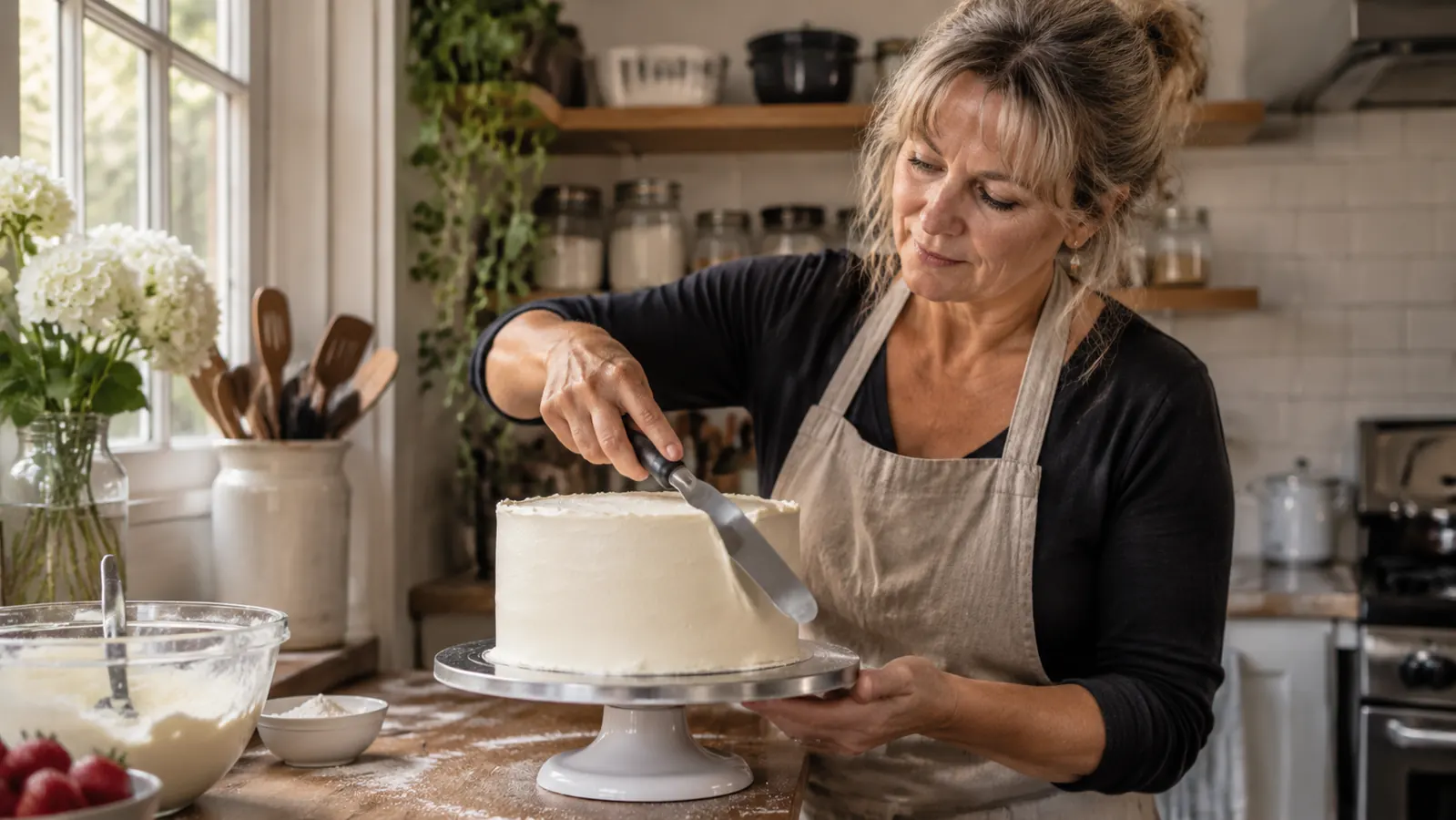
I frosted cakes on a dinner plate for close to twenty years. The method was simple and it was not good: spread a little, turn the plate a quarter turn, spread a little more, then walk around the counter to reach the far side. My pastry training had spoiled me. In the hotel kitchen the cakes sat on stands that spun, and nobody thought about it, the way you do not think about a sink having a tap. At home I did not own one, so I did the walking.
About a year ago, a week before my niece Maddie turned nine, I bought a Kootek 12-inch aluminum cake turntable and set it on the counter next to the bowl of buttercream. The first cake I finished on it took about half the time the plate method did, and the sides came out straighter than anything I had managed at home. That is not a dramatic claim. It is what happens when the cake turns and your hands stay where they can work. Here are the ten changes I noticed, roughly in the order I noticed them.
The cake turns. Your hands stay put.
A 12-inch aluminum stand with a non-slip surface, rubber feet, and a full 360-degree rotation in either direction. It holds a cake steady while you work, then stores flat on a shelf when you are done.
Amazon See the Kootek turntable on Amazon →Both hands stay on the tools
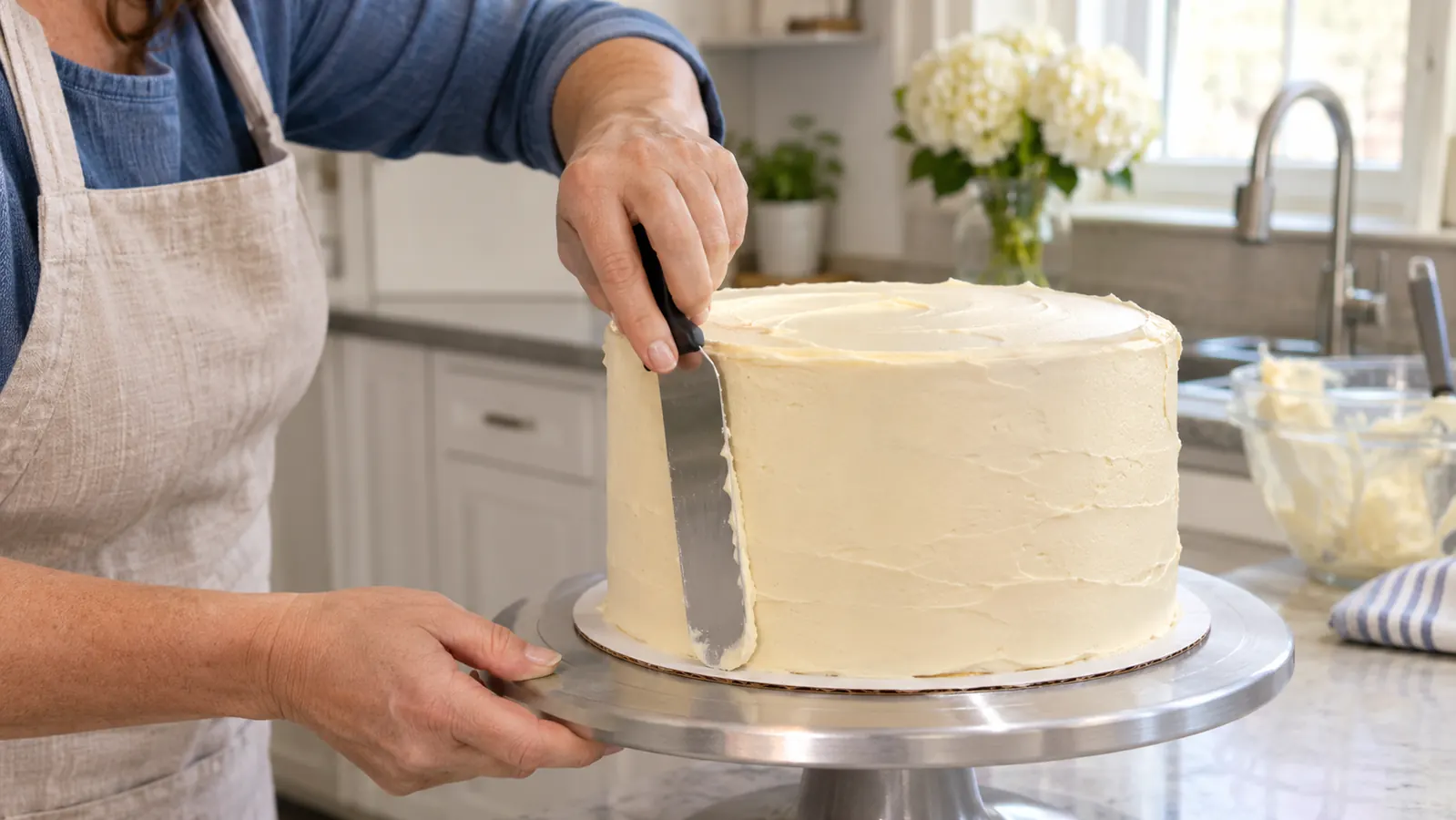
You cannot smooth a side with one hand while the other hand does the turning, or at least not well. On a plate I was always setting the spatula down, turning, picking it back up, losing the angle I had just found. On a turntable your left hand rests on the rim and nudges the cake around while your right hand keeps the spatula in contact with the frosting. The stroke never breaks. That continuity is the whole thing, and it is why the finish improves before your technique does.
The cake comes to you instead of you going to the cake
My counter runs about six feet and the cake always sat in the middle of it, which meant the far side of the cake was a lean and a reach. I would shuffle a half step left, then a half step back, and my shoulders would end up in a different position for every quarter of the cake. A turntable a foot in front of you puts every part of the cake at the same distance. Your body stays still. Only the cake moves, which is the arrangement you want.
You finally see the side of the cake straight on
Judging the profile of a cake means putting your eye level with its equator. On a plate you cannot do that without crouching, so you tilt your head and read the shoulder from above, and from above a sloping shoulder looks flat. The stand measures 12 by 12 by 3.77 inches, so the working surface sits a few inches above the counter. That is enough that a small bend at the waist puts your eye where it needs to be. I caught more uneven tops in the first month than in the previous two years.
One continuous pass means no lap marks
A lap mark is where the spatula stopped and started again. You get them when you pause to reposition, and you pause to reposition because you cannot reach. Going around a turntable in a single slow revolution, with steady pressure, lays the frosting down as one surface instead of a series of patches. When I pull a comb scraper around a chilled cake now, the ridges run unbroken from the bottom edge to the top. On the plate they always broke somewhere near the back, in the spot I could not reach comfortably.
It turns either way, so your good hand leads
The platform rotates a full 360 degrees clockwise or counter-clockwise, which sounds like a small thing until you are left-handed or until you are piping on the far side of the cake. I am right-handed and I turn counter-clockwise for smoothing, but when I pipe a shell border I switch direction so the bag stays in front of my body. One flick of the wrist and the whole motion reverses. Nobody has to reach across their own arm, and nobody has to work backwards.
The cake board grips instead of skating
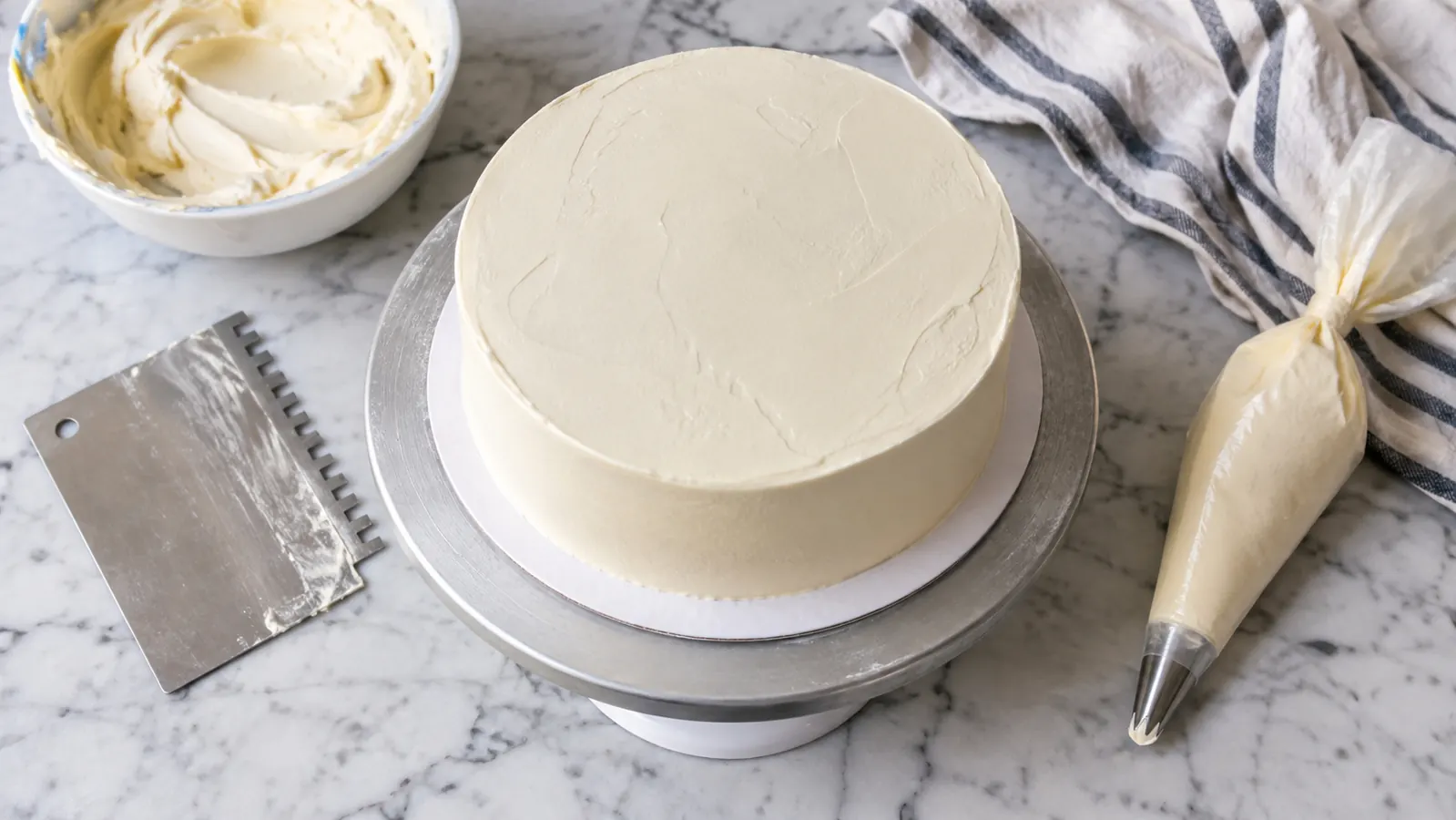
The Kootek surface is a 12-inch non-slip pad and the base sits on rubber feet, so the cake stays where you put it and the stand stays where you put it. My old plate method had a genuine hazard: a heavy cake on a smooth plate, pushed a half inch too hard, sliding toward the edge of the counter. The worst near-miss I had was a three-layer chocolate cake that shifted most of the way off its board. That has not happened once since the cake has been sitting on a surface that grips.
The pedestal base gets the cake to wrist height
The base is a pedestal rather than a flat disc, so the working surface sits above the counter at a comfortable height for standing work. That matters more as the cake gets taller. A four-layer cake on a plate is a low, wide thing you have to bend over. The same cake on a pedestal is closer to your hands, and you spend the decorating session with a neutral wrist instead of a cocked one. It sounds minor. After an hour of piping, it is not minor at all.
Piped borders close without a lump
A border is a timing problem as much as a pressure problem. The bag has to travel at a consistent speed, and if the cake is still you have to walk your arm around it, which changes the angle of the bag as you go. With the cake turning under a stationary hand, the bag stays at the same angle to the surface for the entire circumference. My shells come out more even and the join where the border meets itself is much less obvious. That join is the first thing I look at on anyone's cake.
Texturing and combing come out even
Comb scrapers, the notched ones you drag around a chilled cake to make stripes or a wood-grain pattern, only work if the drag is constant. Stop halfway and you get a visible step. A turntable lets you set the comb against the side and rotate the cake with your other hand in one motion, so the pattern runs the full height without a seam. I use this for the ridged finish on Maddie's birthday cakes, and it stopped being the part of the job I put off until the end.
It stores on a shelf and cleans up in a minute
Space is the real tax in a narrow galley kitchen, and this is the test most gadgets fail. The Kootek stand is 12 by 12 by 3.77 inches and weighs 2.36 kg, so it goes flat on the top shelf of my pantry between uses rather than living on the counter. Frosting wipes off the aluminum surface without soaking. I have not found a reason to baby it. It goes up on the shelf, comes down when there is a cake, and that is the whole relationship.
What I'd Skip
Three things I would skip. First, the plastic lazy susan my sister Karen keeps in her kitchen: it turns, but the platform flexes under a heavy cake and the whole thing creeps across the counter when you press on it. The Kootek is aluminum with a non-slip pad, and it does neither. Second, the assumption that a turntable fixes a cake that was never leveled or never chilled. It cannot. A domed top stays domed, and warm buttercream slides no matter what it is sitting on. Third, if you bake one layer cake a year for a birthday and you are happy with how it comes out, keep your plate. This earns its shelf when you frost often enough that the reaching starts to annoy you. At my house that is most months, so it stays.
The turntable did not teach me to frost. It removed the two seconds of re-aiming between every stroke, and across a whole cake those two seconds are the difference between a clean side and a wobbly one.
If the reaching is the part you dread, this is the fix
12 inches across, a non-slip surface, rubber feet, and 360-degree rotation both ways for left- and right-handed decorators. Flat enough to live on a pantry shelf.
Amazon Check today's availability on Amazon →