
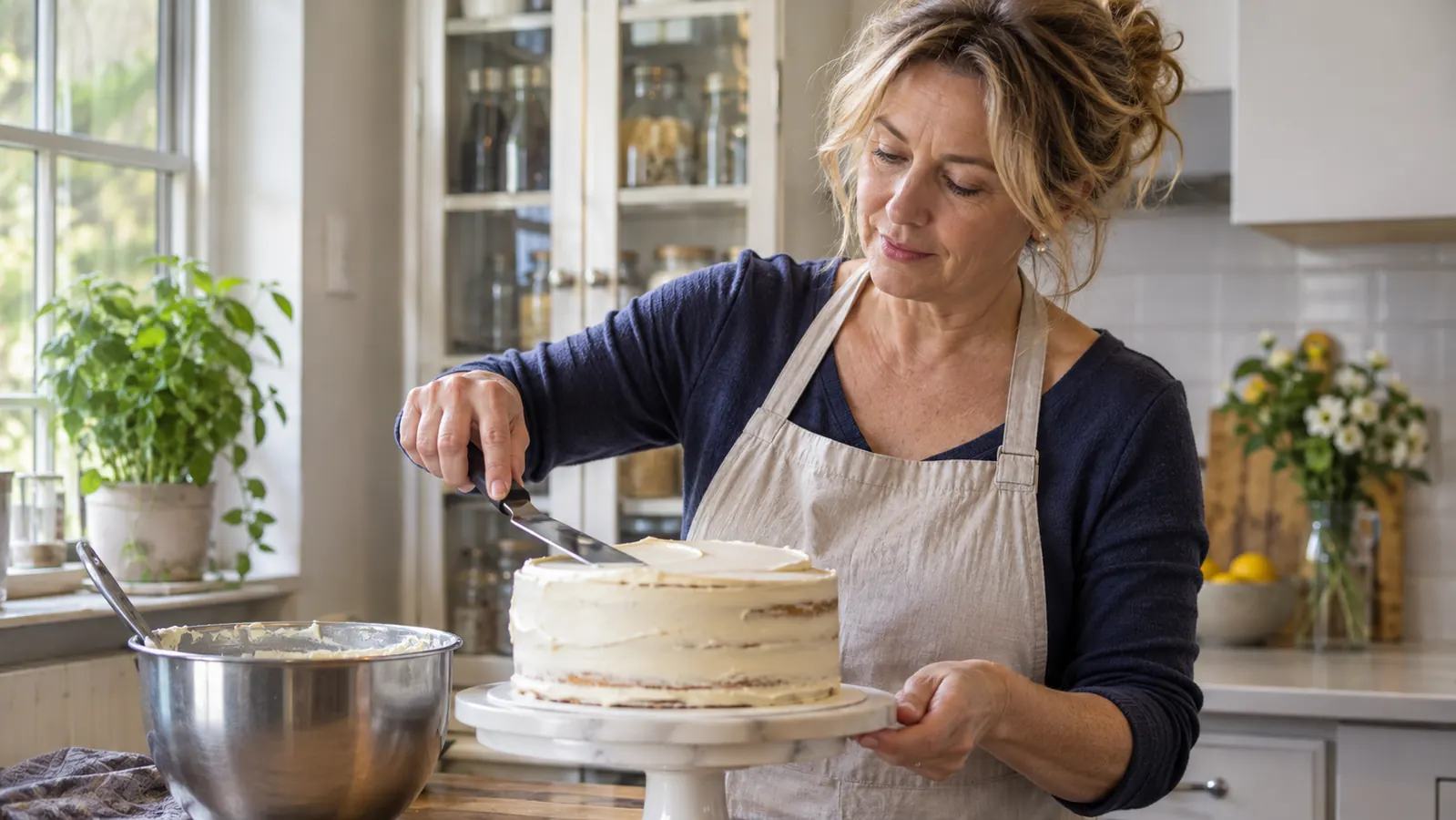
The short answer is that a cake turntable is built for frosting a cake and a lazy susan is built for passing the peas. I bought the Kootek 12-inch aluminum cake turntable about a year ago, before my niece Maddie turned nine, because I was tired of walking around a plate to get a smooth buttercream edge. Before that I frosted cakes on a flat dinner plate, turning the plate with one hand and stopping every few inches to shift my feet. My sister Karen has a plastic lazy susan in her kitchen, and I have used it for a cake once. That afternoon told me most of what I needed to know.
If you already own a lazy susan and frost two cakes a year, you can get by. If you want a cake to come to your spatula at a comfortable height, with the cake board staying put, the Kootek is the better tool. The difference is not spin. Both things spin. The difference is the raised pedestal, the 12-inch non-slip top, and the rubber feet that keep the base from walking while you pipe a border.
What I Compared, and What I Did Not
I did not run a lab test. I compared the Kootek I use most weekends with the plastic lazy susan in Karen's kitchen, and I paid attention to the jobs that actually matter: getting a cake board to stay put, reaching the top edge without hunching, turning the cake in small increments, and cleaning up afterward. I have never owned a lazy susan. I have owned the Kootek for about a year, and it lives on the top shelf of my pantry in a narrow Baltimore rowhouse kitchen with about six feet of counter.
Both tools rotate. That is where the similarity ends. A turntable is a cake stand with a purpose. A lazy susan is a serving helper that happens to turn. If you put a cake on the wrong one, you will spend the whole decorating session correcting for it. That is why the comparison comes down to height, grip, and stability more than the spin itself.
The Comparison at a Glance
| Kootek cake turntable | Plastic lazy susan | |
|---|---|---|
| Working height | Pedestal base raises the cake about 3.77 inches, so the top edge sits closer to your hands | Sits flat on the counter, so you bend over the cake |
| Cake hold | 12-inch non-slip surface grips the cake board | Slick plastic lets a light board slide |
| Rotation range | Turns a full 360 degrees clockwise or anti-clockwise | Free spin, usually in either direction |
| Stability | Rubber feet keep the pedestal planted while you pipe | Hard plastic foot can slide on a smooth counter |
| Storage | Measures 12 x 12 x 3.77 inches and needs a shelf tall enough for the pedestal | Low profile slips into a cabinet or stays on the table |
| Table use | A work tool that looks like a cake stand, but I would not pass plates on it | Made for serving, so it earns its keep at dinner |
| Cleaning | Flat top and pedestal wipe clean | A flat disc wipes clean too, though the rim can catch frosting on Karen's model |
| Decorating reach | 12-inch top leaves room for a cake board, a border, and a little working edge | A wide disc and a rim can crowd a 9-inch cake board |
| Best for | Layer cakes, buttercream, piping borders | Serving snacks, condiments, and a casual cake |
A table can only show so much. The row that matters most is the one about height. Once I stopped bending over a low plate, my buttercream edges got cleaner because my hand was steadier. The Kootek did not make me a better decorator. It removed a physical annoyance that was making every cake harder than it needed to be.
Where Kootek Wins
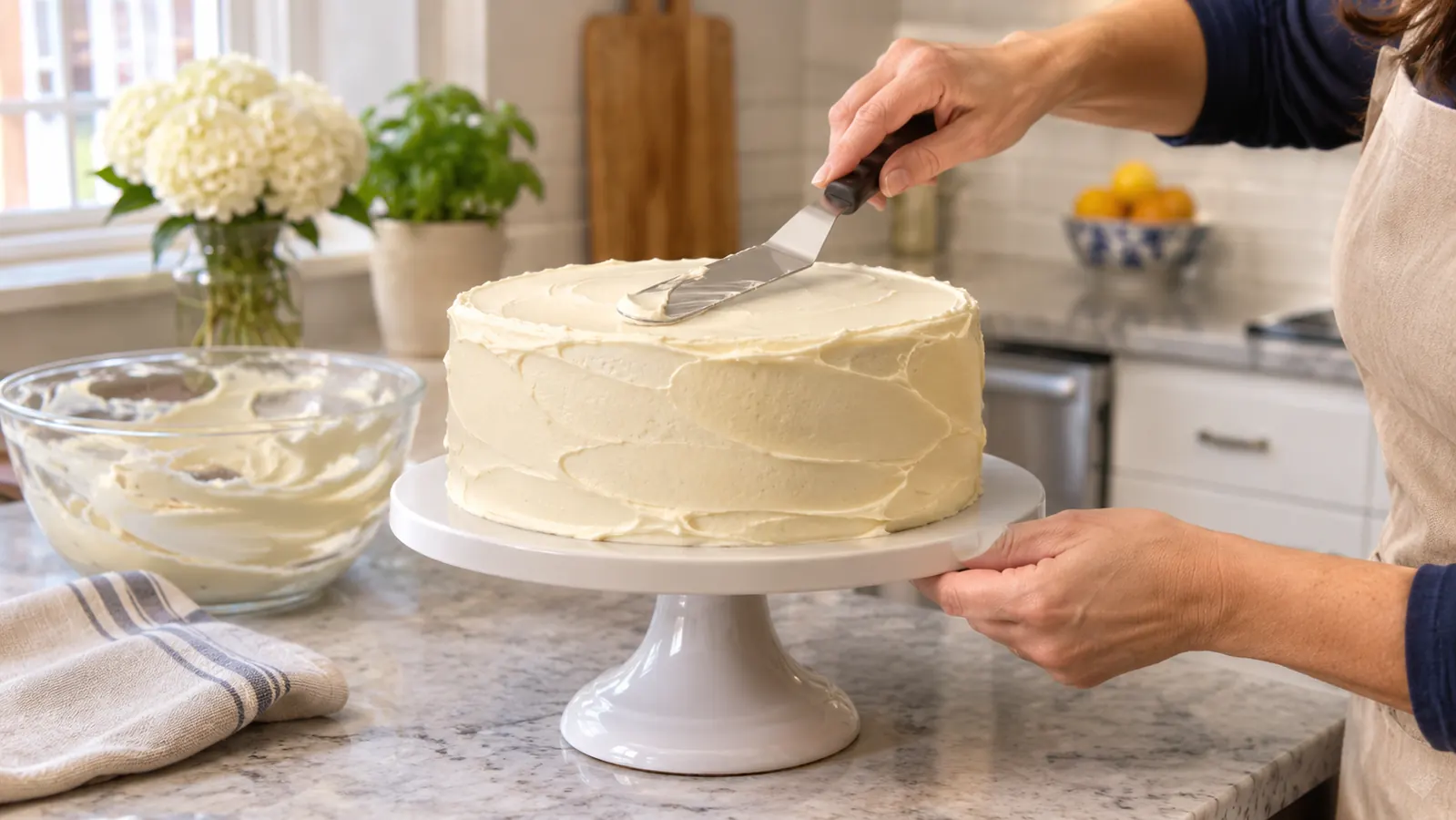
The first win is posture. The pedestal lifts the cake 3.77 inches, so I can stand at my counter and work with my forearms closer to level. I am 52, and after two cakes on a flat plate my lower back notices. The second win is the surface. The 12-inch non-slip top holds a cake board. When I turn the cake, the board turns with the turntable instead of slipping. That matters when you are pulling a bench scraper up the side of a cake and you need the cake to move with your hand, not against it.
The difference is not spin. Both things spin. The difference is whether the cake stays put at a height you can work at.
The Kootek turns a full 360 degrees in either direction. I am right-handed, but I pipe the back border with my left hand sometimes, and being able to turn the cake the other way saves me from reaching across a finished side. The rubber feet are the unglamorous part. On a smooth counter, a hard plastic disc can drift. The Kootek stays. That means I can turn the cake with my left hand and keep the spatula steady with my right, which is the whole point of a turntable.
The other quiet advantage is evenness under load. A turntable that binds halfway around forces you to break your stroke, and a broken stroke shows up later as a flat spot or a wavy line in the frosting. The Kootek turns smoothly with a filled three-layer cake on top, and it keeps the same feel whether I nudge it an inch or send it half a turn. When I drag a bench scraper up the side, that steadiness is the difference between a clean vertical edge and one I have to patch. I noticed it on the first cake I did on it, the one before Maddie's ninth: the sides came out straighter than anything I had managed on a plate, and I had not changed a thing about how I made the buttercream.
Where a Lazy Susan Wins
Karen's lazy susan wins on storage. It is low, so it slides into a cabinet or stays on the table without asking for much shelf height. My Kootek is 12 x 12 x 3.77 inches, and it lives on the top shelf of my pantry because that is the only place it fits. In a narrow kitchen, that is a real tradeoff. If you have one cabinet for tools and no room for a pedestal, the lazy susan is easier to live with.
It also wins at the table. A lazy susan is designed to be seen and used, and Karen uses hers for rolls, condiments, and the occasional casual cake. If one object has to move from cabinet to table and back again, the flat disc is more flexible.
In use for decorating, though, it is a compromise, and I can tell you exactly how the compromise goes because I lived it one Saturday. I was making a two-layer yellow cake for Karen's book club. I set the cake board on the plastic disc and started the crumb coat, and the board slid about a quarter inch on the first stroke of the spatula. So I switched to holding the board down with my left hand, which left me no hand free to turn the disc. Then the rim caught the tip of my offset spatula twice while I was trying to pull frosting up from the bottom edge. The cake came out fine, because frosting covers a great deal, but it took me half again as long as it would have on the Kootek, and I was bent over the counter the whole time.
A cake that turns at the right height changes the whole job
The Kootek 12-inch turntable gives you a 12-inch non-slip top, a pedestal that lifts the cake, and rubber feet that hold the base while you work. If layer cakes are part of your regular rotation, this is the tool that does the job.
Amazon Check It on Amazon →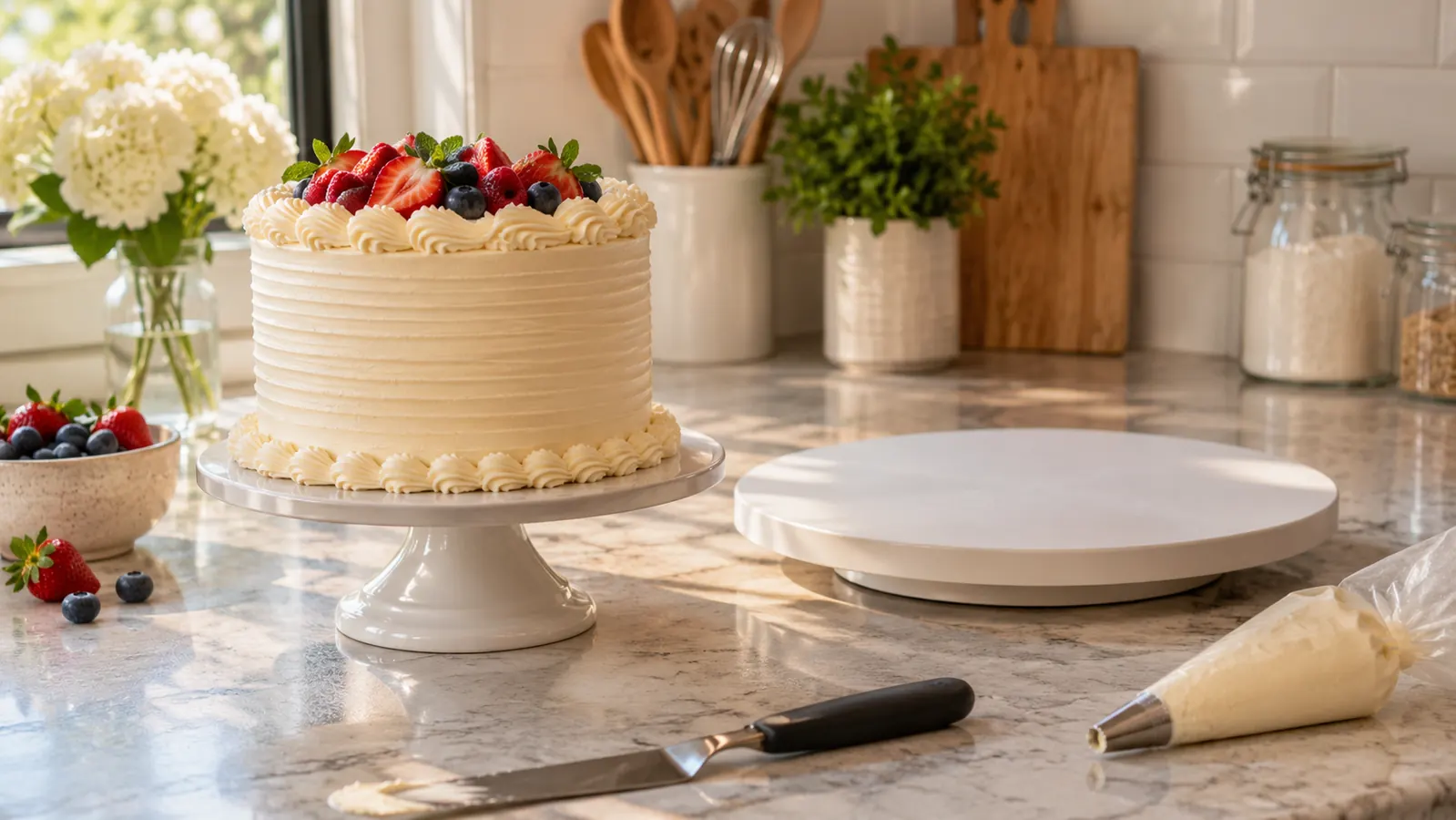
How I Actually Use It on a Weeknight
I bake a layer cake for Maddie's birthday every year and for the church bake sale when my name comes up on the rotation. On a weeknight, I crumb coat on the Kootek, let the cake sit while I wash a few dishes, then come back for the final coat. The 12-inch top is wider than the cake board, so I have a little margin to rest my spatula without dragging it through the frosting. I turn the top with my left hand and keep the spatula still with my right. That is the habit that gives me a straight side.
Maddie's tenth birthday cake is the clearest example of how the whole thing runs. She asked for three layers of chocolate with a pink buttercream border, which meant an 8-inch board, three layers to stack and fill, and a border piped at both the base and the top edge. I started at nine in the morning because I wanted the cake properly chilled before the final coat. I set the board on the turntable, built the cake on it, crumb coated, then carried board and all to the fridge for twenty minutes. When I brought it back, the board went straight back onto the non-slip top and I piped the base border in one continuous pass, turning the stand with my left hand and never moving my feet. On a plate I would have shifted position four times and smudged a side doing it.
I do not put the turntable in the sink. I wipe the top and the pedestal with a damp cloth, then dry it. The aluminum has picked up a few faint marks after a year, which I expect from a tool that gets used. The rubber feet have stayed put on my counter, and the rotation still feels even. I have not had to tighten anything. That matters to me because I would rather bake than fiddle with hardware.
The one thing I would tell a beginner is to put the cake board down first, then the cake. The non-slip surface works on the board, and the board gives you a way to lift the finished cake without touching the sides. If you try to center a cake directly on the turntable, you will chase it around. A board also lets you move the cake to a plate without a second set of hands.
What to Look For If You Are Buying a Turntable
Look for a raised pedestal first. A turntable that is only a disc is a lazy susan with a different name. The pedestal is what saves your back and gives your hands room to work. Look for a top that grips. The Kootek uses a 12-inch non-slip surface, and that is the detail that keeps a cake board from sliding when you turn the cake. Look for rubber feet. A base that walks across the counter is worse than no turntable at all because you are correcting two things at once.
Size matters more than most people think. A 12-inch top handles a 9-inch cake board with room to spare, which is what I need for a two-layer cake with a border. A smaller top can feel cramped when you are trying to get a bench scraper around the back. Height matters too. The Kootek is 3.77 inches tall, which puts the cake at a comfortable working height on my counter. If your counter is already high, a lower turntable might suit you better. If your counter is standard, the Kootek height is a sensible place to start.
One more check is worth the thirty seconds, and I do it with anything I am about to trust with a cake. Put a dinner plate on the top and give it a spin before you commit. A turntable that wobbles with a plate will wobble worse with three layers of cake and buttercream on it, and a wobble under a loaded cake is how you end up with a lean. I also measure the board I actually use rather than the board I wish I used. Almost every cake in this house goes on a 9-inch board, so a 12-inch top leaves me a working margin on all four sides. Weight is the last thing I check. The Kootek is 2.36 kg, light enough to bring down off a pantry shelf above my head with one hand, which sounds trivial until you are doing it with buttercream on the other.
Who Should Buy Which
Buy the Kootek if you frost layer cakes more than twice a year, if you pipe borders, or if you have a bad back and a low counter. Buy it if you want one tool that lives on a pantry shelf and does one job well. The 12-inch non-slip top, the pedestal, and the rubber feet are not features for their own sake. They solve the three things that make home decorating frustrating: a low cake, a sliding board, and a base that moves.
Keep the lazy susan if it already lives on your table and you only need a cake turned once in a while. Keep it if you serve family-style and need one thing to pass rolls. Do not buy a lazy susan for decorating if you do not already own one. It will spin, but it will not make the job easier. The Kootek is the tool I reach for when the cake matters. The lazy susan is the tool I reach for when the plates matter.
One job, done at the right height
If layer cakes are part of your regular rotation, the Kootek turntable is the tool that stops the walk-around. The 12-inch non-slip top and rubber feet do the quiet work while you focus on the frosting.
Amazon See It on Amazon →