
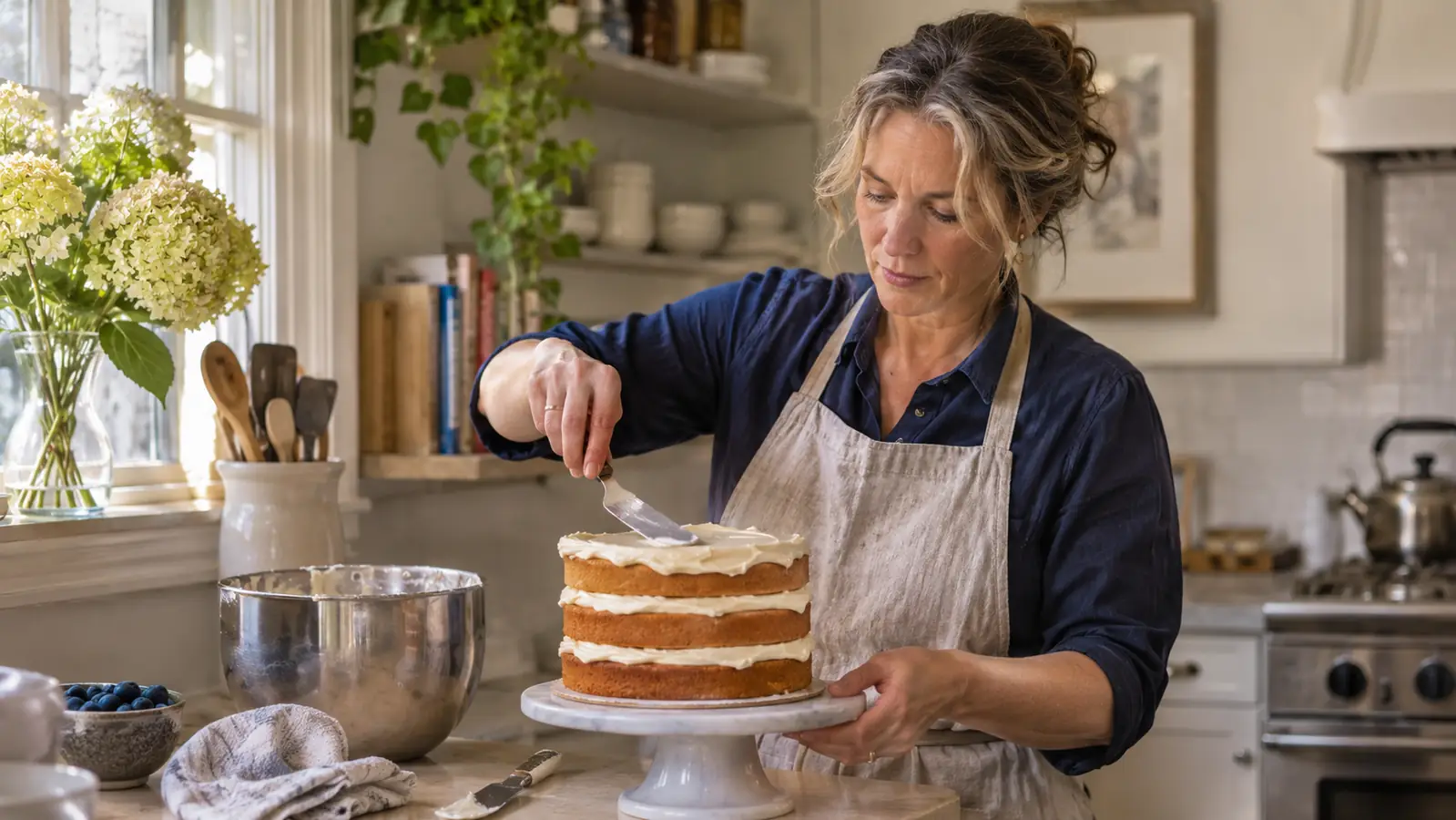
The first turntable I worked on was bolted to a marble bench in a hotel pastry kitchen, so I never thought about it. It was furniture. When I left that kitchen at thirty-one and moved into a Baltimore rowhouse with six feet of counter, I went back to frosting layer cakes on an upside down dinner plate, turning the plate with one hand and chasing the seam with the other. I did that for twenty years and told myself a turntable was a tool for people who sell cakes. Then my niece Maddie turned nine, asked for a cake with piped flowers all the way around the sides, and I bought the Kootek 12-inch aluminum turntable so I would not have to walk a circle around my own kitchen to finish one cake.
Here is the part it took me a while to say out loud. A turntable does not improve your piping. What it removes are the two things that make piping hard, which are moving your own body while your hand is trying to hold a steady angle, and losing your place every time you stop to turn the cake. If the cake spins and you stand still, your hand learns the motion once and then repeats it. That is the entire mechanism, and it is the reason the Kootek has stayed on the top shelf of my pantry for about a year, through Maddie's ninth and tenth birthdays, Paul's birthday in March, and a handful of practice cakes I made for no better reason than wanting a cleaner shell border.
The Quick Verdict
Heavy, wide, and quietly competent. It turned frosting from a job I walked around into a job I finish standing in one place. Buy it for the 12-inch top and the 2.36 kilograms, not for the finish.
Amazon Check Today's Price →A cake you can turn is a cake you can frost evenly
Twelve inches of non-slip surface, a pedestal base with rubber feet, and a full 360 degrees of rotation in either direction. Mine has been in near-weekly use for a year without a wobble.
Amazon Check Today's Price on Amazon →How I've Used It
The first cake on it was Maddie's ninth, three layers of chocolate with vanilla buttercream, and I set the thing up the way I set up anything unfamiliar, slowly and with suspicion. I put a damp towel under the base out of pure habit, the way you steady a cutting board, then took the towel away halfway through because the rubber feet were already doing the work on my counter and the towel was only making the base harder to center. That was the whole learning curve. Everything after it was practice, and the practice went faster than it had ever gone on a plate.
I work with the spatula in my right hand and nudge the platform with my left. It turns a full 360 degrees in either direction with no click and no lock, so I can spin it a quarter turn, step back and look at the shoulder of the cake from arm's length, then spin it back to where I was. That sounds like a small thing. It is not, because the looking is where a cake actually gets level. On a plate I had to walk around the counter to check, which meant I checked less often, which meant I fixed my mistakes later and with more buttercream than the cake needed.
Because I am the kind of person who writes things down, I timed one. Paul's birthday cake in March, three layers, a crumb coat, a finish coat and a piped border, took forty-one minutes from the first swipe of buttercream to the last shell. The last cake I frosted on the plate, a spice layer cake for Karen's birthday two years earlier, ran closer to an hour and ten, and I stopped twice to walk around the counter and check the sides. The turntable did not make my hands faster. It deleted the walking, and the walking was where the time went.
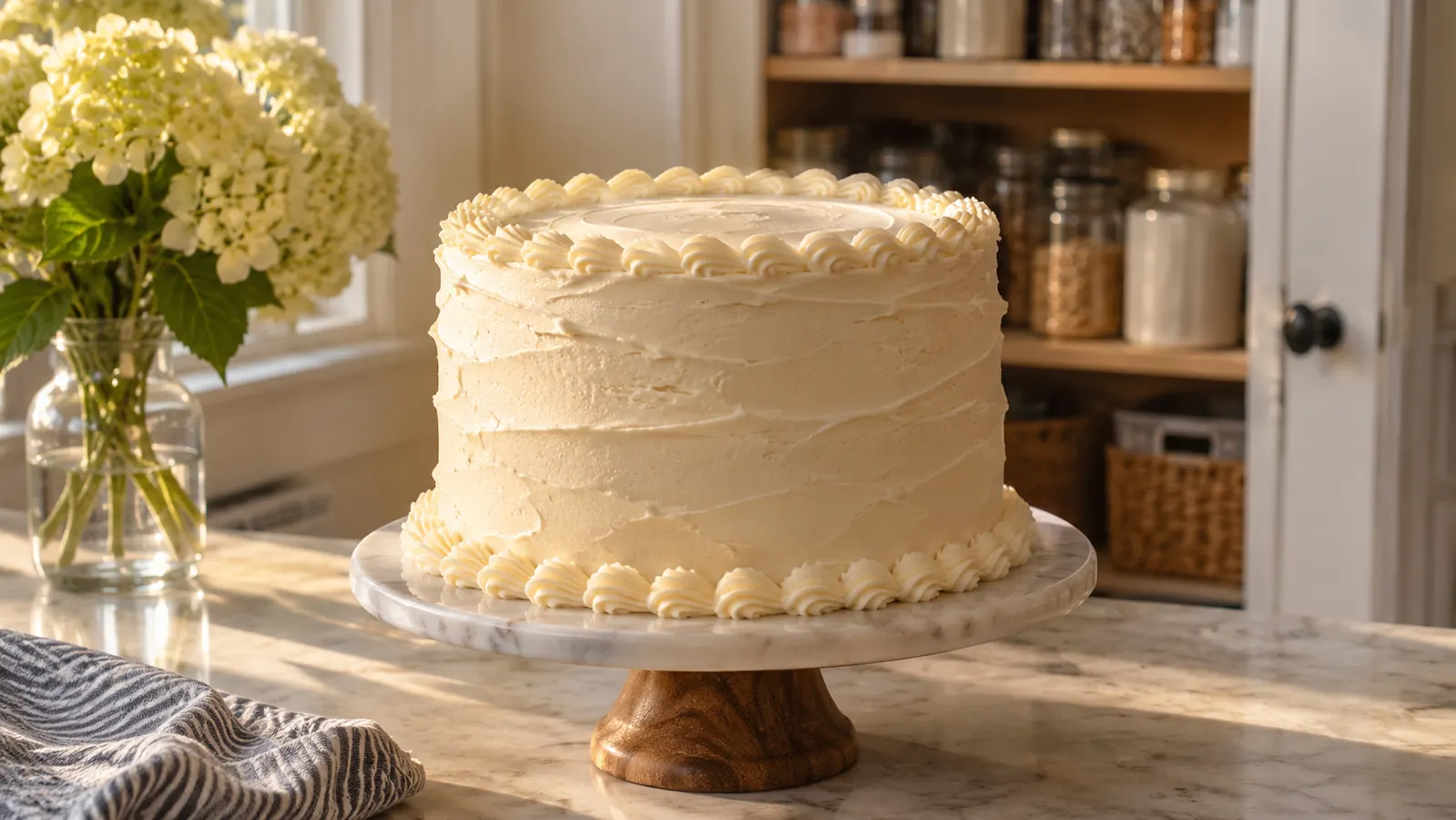
Maddie's tenth was the first cake I finished in one standing session with no repair pass, a two-tone cake with a piped border at the base and a shell border on top. I am not going to pretend that was the turntable alone. It was a year of using the turntable. But the year of using it is the part that would not have happened if the tool were still a dinner plate, because I would have kept finding reasons to bake cookies instead.
What a 12-Inch Surface Actually Changes
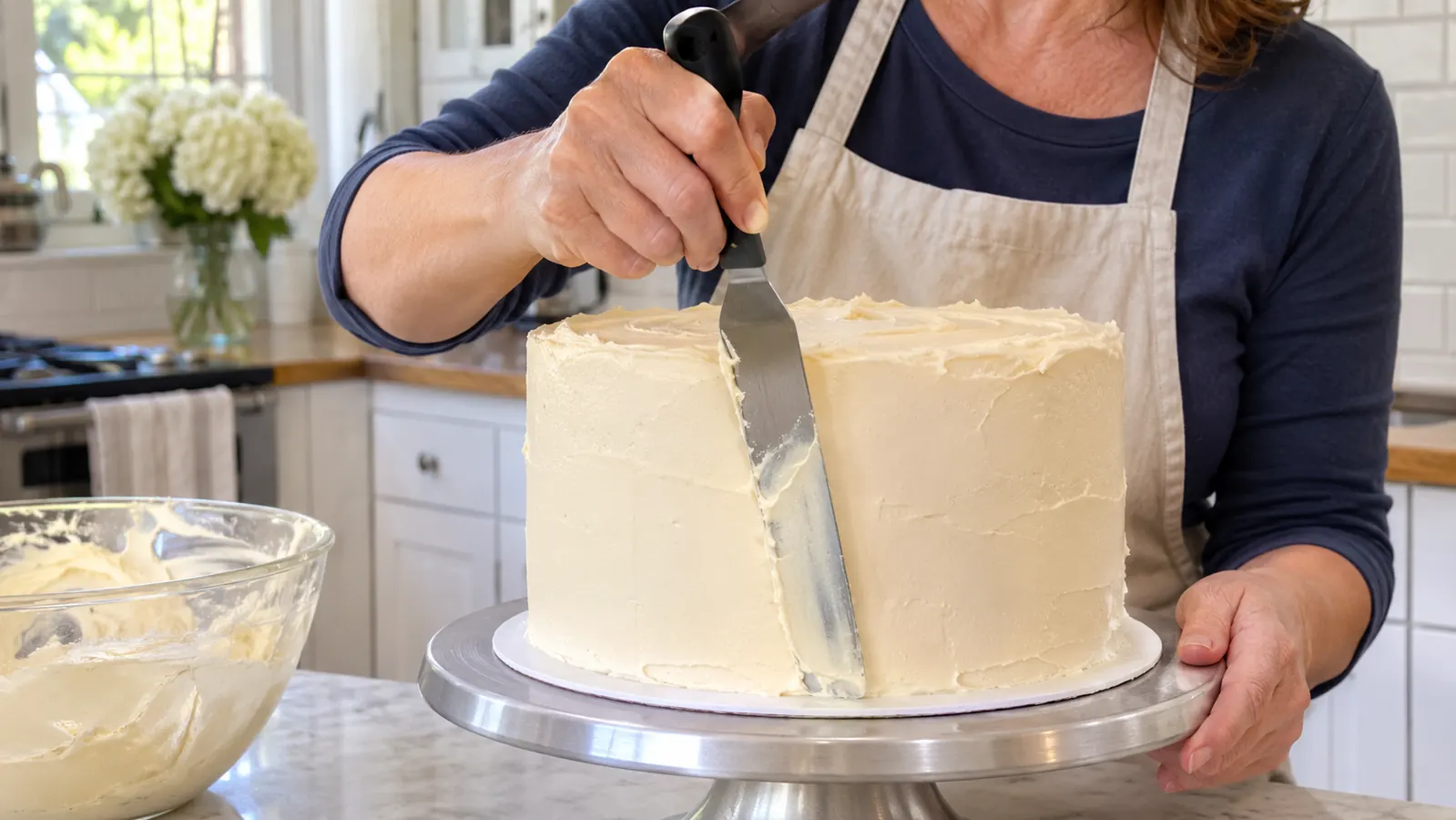
Twelve inches is the number to think about. An 8-inch or 9-inch round, which is what most home layer cakes are, sits on that platform with an inch and a half to two inches of clearance all the way around. That clearance is exactly where your offset spatula and your piping tip need to live. On a plate the rim is right at the cake, so every stroke either drags on the rim or stops short of it. The first time you pull a bench scraper up the side of a frosted cake with room to spare on both sides, the difference stops being theoretical.
When I first set an 8-inch cake on it I did not trust my eye, so I laid a ruler across the platform. Two inches of open platform on every side, and closer to two and a half at the widest point of the cake board. That is the number that decides whether you can get a bench scraper flat to the bottom edge without the handle fouling the platform. On the dinner plate I used for twenty years the answer was no, which is why my bottom edges were always the ragged part of the cake. I had spent years blaming my scraper.
The platform sits 3.77 inches above the counter, on a pedestal base that is narrower than the top. That does two things. It lifts the cake so you are not hunched over your own work, and it lets your fingers get under the edge to lift the whole thing when you need to move it. My counter is at normal height and the cake ends up roughly at chest level, which means my wrist stays neutral through a full pass instead of curling down toward the counter at the bottom of the cake. Because the platform sits up off the counter, I can also get the palm of my hand flat under a cake board and lift a finished cake onto a plate without tipping it.
The narrower base also means it does not eat the counter the way the top suggests it might. The footprint that touches the surface is smaller than the full 12 inches of the platform, so on my six feet of counter I can set it down beside a bowl of buttercream with room left over for it to spin without clipping anything.
The Rotation, the Rubber Feet, and the Non-Slip Top
The platform spins continuously in both directions, clockwise and anti-clockwise. There are no detents and no stops, so it travels exactly as far as you push it and stays there. That matters more than it sounds for a left-handed decorator, because the whole motion reverses and the tool does not fight you either way.
It weighs 2.36 kilograms. If you only let me point at one line on the spec sheet, that is the line I would pick. Weight plus rubber feet is the reason the base stays planted when you lean into the side of a cake with a bench scraper, which is the exact moment a lighter stand starts to skate and you end up chasing it across the counter with buttercream on your knuckles. I have never once had to hold the Kootek down with my other hand while scraping.
Here is the test I would give anyone who wants to know whether a stand is stable enough to work on. Frost a cake with a stiff buttercream, the kind you have to push rather than glide. Lean into the counter, put both hands on the scraper, and pull one long stroke up the side from the board to the top edge. If the base moves even a quarter inch you will feel it in the stroke and see it in the line you just made. Mine has not moved. I made that stroke fifty or sixty times last year and the platform has never shifted under it.
The top surface is non-slip. I set every cake on a cardboard cake board, and in a year of use the board has not slid, rotated on its own, or lifted when I pulled the spatula away. Frosting straight onto the platform with nothing under the cake is a different job and I would not do it. The board is what makes the transfer to a plate or a cake box possible anyway, so you may as well start there.
Cleaning, Storage, and the Small-Kitchen Question
It is aluminum, so it gets washed by hand. A damp cloth and a drop of dish soap takes buttercream and stray cocoa off in under a minute, then it gets dried properly before it goes away. The one thing I would tell anyone with an aluminum tool is not to leave it sitting wet, because aluminum does not need any help to start looking tired. Mine has a year of small marks on it and I do not mind them.
It measures 12 by 12 by 3.77 inches, so it wants a shelf, not a drawer. Mine lives on the top shelf of the pantry cabinet where the tall things go, and it comes down in one hand. The weight that makes it stable on the counter makes it slightly awkward to pull from above shoulder height, and I would not want to carry it to a friend's kitchen to decorate a cake there. That is the price of the stability, and it is worth it to me.
The shelf it lives on is fourteen inches deep, and I measured it before I ordered, because twelve inches of platform on a base that flares is not a thing you want to discover after the box arrives. Standing upright it needs 3.77 inches of height and nothing more, so it slides in beside a stack of cake boards and a tin of piping tips without a fight. If I had a drawer deep enough I would use it. I do not, and the shelf has been fine.
It does not live on my counter, and I want to be straight about why. It is not that it is unattractive. It is that six feet of counter is six feet of counter, and a tool that comes out a couple of times a month cannot hold a permanent twelve inches of it. If you have more counter than I do, you will probably leave it out. If you have less, it stacks on a shelf and you will not think about it until the next birthday.
What It Does Not Fix
A turntable will not save buttercream that is too warm to hold a ridge. It will not level a cake you never leveled, and it will not teach you how much pressure to put on a piping bag. The first cake I made on it had the same slightly domed top as the ones before it, because the problem was my crumb coat and not my stand. I had to fix that the way everyone fixes it, with a serrated knife, a level eye, and a little patience.
There is no lock, so the platform turns when you lean on one side of it, and it turns while you carry it. That is a fair trade for continuous rotation in both directions, but it does mean the last thing you do before moving a finished cake is hold the platform with one hand. The other thing to know is that 12 inches is 12 inches, so a 14-inch cake board overhangs the edge, and the overhang is where you will bump it on the way to the table.
What I Liked
- A 12-inch top leaves real clearance for an offset spatula and a piping tip around an 8-inch or 9-inch cake
- 2.36 kilograms of weight plus rubber feet means it stays planted while you scrape
- Spins a full 360 degrees in either direction with no detents to catch on
- The pedestal base lifts the cake to a working height, 3.77 inches off the counter
- Wipes clean in under a minute and stores on a single pantry shelf
Where It Falls Short
- No lock, so it turns when you lean on one side and turns while you carry it
- Heavy enough that you will not want to move it between kitchens
- A 14-inch cake board overhangs the platform edge
- It will not fix loose buttercream or an unleveled cake
A turntable does not improve your hand. It holds the cake still long enough that your hand can finally learn.
Who This Is For
This is for the home baker who makes layer cakes a few times a year and has quietly begun to dread the frosting step. If you own 8-inch or 9-inch round pans and a bench scraper, you already have the rest of what you need and this closes the last gap. It is also for anyone with a narrow kitchen and one shelf they can give up, because the counter footprint is the smaller question and the shelf is the one that decides whether a tool gets used. And it is for someone who wants to buy once. The Kootek has no electronics, no moving parts you can lose, and nothing to break except the rotation itself, which after a year of steady use is as smooth as it was in the first week.
Who Should Skip It
If your baking runs to sheet cakes, brownies and cookies, this will sit on the shelf and you should put the money into a second half sheet pan instead. If you decorate one cake a year and storage is genuinely tight, a plate plus a lazy susan you already own will get you most of the way there and I would not argue with you. And if you are hoping a spinning stand will fix loose buttercream or a domed cake, it will not, and you will be disappointed in a tool that is doing exactly what it promised. My sister Karen has a plastic lazy susan she has used for years and it works for her, mostly because she frosts a cake once a summer and does not need the height or the weight. Different job, different tool.
The frosting step is the one you can actually fix
If the cakes you dread are layer cakes, this is the piece of equipment that changes the afternoon. 12-inch non-slip platform, pedestal base, rubber feet, 360 degrees either way.
Amazon Check Today's Price on Amazon →