
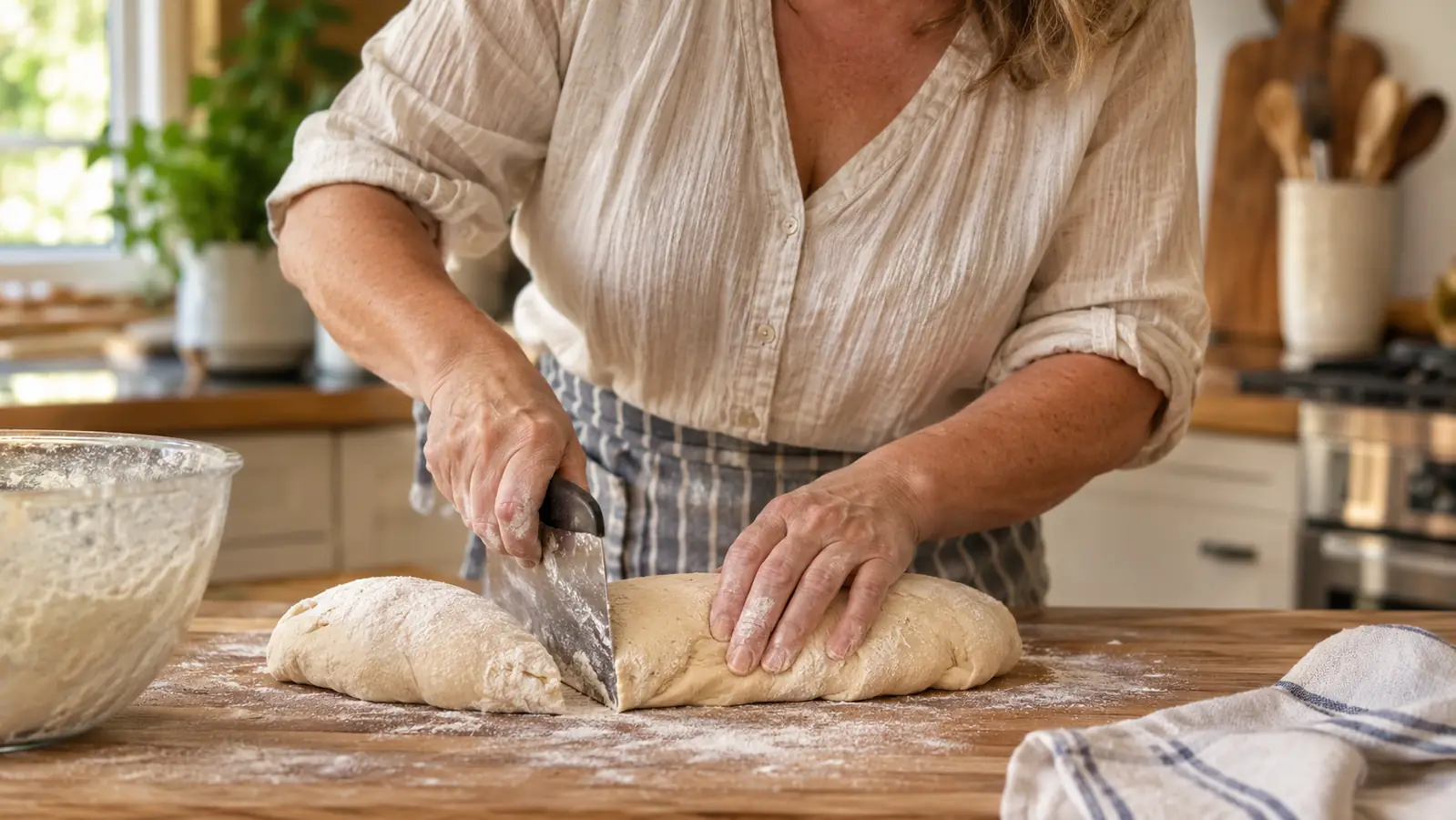
The first time I divided a batch of bread dough on my own counter, I used a chef's knife, a dinner plate in place of a scale, and about a cup of extra flour for insurance. The cuts were ragged, the pieces were uneven by a third, and half the batch welded itself to the counter while I was still shaping the first loaf. I had spent seven years in a hotel pastry kitchen by then, so I knew better. What I did not have at home was the tool I had reached for without thinking for those seven years: a bench scraper.
A bench scraper does two jobs that look like one. It cuts, and it lifts. Most people buy one for the cutting and then find the lifting is what earns it a hook next to the stove. I bought the OXO Good Grips Multi-Purpose Scraper & Chopper about 18 months ago, after years of working with plain unbranded stainless scrapers in the hotel kitchen, and in a Baltimore rowhouse with six feet of counter it is the tool I would replace first. Here is the sequence I use when I divide dough, in order, with the reason behind each part, because the reasons are what actually make the cuts clean.
The blade I keep within arm's reach every time I divide dough
Six-inch stainless steel blade, 1-inch markings along the edge, soft non-slip grip. Mine has hung by the stove for 18 months and has not been sharpened, adjusted or replaced.
Amazon Check Today's Price on Amazon →Step 1: Set the blade angle before the dough leaves the bowl
A bench scraper only cuts cleanly when the blade meets the counter at 90 degrees. That sounds too obvious to write down, and it is the thing I see home bakers get wrong most often, usually because a soft handle invites a loose grip and the blade drifts to 60 degrees without anyone noticing. A tilted blade shoves dough ahead of it. A vertical blade cuts on the first pass, and the first pass is the one that matters.
The OXO handle is what makes a vertical grip easy to hold. It is a soft, non-slip grip with enough bulk that your whole hand closes around it, and the blade sits below your knuckles rather than under your palm. In the hotel kitchen I divided brioche with plain unbranded stainless scrapers, steel plate and nothing else, and after an hour the top edge had pressed a line into my hand. I did not expect a handle to matter that much. It does.
Before you turn anything out, set the scraper on the counter and leave it dry. Dry matters, because a wet blade sticks to dough and skips across the surface instead of cutting into it. Then put out what you will need next: a scale, a light dusting of flour, and a pan or board for the pieces to rest on. The blade is 6 inches long with 1-inch markings stamped along it, and I use those markings more than I expected, mostly to eyeball a first rough division so I am not sliding pieces on and off the scale six times.
Step 2: Lift with the flat, not the edge
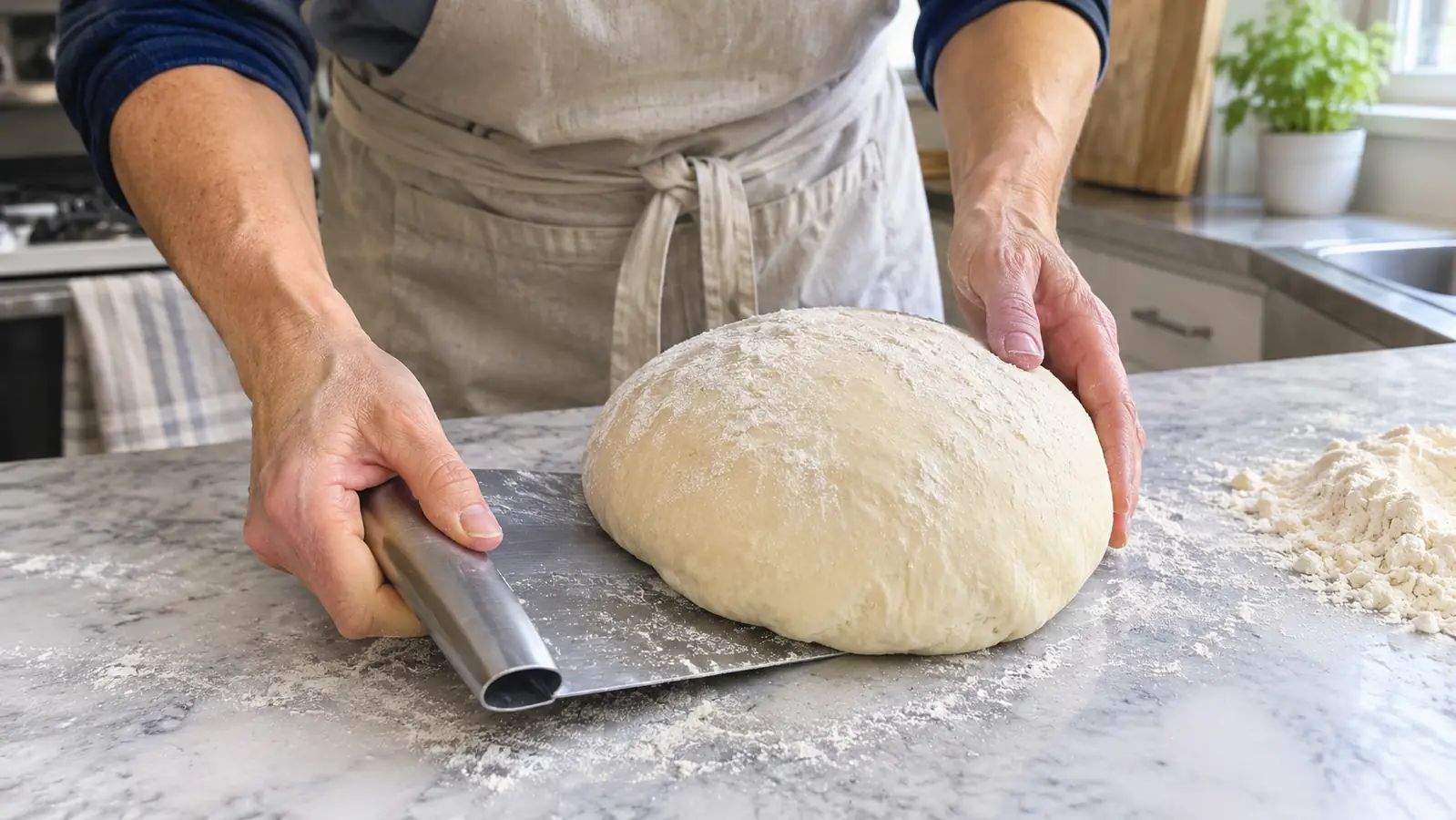
Flour the counter lightly, turn the dough out, and get the flat of the blade under it before you do anything else. The blade is 4 inches wide across the face, which is enough surface to slide under a two-pound round of bread dough without tearing the skin. The motion is slide, lift, move, set down. The edge is for cutting. The flat is for carrying.
This is the part people skip, and it costs them. When dough sticks and you pull it up with your hands, you stretch gluten you spent twenty minutes building, and the outside tightens unevenly. The loaf then bakes with a lopsided shoulder and one tight spot where the skin never relaxed. Sliding the blade underneath breaks the seal with the counter instead of pulling against it, so the round stays round.
It also keeps the work area clean as you go. Every lift carries a little flour and a few crusted bits with it, so the next piece comes off a clean surface instead of a tacky one. On six feet of counter that is not a small thing. A sticky patch in the middle of my work area means everything after it slides, and I end up fighting the bench instead of the dough.
The same lift is how I move a rolled round of pie crust from the counter to the pan without stretching it out of shape. The rolling pin does the rolling. The scraper gets underneath, all the way across in one slide, and the round keeps the size it had a second earlier.
Step 3: Weigh first, then cut with one press
Weigh the whole batch, then divide by weight rather than by eye. My scale reads to 1 gram, which is finer than bread needs and exactly right for rolls, where a 10 gram difference between pieces shows up as a lopsided pan. For my standard sandwich loaf I split the batch into two pieces of about 450 grams each and shape from there. The scraper cuts. The scale decides where.
The cut itself is one firm press straight down. No sawing. Sawing drags the cut face, tears the gluten at the edge, and leaves two pieces that seal back together into a ragged seam the moment you shape them. Press, and let the blade work along its full 6 inches. If your log is wider than the blade, cut in two presses: press, lift, reposition, press again. Never slide the blade sideways through the dough, because sideways is how you rip it.
One firm press leaves a cut face clean enough to seal. A sawed cut looks identical for ten seconds, and then it does not.
Paul, who does the dishes and therefore has opinions about my methods, once asked why I do not simply use a knife. A knife works. It also needs a board under it, and a board needs washing, and every extra thing on a narrow counter is in the way. A bench scraper cuts on the counter itself and then cleans the counter, which is a trick a knife cannot do.
Step 4: Keep the blade and the cut faces clean while you shape
Between pieces, wipe the blade. A blade with dough stuck along it does not cut, it tears, and it is always the second and third pieces that suffer because nobody wipes after the first. I keep a damp cloth folded at the back of the counter and run the blade across it every two or three cuts.
When you shape, think of the scraper as a third hand. The flat of the blade pushes a piece of dough across the counter to build tension on the surface, which is the same motion as a cupped palm, only with a straighter edge. Rotating the dough a quarter turn between pushes does more for a tight, even skin than adding flour does. Flour stops dough from sticking. It does not make it hold together.
The one place I put it down: very slack, high-hydration dough. A bench scraper will still lift a wet dough, but it will not cut one cleanly, because there is nothing firm enough to cut. Wet your hand, use a bowl scraper, and come back to the bench scraper once the dough has some structure. Tools do specific jobs, and knowing which one you are holding is most of the skill.
Step 5: Scrape the bench clean before the scraps dry
The last job is the one the tool is named for, and the one most people do badly because they do it late. Dough scraps left on the counter dry into something that takes soaking to remove. Scrape them while they are still soft: tilt the blade down to about 30 degrees, press the edge to the counter, and push everything into a bowl in long strokes.
The same pass clears the flour, the stray oats if I am making a seeded loaf, and the crusted bits from the first division. Two strokes and my counter is workable again, which on a galley counter is the difference between finishing the bake at a reasonable hour and not. Then the scraper goes back on its hook by the stove, dry, edge up.
I do not leave it lying flat in a sink of dishes. A flat blade under a stack of plates is how an edge gets knocked about, and it is also how hands get cut. Thirty seconds with a cloth and back on the hook is the whole maintenance routine, and it is why the tool still looks the way it did the week I bought it.
What Else Helps
The scraper divides and lifts, and that is the sum of its job. Weighing belongs to the scale. If you are dividing by eye, you are giving up most of what a clean cut buys you, because even pieces proof at the same rate and uneven ones do not. My scale lives flat in the pantry cabinet and has needed one battery change in two years.
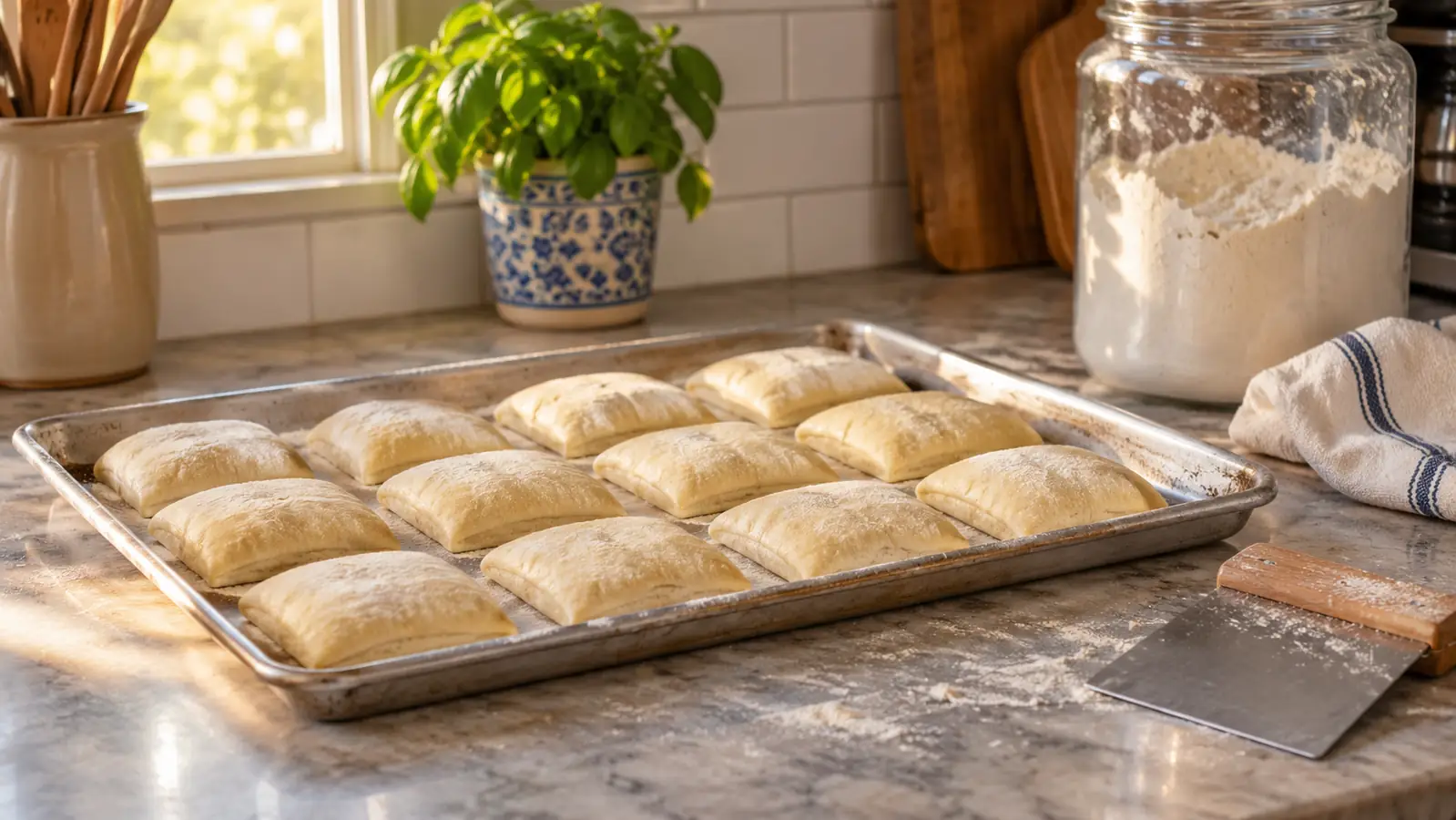
Resting and proofing belong to the half sheet pans, which are also what the rolls go onto once they are shaped. A piece of shaped dough needs a flat, rimmed surface it can be moved on without distortion, and the pans that have stood on edge in the cabinet over my fridge for the last sixteen months are the ones I reach for without looking. Cookies, sheet cakes, and the brownies for the church bake sale all come off the same two pans.
For pie crust, the rolling pin does the rolling and the scraper cleans up after it, lifting the round without stretching and scraping the butter-and-flour paste off the counter afterwards. There are more tools in my kitchen that touch dough than there are drawers to hold them, so each one has to earn its place. If you want the longer account of how the OXO has held up over a year and a half of weekend baking, that story is written up separately. There is also a direct comparison against the plain metal scrapers I used at work, and if you are still deciding whether the tool deserves counter space at all, that question has its own answer. None of it is required reading to divide a batch of dough. All of it answers the question people actually ask me, which is whether the handle is worth paying attention to.
Division is a technique. The blade is what makes it repeatable.
Stainless steel, 6-inch rectangular blade with 1-inch markings, soft non-slip grip, 6.25 inches long overall. The one I hang by the stove and reach for every time I split a batch.
Amazon Check Today's Price on Amazon →