
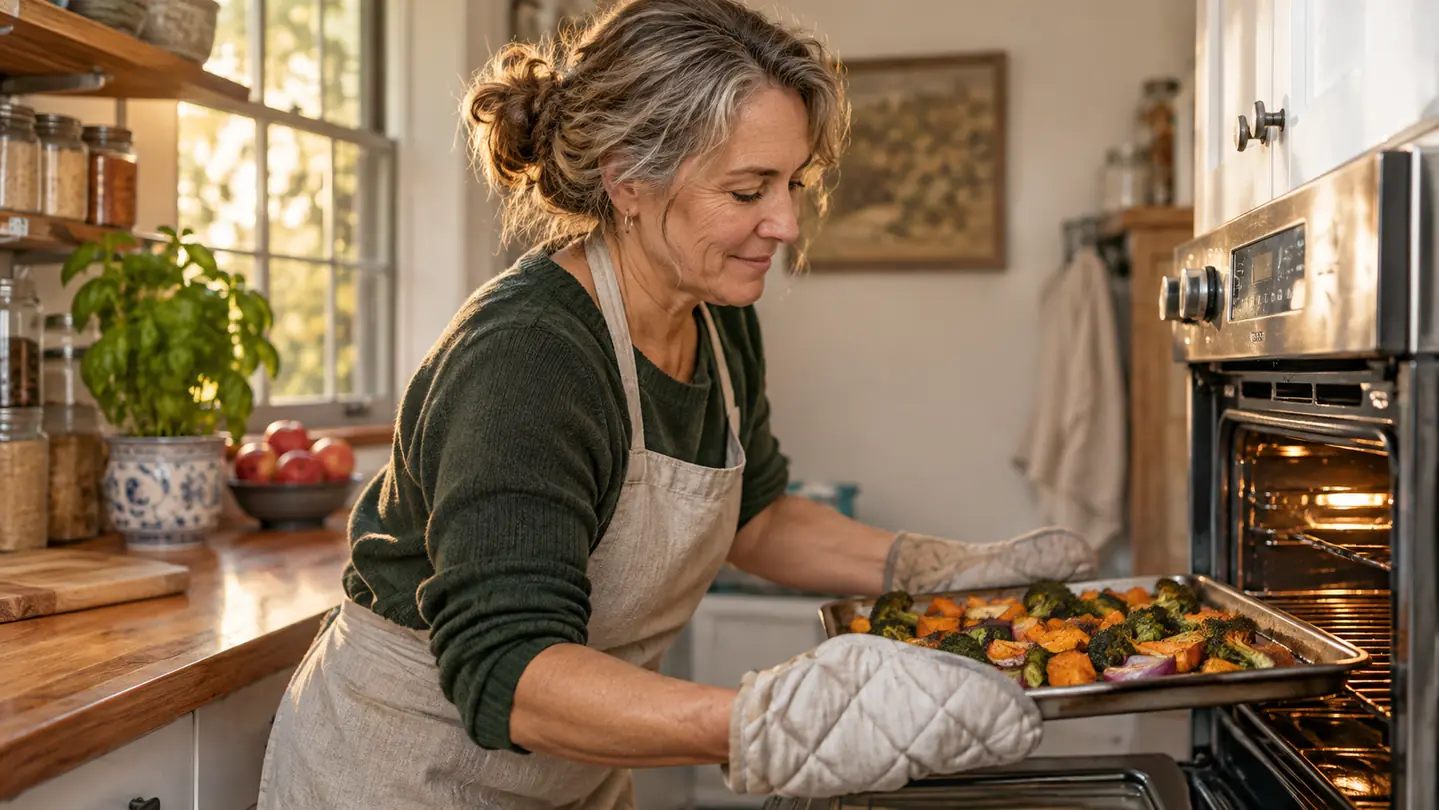
The first thing nobody tells you about the Nordic Ware half sheet pan is that it will look worse a year in than it did the afternoon it came out of the box. Mine have been in near weekly rotation for about sixteen months. They have discoloured, they have picked up shallow scratches, and one of them carries a dull patch in the corner where a roast chicken let go. I would buy them again tomorrow without hesitating. That gap between how the pan looks and how the pan performs is the whole honest story here, and it is the part most reviews leave out.
The short version before the long one. I bought the two-pack of Nordic Ware Naturals half sheets to replace two thin dark nonstick cookie sheets that had warped and were scorching the bottoms of every cookie in the house. The new pans have not warped. They have not rusted. They brown a tray of cookies evenly enough that I stopped turning the tray halfway through. And they ask two things of you that a nonstick sheet never did: line them or grease them, and wash and dry them by hand. If that trade sounds acceptable, the rest of this is detail. If it does not, save yourself the shelf space and stop here.
The Quick Verdict
Even browning and a pan that stays flat for years. The trade is lining, hand washing, and a finish that stops looking new around month four.
Amazon Check Today's Price →A pan that stays flat is worth ninety seconds of hand washing
The Nordic Ware Naturals half sheet two-pack is the pan I reach for first for cookies, sheet cakes, roasted nuts and sheet-pan dinners. Sizing and current price are on the listing.
Amazon Check Today's Price on Amazon →How I've Used These Pans for Sixteen Months
I bake most weekends and a couple of weeknights, in a narrow galley kitchen in a Baltimore rowhouse with one standard 30-inch electric oven and about six feet of counter. The pans live on edge in the cabinet over the fridge, which is the only place two pans this size fit without eating workspace. In sixteen months they have carried chocolate chip cookies more times than I can count, caught drips under a Thanksgiving apple pie, held plain yeasted sandwich bread and dinner rolls, baked brownies for the church bake sale and a birthday layer cake for my niece Maddie, and roasted a rotating cast of vegetables and chicken thighs on nights when I am not baking at all.
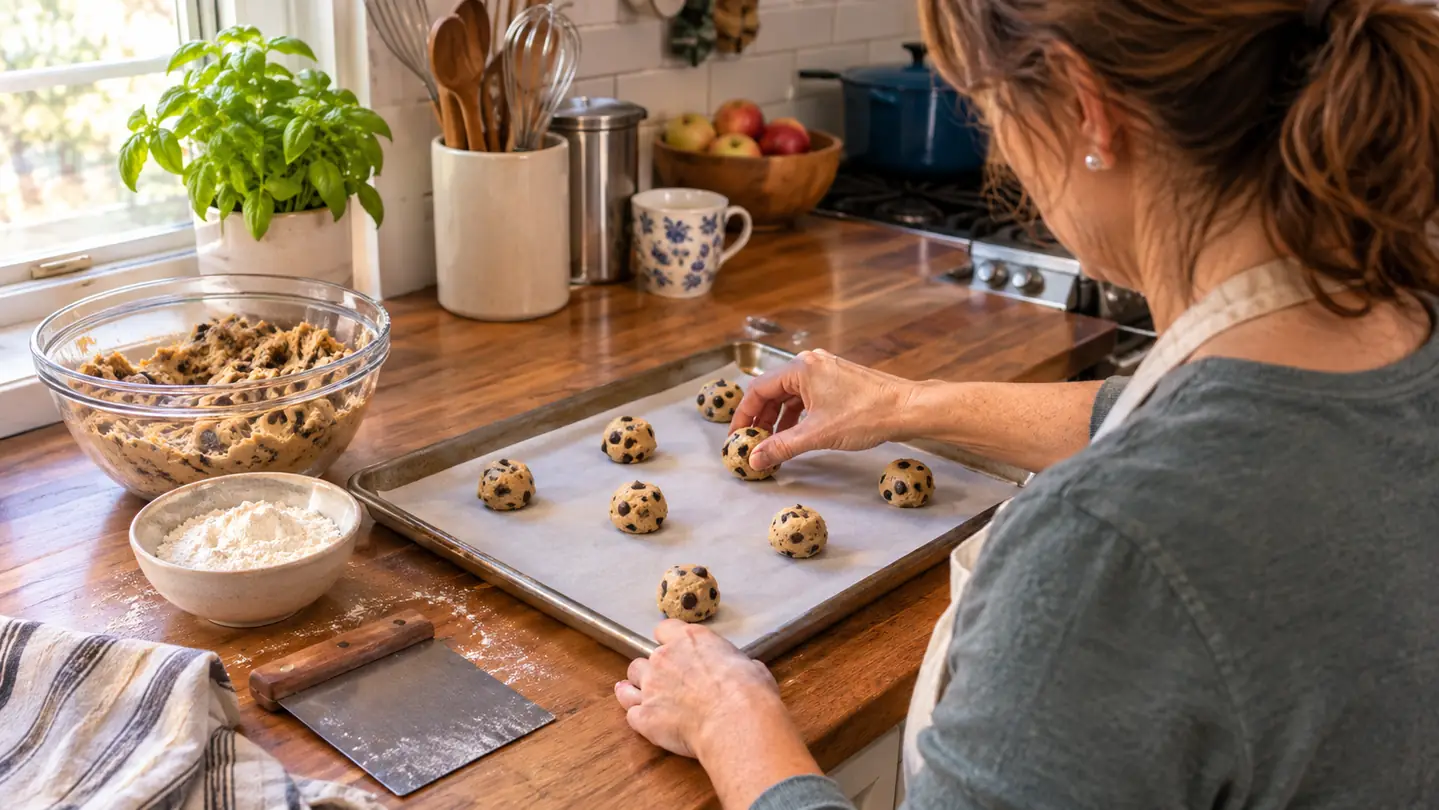
The learning curve was shorter than I expected. The first batch of chocolate chip cookies I baked on the new pan, in the second week of ownership, came out with a bottom that was set and golden and a top that was still soft, which is the order you want. I had been fighting the opposite on the old sheets for a year, pulling trays early to stop the bottoms burning and then eating cookies that were raw in the middle. That first tray was the moment I understood what people mean when they say a pan bakes evenly, and it had nothing to do with the pan being new. It was the aluminum doing what aluminum does.
What I did not expect was how fast they would become the default pan rather than the baking pan. A half sheet this size, 17.9 by 12.9 inches outside and 17.1 by 12.1 inches inside, fits a standard home oven with a couple of inches to spare on each side, and that matters more than it sounds. A pan that touches the oven walls blocks heat from moving around the food. A pan with air on all four sides browns more evenly. That inch of clearance is doing quiet work every time you bake.
The pans weigh about 1.7 pounds each, heavy enough to feel substantial in the hand and light enough that pulling a loaded tray out of a hot oven is not a two-handed job. That weight sits evenly across the pan rather than pooling at the rim, so the tray does not tip when you set it down with one side loaded and the other still empty. Small thing. I noticed it in the first week and I still notice it every time I slide one onto the rack.
Before these, I owned two thin dark nonstick sheets. They warped inside the first year, they scorched the bottoms of sugar cookies while the tops stayed pale, and by the end I was rotating the tray and dropping the oven temperature to compensate for a pan. I threw both in the trash the week the Nordic Ware pans arrived and I have not owned a nonstick sheet since. That is not a knock on nonstick as a category. It is a knock on thin nonstick sheets, which are the ones most of us buy first.
The brownies deserve a note. I bake them for the church bake sale in the pan itself, lined with parchment that overhangs on two sides so I can lift the whole slab out and cut clean squares with the bench scraper. The pan is 1 inch deep, enough for a decent brownie without the batter climbing the walls, and it spreads the batter to an even thickness corner to corner. Twenty four squares, all the same size, none of the thin edge pieces that come out of a deeper dish.
What Pure Aluminum Actually Changes
Most inexpensive cookie sheets are steel with a dark nonstick coating. Steel is a slower conductor, and a dark coating pulls heat hard into the surface, which is why thin nonstick sheets scorch cookie bottoms while the tops are still pale. The Nordic Ware pans are pure aluminum, and aluminum moves heat quickly and spreads it, so the whole surface comes up together. That is the physical reason a tray of cookies comes out one shade instead of three, and it is why the bottoms stop burning before the tops are done.
There is a practical test you can run in your own oven. Put a tray of sugar cookies on the middle rack and watch the front of the tray against the back through the window, without opening the door. On my old dark sheets, the cookies nearest the back wall were always two shades darker by the eight minute mark, because a dark coating absorbs radiant heat from the oven walls as well as from the element below. On the Nordic Ware pans, the front row and the back row finish within a shade of each other. I still rotate the tray out of habit, but the rotation stopped being a rescue and became a formality.
The second piece of engineering is the rim. These pans have an encapsulated galvanized steel rim running around the top edge. That rim is what keeps a large pan flat when it hits a hot oven, and flatness is the whole game. A warped pan rocks, a rocking pan sits at an uneven distance from the heating element, and uneven distance means one end of the tray browns before the other. My old sheets warped inside a year. These have not budged, and the flatness is the one thing I would pay for again.
Aluminum also does not rust. There is no iron in it to oxidize, so the pan will not develop the flaking rust that eventually kills a cheap steel sheet left in a damp dish rack. Nordic Ware covers the pans with a lifetime limited warranty, and while I have never had to test a warranty on a sheet pan, it says something about how the company expects these to hold up. The pans are made in America of domestic and imported materials, and the listing describes them as chemical free, which in practice means there is no coating to chip off into your food.
One thing I did not appreciate until I had used them for a year is how they handle a roast. Vegetables spread in a single layer on an aluminum half sheet brown at the edges and cook through at the same time, because the pan delivers heat from below evenly rather than in stripes. On my old sheets the outer ring of carrots would char while the middle stayed pale and steamed. That difference alone made me stop reaching for a glass baking dish on weeknights.
A warped pan rocks, a rocking pan sits at an uneven distance from the heating element, and uneven distance means one end of the tray browns before the other.
What Nobody Tells You Before You Buy
First, the finish does not stay. Bare aluminum reacts with air, with heat, and with anything acidic that touches it, and mine went mottled within a few months. It is cosmetic, it does not change how the pan bakes, and it is not a defect, but if you are the sort of person who wants a pan to look new after a year, this is not that pan. The change is patchy rather than even, so expect blotches. Everything I have read and everything I have seen says the same thing: it is normal and it is harmless.
Second, aluminum is reactive. Tomato, citrus and long braises with a lot of acid will pit a bare aluminum surface if they sit on it. I line the pan with parchment for anything wet or acidic, and I do not leave a sheet-pan dinner sitting in the pan overnight. That is not a hardship, but it is a rule, and no listing photo mentions it. If you want a pan you can roast tomatoes in and leave on the stove until morning, buy enamel or stainless steel instead.
Third, in practice these are hand wash pans. Dishwasher detergent is alkaline and it attacks bare aluminum, etching and dulling the surface over time. I wash mine with a soft sponge and a little dish soap, dry them with a towel, and stand them on edge to finish drying. It takes about ninety seconds a pan. That is the real cost of owning these, and it is not money, it is a small amount of attention every single time. If you know yourself well enough to know you will not do it, buy something coated and replace it every couple of years.
Fourth, baked-on grease from a roast is real. Sugar and fat that caramelize on the pan during a long cook will not always lift with soap and a sponge. I make a paste of baking soda and hot water, let it sit for ten minutes, and it comes away. I do not use steel wool, because it scratches, and I do not use oven cleaner on bare aluminum. The stubborn corner on my upper pan has a faint dull patch I have decided to live with, and it has not affected a single batch since.
Fifth, the two-pack is a storage decision as much as a baking one. Two pans at 17.9 by 12.9 inches take up real room. In my kitchen they stand on edge over the fridge, which works because that cabinet is deep and it holds the things I do not need every day. If you have a small kitchen and no vertical space, one pan would have done the job. I use both constantly, though, one for the bake and one to hold a cooling rack or catch drips underneath.
Sixth, and this one surprised me, the pan bakes differently under parchment than it does bare. Parchment is a thin insulator, and cookies baked on it brown a little more slowly and spread a little less than cookies dropped straight onto a greased pan. Neither result is worse. They are just different, and if you are chasing a result you have been getting for years on another pan, change one variable at a time. I spent two batches convinced I had bought the wrong pan before I worked out that I had also switched parchment brands, and the paper was the difference, not the aluminum.
What I Liked
- Browns cookies evenly across the whole tray, with no scorched corners
- Still flat after sixteen months of near weekly use
- Pure aluminum with no coating to chip, flake or wear through
- Will not rust, even left damp in the rack by accident
- Two pans in the pack, so one bakes while the other holds a cooling rack
- Lifetime limited warranty and made in America
Where It Falls Short
- The finish discolours and mottles within a few months
- Hand wash and towel dry in practice, every time
- Bare aluminum reacts with acidic food, so you have to line it
- Needs greasing or parchment for anything that sticks
- Two large pans take genuine storage space in a small kitchen

Who This Is For
This is for the baker who has already been annoyed by a dark nonstick sheet and wants to know why. If you bake cookies, sheet cakes, roasted vegetables, dinner rolls or brownies for a bake sale, and you want the left side of the tray to match the right, this pan does that. It suits anyone willing to keep parchment in the drawer and spend ninety seconds at the sink. It also suits a beginner, because it removes a variable: when cookies brown unevenly on an aluminum half sheet, the problem is your oven or your dough, not the pan.
If you bake in volume at the holidays, the two-pack earns its shelf space. I run one tray in the oven and stage the next batch on the second pan, which keeps the oven door closed and the heat steady. That rhythm is worth more to me than any single feature on the pan, and it is the reason I would buy the pair again rather than a single sheet.
If you make plain yeasted sandwich bread or dinner rolls, this pan does double duty as a proofing and cooling surface. I shape rolls, set them on parchment on the pan, cover them with a towel, and let them rise right there, then slide the parchment onto the second pan and bake. After baking, the rolls cool on a rack set into the pan, which catches every crumb and keeps the counter clean. None of that is a feature Nordic Ware advertises. It is just what a large flat surface with a 1 inch rim turns out to be good for, and it is a big part of why the pans never go back into the cabinet for long.
Who Should Skip It
Skip it if you want to put a pan in the dishwasher. Skip it if you roast a lot of tomato or citrus and like to leave the pan to soak. Skip it if visible wear bothers you, because this pan will look used, and it will look used sooner than you expect. Skip the two-pack if your kitchen is small and you have nowhere to stand a pan on edge, since a single half sheet does most of what two do in half the room.
One more honest note about size. A half sheet is not a small pan. It is sized for a standard home oven, and it will not fit a countertop oven, a toaster oven, or most narrow pull-out racks. Measure your oven if there is any doubt, and measure the cabinet if the pans are going to live on edge. Mine clear the oven walls with room to spare and fit the cabinet over the fridge by about an inch.
Buy it for the flat pan, not the finish
Sixteen months in, mine are still flat, still even, and still the first pan I pull out for cookies. Check today's price and the current sizing on the listing.
Amazon Check Today's Price on Amazon →