
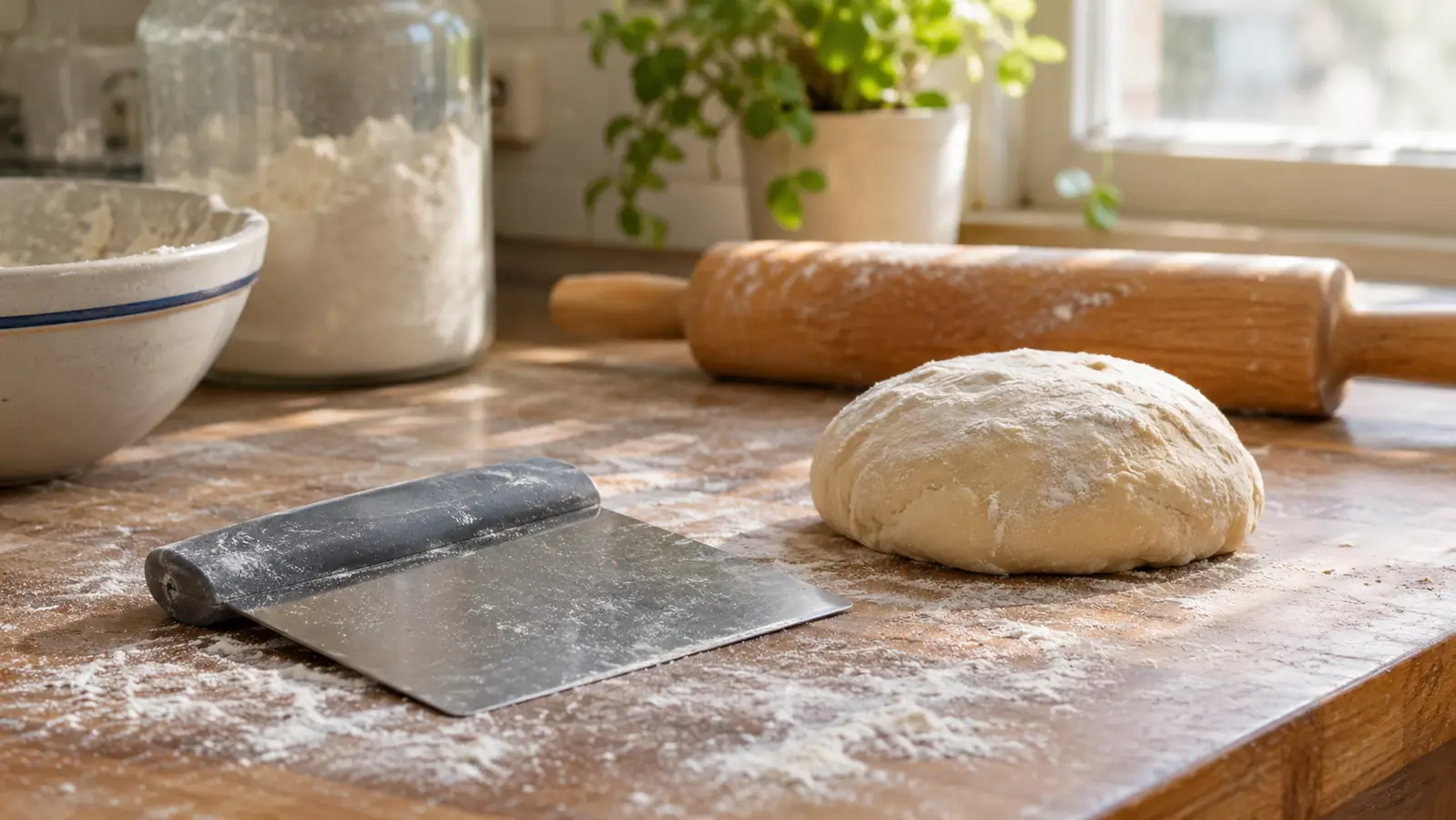
Eighteen months ago I hung an OXO Good Grips scraper on a hook beside my stove, and it has not moved since. That is the shortest honest summary of this review and also the least useful one, because a hook by the stove is where a tool ends up after it has already earned its place. It says nothing about the first month, when I kept forgetting the thing was there and reached for a knife instead. This review is about that first month as much as the eighteen that followed.
I trained in a pastry kitchen and spent seven years in a hotel doing plated desserts, laminated doughs and wedding cakes before I left the professional side for a desk job. In that kitchen a bench scraper was not equipment, it was furniture. There were four in a drawer and nobody owned one personally. When I started baking seriously at home again, in a Baltimore rowhouse with a narrow galley kitchen and about six feet of counter, I did not own one. The OXO was the first I bought, and it has been used most weekends since, plus a good number of weeknights.
The Quick Verdict
A comfortable, well-made scraper that earns its hook by the stove. The handle is both the reason to choose it and the reason it is not perfect. Treat the chopper half of the name as marketing.
Amazon Check Today's Price →The tool I reach for before I reach for a knife
A six-inch stainless blade with one-inch markings and a soft, non-slip grip that holds when your hands are covered in dough. It hangs by the stove and gets picked up every bake day.
Amazon Check Today's Price on Amazon →What This Tool Actually Is
The listing calls it a Multi-Purpose Scraper and Chopper, and that name is doing two jobs. The scraper half is the real one: a rectangular stainless blade six inches on the long edge, a soft handle running along the top, and one-inch markings on the blade. Overall it measures 6.25 inches long, 4 inches wide and 1.75 inches tall, and it weighs 0.37 kg, a little over 13 ounces. That is heavier than the flat steel scrapers I used in the hotel kitchen, and you feel the difference in the hand the first time you pick it up.
The chopper half is where the name oversells. Vegetables are listed among its recommended uses, and you can chop with it, in the sense that you can press the blade down through an onion and rock it back and forth. I did this once, deliberately, so I could tell you what actually happens. What happens is uneven pieces, some of them crushed, and a cutting board with onion juice running across it. A cook's knife is faster and better at the job. The scraper is what you use to gather the onion up afterward.
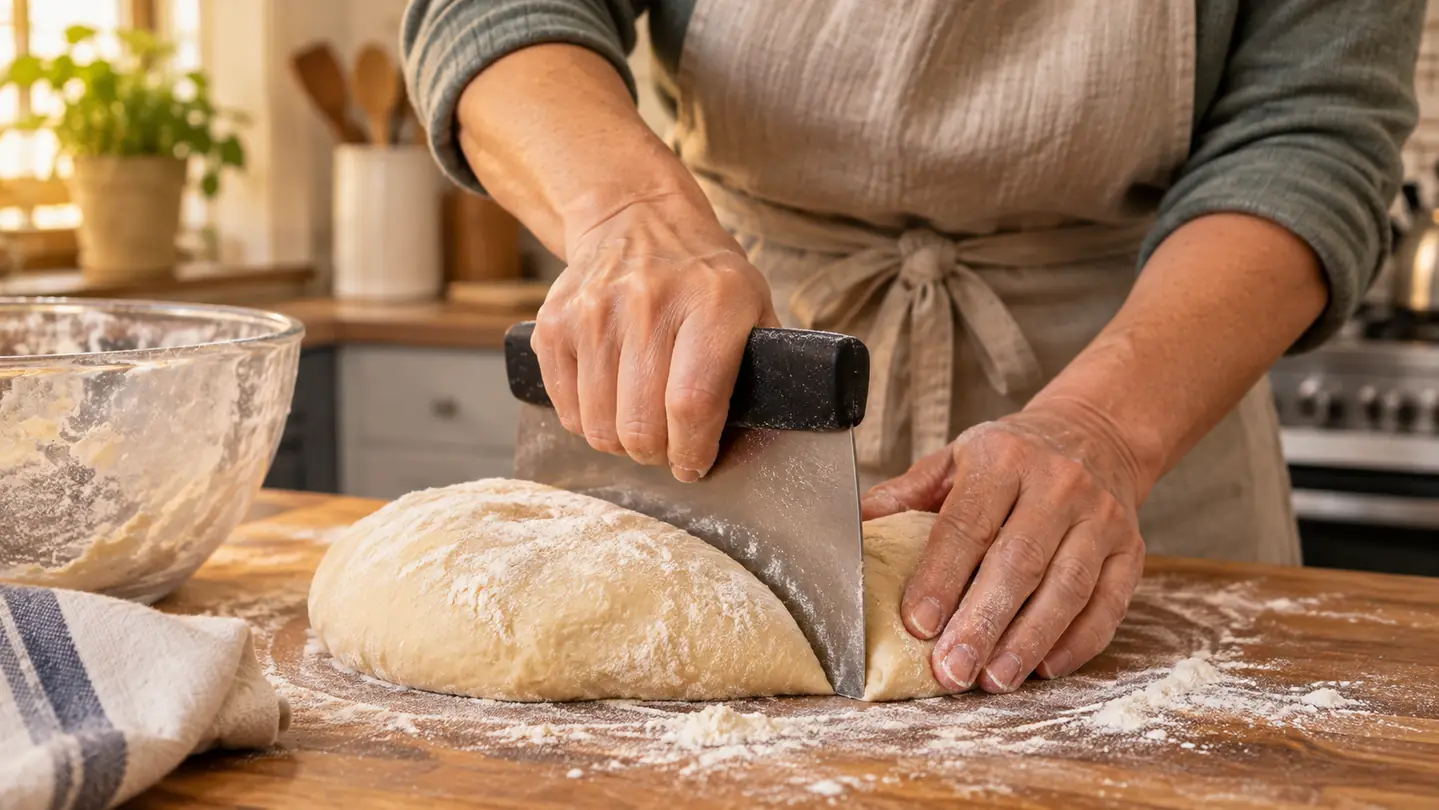
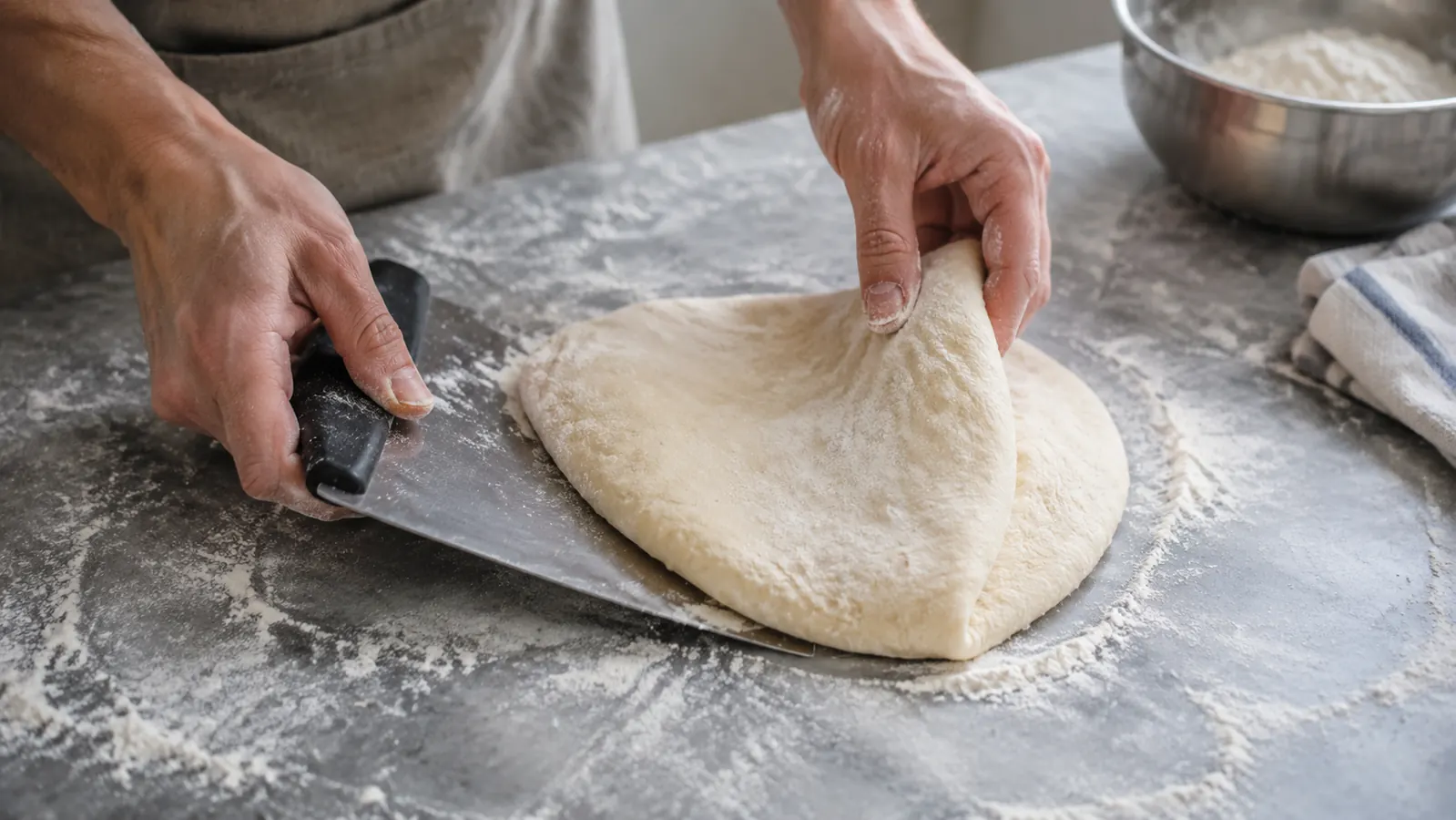
What it does that no other tool in my kitchen does is move dough. A round of proofed bread dough is soft enough that your fingers leave dents in it, and a spatula slides out from under it and leaves half the round behind. The scraper goes under the round in one motion and lifts it whole. That single job is worth the space it takes up, which in my kitchen is a hook rather than drawer room, and everything else it does is a bonus.
How I've Used It for Eighteen Months
Bread is the main event. Plain yeasted sandwich bread most weeks, dinner rolls when there is a bake sale or a Sunday supper, and a batch of rolls for the church sale each autumn that gets cut into sixteen pieces right on the counter. I cut them by eye with the scraper. They come out within a few grams of each other, which I know because I weigh them after, and that is close enough for rolls. It would not be close enough for laminated dough and I would not ask it to be.
The second job is the one nobody mentions when they talk you into buying one. It cleans the counter. Flour, dried bits of dough, the sugar that escapes when you turn a cake out of its pan, the smear of butter that somehow ends up six inches from where you were working. Two passes and the counter is clear enough to wipe. Before I owned one I did this with the back of a knife, which works, is slower, and is not kind to the knife.
The third job is lifting and moving. A rolled pie crust that needs to go onto a plate, a slab of brownies that needs to come out of the pan, a round of dough that needs to slide onto a sheet pan. The blade is wide enough to get under a whole pie crust and stiff enough that the crust does not fold in the middle when you lift. That last part is the difference between a scraper and a spatula, and it is why the scraper lives on the hook and the spatula lives in the crock.
The fourth job, the one I did not expect to use it for, is cutting butter into flour. Pie crust, biscuits, the crumble topping I make too often in November. Cold butter, cubed, tossed in the flour and then cut through with the blade, turning the bowl a quarter turn each pass. It works because the blade is stiff and the handle lets you press down hard without your palm complaining. I used a pastry blender for years and I have not taken it out of the drawer since.
And it cuts bars. Brownies for the bake sale, lemon bars when I am feeling ambitious, shortbread at Christmas. Press straight down, wipe the blade between cuts, and the edges come out clean. The six-inch blade spans most of a square pan in two passes if you line it up properly.
Sixteen rolls cut by eye and within a few grams of each other is what a bench scraper actually buys you. Everything else it does is a bonus.
What Nobody Tells You About the Handle
The handle is the entire reason to buy this version instead of a plain steel blade, and it is also the reason the tool is not perfect. In the hotel kitchen the scrapers were unbranded stainless with a bare spine along the top. After twenty cuts your palm is sore where the steel digs in, especially with a stiff dough. The OXO handle is soft and does not slip, and I have cut sixteen rolls with a hand still buttery from greasing the bowl without the scraper turning on me once.
The tradeoff is height. A flat blade slides under a cutting board, under a bowl, under a stack of pans. This one is 1.75 inches tall at the handle, so it does not slide under much of anything, and it will not lie flat in a shallow drawer without eating the depth. That is why mine hangs by the stove instead of living in the drawer with the rolling pin. In a kitchen with six feet of counter, that turned out to be the better arrangement anyway.
The other thing nobody mentions is the seam. Where the handle meets the blade, flour gets in. Not a lot and not every time, but if you are working with a wet dough or a generous bench of flour you will find a pale line of it in the joint when you rinse the tool afterward. I rinse, wipe and hang it back up, and once a month or so I run a fingernail along that seam. It takes five seconds and it is the only maintenance the tool has asked of me in eighteen months.
The One-Inch Markings, Tested
The blade carries one-inch markings, and I expected to ignore them. I use them more than I expected, though never for anything that has to be exact. They are handy for cutting brownies into even squares, for checking that a rolled dough is roughly the width I need before it goes into the pan, and for cutting a rough rectangle for a free-form loaf. If a recipe says roll to a 10 by 14 rectangle, the markings get you close and a ruler gets you exact. Close is usually what you need.
Where they do not help is precision work. If you are cutting a lattice for a pie, you want a knife, a ruler and a steady hand, and the markings will not stand in for any of those. They are a convenience rather than a measuring tool, and I would not buy the scraper for them alone. I would not want them gone either.
How It Has Held Up
The blade has picked up fine scratches, the way stainless does after a year and a half of being wiped and set down on a counter. Nothing has rusted. The markings are still legible. The handle has not loosened, which was the failure I half expected from a soft grip attached to a steel blade. I have leaned on it harder than I should when cutting chilled dough for hand pies, and the blade has not bent.
I wash it by hand and dry it, mostly because it is easier to hang a dry tool than a wet one. That is a habit, not a warning. What I will say is that a tool you can rinse and put away in fifteen seconds gets used more often than one that has to be dealt with, and this one is easy to deal with.
What I Reach For Instead, and When
For anything inside a bowl I use a flexible plastic bowl scraper, the kind with no handle that bends to the curve of the bowl. The OXO scraper is rigid and rectangular and it does a poor job on the inside of a mixing bowl, so I do not ask it to. Bowl scraper for bowls, bench scraper for the counter. It sounds fussy written down and it is completely automatic in practice.
For chopping, a knife. For scraping out a narrow jar, a small spatula. For splitting a cake layer I use a long serrated knife and a steady hand, and I have never been tempted to try it with the scraper. The honest picture is a tool with about four jobs it does very well, sitting next to several tools that do the rest, which is what a working kitchen actually looks like.
Where It Falls Short
The chopping claim, covered above. It is not a knife and the name invites people to think it is. Buy it expecting to replace a knife and you will be disappointed inside the first onion.
It is heavier than a flat scraper at 0.37 kg, and the handle sits on top of the blade rather than behind it. When I scoop a pile of chopped nuts or a spill of flour, some of it goes over the back of the handle instead of staying on the blade. I do it anyway, because scooping with the tool already in your hand beats fetching another one, but a flat blade scoops cleaner and I will not pretend otherwise.
The width is the other limit. Four inches across the handle and blade sounds generous, and it is, until you want to get into the corner where the counter meets the backsplash. The tool is big enough to move a lot of flour quickly and too big for small jobs, and there is no smaller version of it on my hook.
What I Liked
- Soft, non-slip grip that stays put in a wet or buttery hand
- Six-inch blade with one-inch markings, genuinely useful for bars and rolled dough
- Stiff enough to lift a proofed round of dough without stretching it
- Cuts butter into flour for pie crust and biscuits better than my pastry blender did
- Short enough to hang by the stove, which matters when counter space is tight
Where It Falls Short
- Taller than a flat blade, so it does not slide under boards or bowls
- Flour collects in the seam where the handle meets the blade
- Not a chopper in any real sense, onions come out uneven
- Heavier than a plain steel scraper at 0.37 kg
- Too wide to scrape out a narrow container or a tight counter corner
Who This Is For
If you make bread, rolls or pie dough more than once a month and you work on the counter, this earns its place. It divides dough, lifts dough, cuts butter into flour, cuts bars and cleans the counter, and it does all of that without a knife edge to worry about. It suits a small kitchen too, because it hangs rather than stacking in a drawer. In my house it is the tool I pick up most often, ahead of the scale, which I did not expect when I bought it.
It also suits anyone upgrading from a bare steel blade who finds the spine uncomfortable. The handle is the whole proposition here. If your hands are in dough three times a week, that soft grip stops being a detail and starts being the reason.
Who Should Skip It
If you bake cakes and cookies and your doughs never touch the counter, you can skip it. A spatula and a bowl scraper cover that kind of baking and take up less room. If you want to chop vegetables, use the knife you already have. And if you own a flat steel scraper you like, the OXO is a comfort upgrade rather than a capability upgrade, so you have to care about the handle to justify the swap. That is an honest reason, but it is the only one.
Hang one by the stove and see how often you reach for it
Six-inch stainless blade, one-inch markings, soft non-slip grip, and a tool that moves dough in a way a spatula cannot. Mine has been on the same hook for eighteen months.
Amazon Check Today's Price on Amazon →