
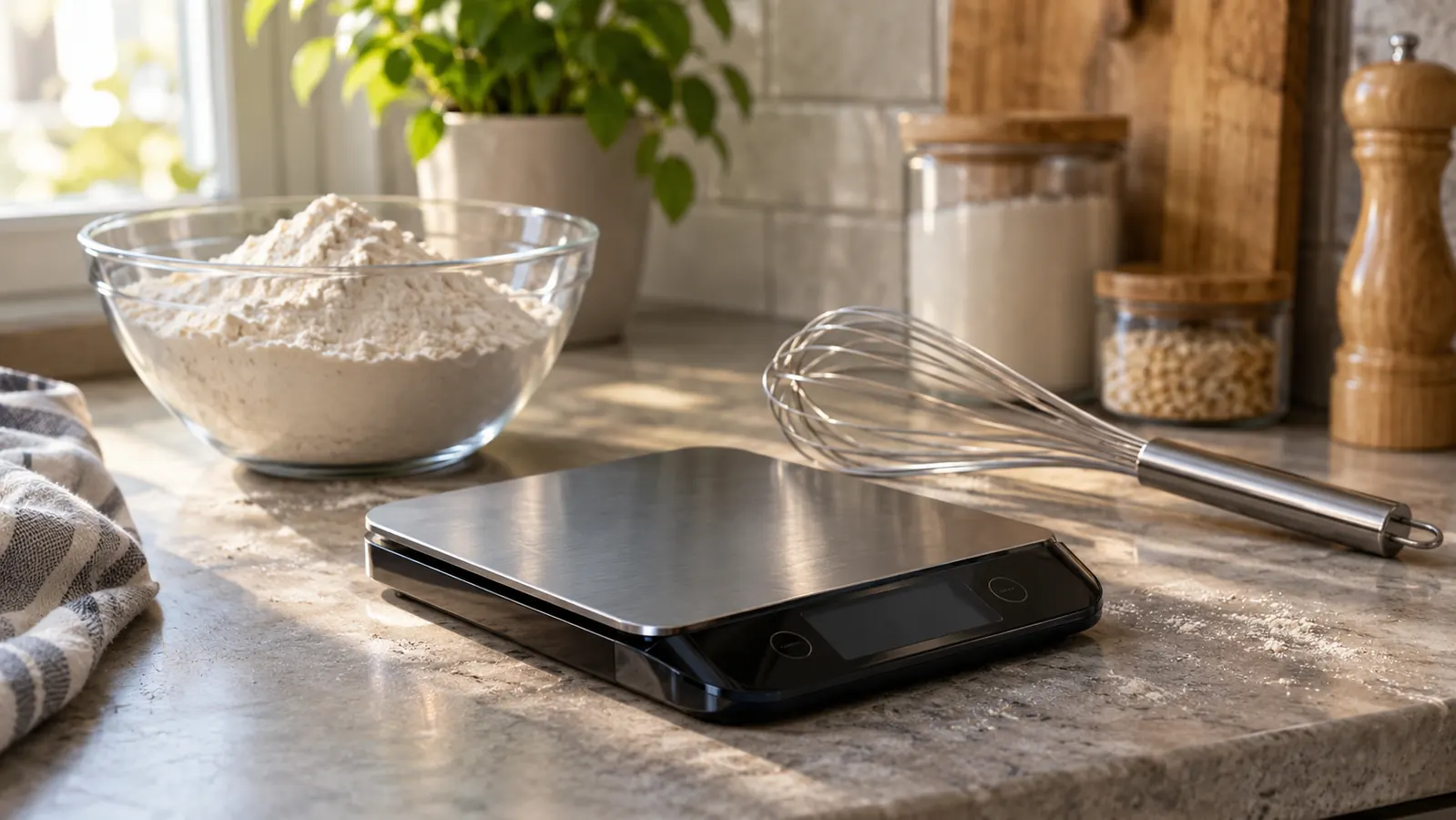
Nobody photographs a kitchen scale. It lives in a cabinet, comes out, gets dusted with flour, gets wiped down, goes back. Mine has done that several hundred times in two years and I have never once thought about it while eating a slice of cake. That is the honest case for the Etekcity digital kitchen scale. It disappears into the work. It is also the honest case against expecting it to fix your baking on its own, because a scale only tells you the truth, and what you do with the truth is still your job.
I trained in pastry and spent seven years in a hotel kitchen where every ingredient went onto a scale, then came home and measured flour in cups for twenty years like everybody else. This scale is what closed that gap for me. It takes up a spot in the pantry cabinet, not on the counter, and in two years it has never been the reason a bake failed. What follows is the less flattering half of the story, because the flattering half is already printed on the box.
The Quick Verdict
Accurate in 1 g steps across the full 11 lb range and small enough to store flat in a narrow cabinet. Judge it on the readout and the tare button, not on features it never claimed to have.
Amazon Check Today's Price →The number that matters here is the 1 g readout, not the feature list
11 lb capacity, five units including millilitres, a tare button, a backlit LCD, and two AAA batteries already installed. If you are replacing measuring cups, this is where I would start.
Amazon Check Today's Price on Amazon →How I Have Actually Used It
I bought this about two years ago, before any of the other tools I lean on now, and it was the first thing in my kitchen that made weighing the default instead of the extra step. My kitchen is a narrow galley with about six feet of counter and one pantry cabinet, so a tool earns its place by being easy to put away. This one lies flat on the shelf and slides out with two fingers. I have changed the batteries once in two years, and the two AAA cells it ships with were already installed when it arrived.
In a normal week the Etekcity weighs flour, sugar, butter and water for whatever is on the counter, and it portions cookie dough and bread dough by weight so the pieces bake evenly. A double batch of sandwich bread dough does not come close to the 11 lb ceiling. The measurement runs in 1 g steps all the way up, which matters more than the top number, because most of what you weigh in a home kitchen is under 500 g.
The functions are short and that is the point. It weighs, it tares, and it switches between ounces, pounds and ounces, fluid ounces, grams and millilitres. There is nothing to program and nothing to look up. My husband Paul does the dishes and has never once asked me how it works, which is a better review than anything I could write.
Why Weighing Beats Scooping, in Plain Numbers
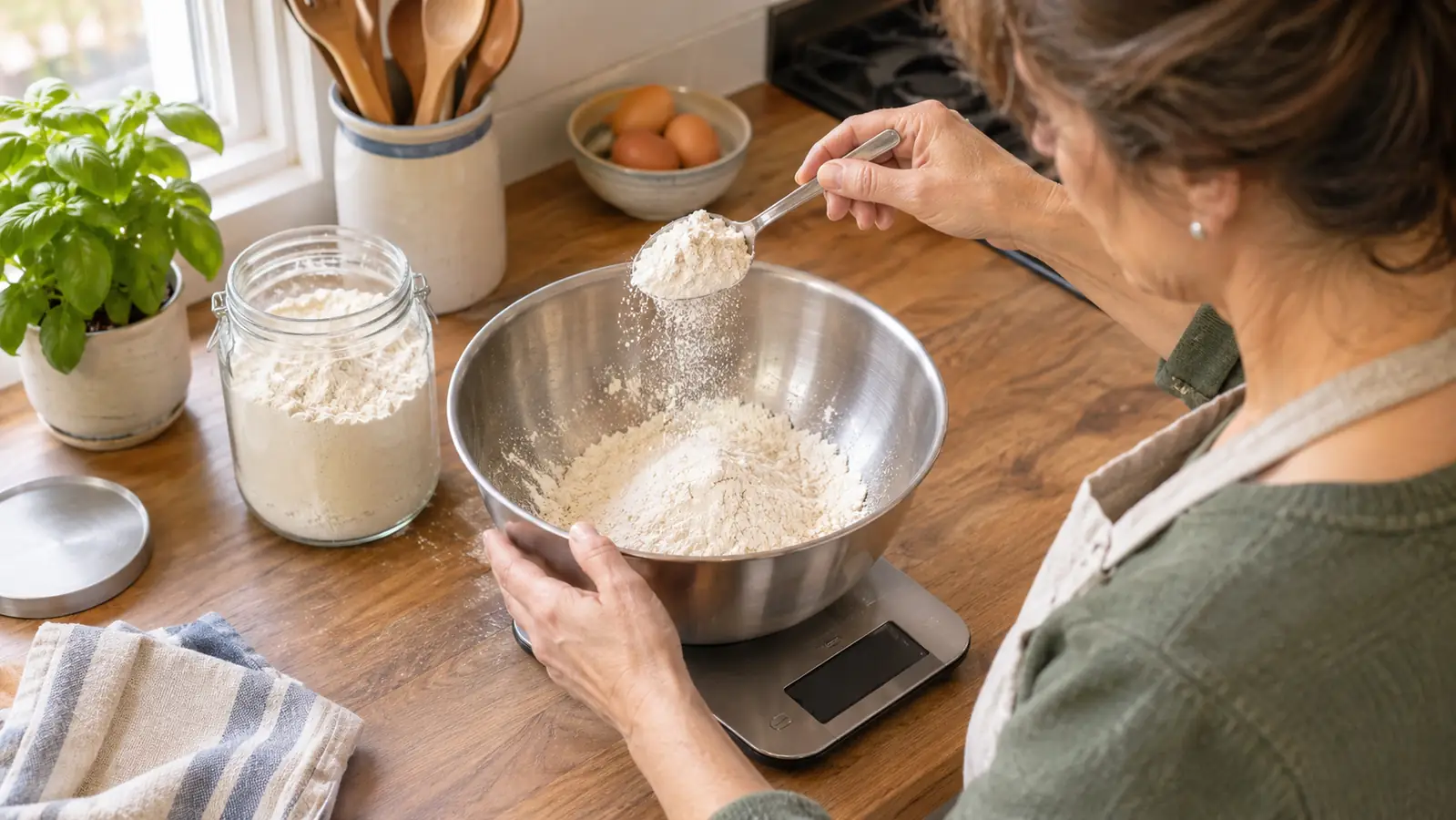
A cup of all-purpose flour is not a fixed amount. Spoon it into the cup and level it and you land somewhere near 125 g. Scoop straight from the bag with the cup and you can pack in 145 g or more. That is a spread of roughly fifteen percent, and fifteen percent is not a rounding error in a cake. It is the difference between a crumb that holds together and one that is dry at the edge and sunken through the middle.
Scale recipes remove the argument. When a formula says 340 g of flour, you set the bowl on, press tare, and pour until the readout says 340. The next time you bake it, you get the same dough. That repeatability is what I missed for twenty years, and it is why the first thing I did when this scale arrived was weigh out the flour for my standard chocolate chip cookies three times in a row, just to see how far my scoop had been wandering.
Here is what that test looked like. I scooped the way I had scooped for twenty years, straight from the bag, and leveled each cup with the back of a knife. Three scoops, three weighings: 148 g, 141 g, 152 g. Then I spooned the flour into the cup and leveled it the way the millers suggest, and got 127 g, 129 g, 126 g. Same bag, same cup, same morning, same pair of hands. The scooping ran heavy and wandered by eleven grams. The spooning ran light and stayed inside three. A recipe written for 130 g would have been close to right with one method and noticeably dry with the other, and nothing in the recipe would have told me which. That settled the argument in about four minutes, on my counter, with a bowl and a scale and no opinions involved. I wrote the numbers on the back of the recipe card and I have not scooped flour since.
The millilitre setting earns its place too. Water, milk, buttermilk and cream are close enough to 1 g per mL that weighing them is faster than hunting for the right jug, and you do not lose a tablespoon to the side of the cup. The tare button is the whole reason one-bowl baking works. Bowl on, tare, flour in, tare, sugar in, tare, butter in. One bowl, one spoon, one scale, no stack of cups to wash.
A scale does not make you a better baker. It makes you a repeatable one, and repeatable is the entire game.
The Honest Limits, Which the Listing Does Not Shout About
The capacity is 11 lb, or 5 kg, and in a home kitchen that is plenty. Where it stops is a full stockpot, a whole turkey, or a bowl of dough big enough to need both hands to lift. If you bake for a crowd on the regular, you will eventually want something larger, and no amount of good design changes that.
The 11 lb ceiling gets closer than you might expect on a holiday. For Thanksgiving I make two apple pies, and the sliced apples for both, with their sugar and spice, is a serious volume of food. I weigh the fruit in two batches now, not because the Etekcity objects but because I cannot see around a bowl that wide on a platform this size, and I would rather split the load than guess at the top end. The pastry dough for both crusts goes in one batch without any trouble at all. Where it genuinely will not work is a whole bird or a stockpot, and the honest answer there is that no counter scale in this size class handles that. What I do instead for big batches is weigh the flour in two passes, taring between them, and add the totals in my head. It is thirty extra seconds and it has never once gone wrong.
The 1 g readout is honest for what it is, but understand what it means. The scale moves in 1 g steps, so a 2 g addition of salt is approximate and a 0.4 g addition of instant yeast is a guess. The listing mentions jewellery and medicines among its uses. For anything where a single gram is a large amount, I would want a scale built for that job. For flour and butter, 1 g is finer than you need.
It is also not waterproof. The top is 304 food-grade stainless steel and the instruction is to wipe it down, which is exactly what I do after a dough session. Do not put it under the tap and do not soak it. A damp cloth, a dry cloth, back in the cabinet. Two years of that routine and mine still looks like a scale.
The Small Annoyances That Show Up Around Month Six
The scale is compact, which is exactly why it stores so easily in a small kitchen, and that same compactness has a cost. Set a wide mixing bowl on it and the bowl can sit over the display, so you tilt the bowl or lift a corner to read the number. I have learned to reach for a narrower bowl when I need to watch the readout, but it is a genuine trade and the listing does not mention it.
The first time it caught me out was a Saturday in November, a double batch of sandwich bread dough. I had a wide bowl on the platform, pouring flour with one hand and holding the bag with the other, and every time the bowl crept back toward the hinge the readout slid under the rim. I poured to what I judged was the number, lifted the bowl off, and the display settled at 52 g over. I scraped the excess back into the bag with a bench scraper, which is a correction a scale makes possible and a cup never does. Now I reach for a bowl with a narrower base whenever I am adding slowly, and the wide one only for things I tip in all at once. It cost me one bake to learn and nothing since.
The backlit LCD is more useful than I expected. My kitchen has one window and the counter sits in the middle of the room, so from November through March I am baking before the light is any good. Large fonts, backlight on, readable at a glance from a standing position. That feature sounds like filler on a spec sheet. It is not.
The last annoyance is the surface itself. A stainless platform shows every flour smear and butter fingerprint, so if you care about that sort of thing you will be wiping it more often than the instructions require. I do not care. I wipe it because flour loose in the cabinet is worse than flour on the scale.
What Two Years Changed, and What It Did Not
It did not make me a better baker. I want to be clear about that, because the internet is full of people crediting equipment for skill. What it did was remove a variable. My pie crust is the same every time now, and on the rare occasion it is not, I know it was the butter temperature or the water and not a cup of flour that happened to be packed tighter than it was last week.
It also changed how I read a recipe. When a book gives cups, I convert once, write the weights in the margin, and never think about it again. The molasses cookies, the brownies for the church bake sale, the sugar cookie cutouts at Christmas, all of them are now written in grams in my own handwriting. That is the quiet benefit nobody puts in a review. The scale teaches you to think in weights.
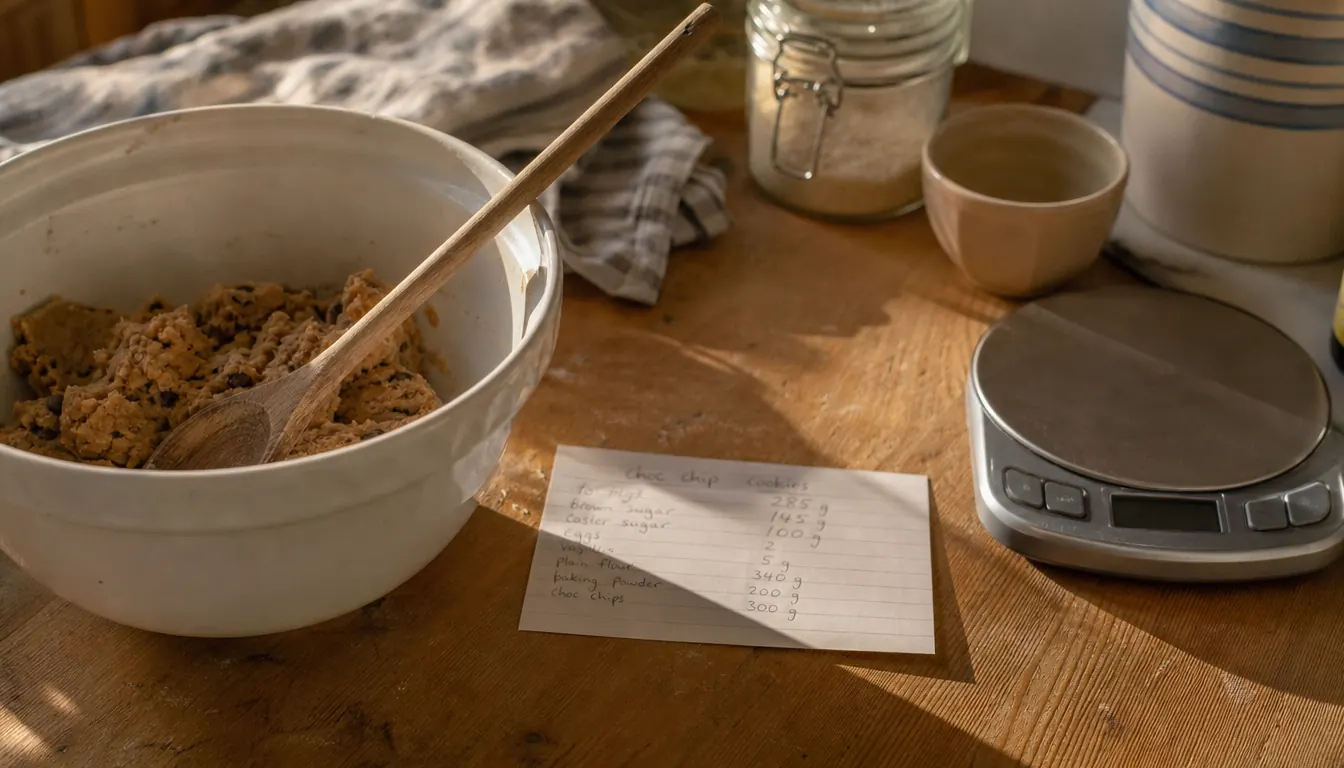
The Christmas sugar cookie cutouts are the clearest example I have. That dough is butter-heavy, and the difference between a dough that rolls clean and one that glues itself to the counter is a few grams of flour, which is a difference cups cannot express and cannot repeat. I weigh the flour and the butter, and the dough behaves the same every December. For Maddie's birthday cake each spring I weigh the batter into the pans so both layers come out level and I am not trimming a dome off one and leaving the other flat. None of that is the Etekcity doing something clever. It is the Etekcity doing the one thing it does, which is giving me a number that stays put. I still have the card from that first batch of cookies, with the gram weights penciled in and one crossed-out figure where I misread the display.
What it did not do is replace my measuring cups entirely. I still own them, I have owned them for twenty years, and they come out for rice and stock and anything where a cup is close enough. It is not an either-or. It is a question of which tool gets the job where accuracy actually matters, and in baking accuracy matters nearly everywhere.
What I Liked
- 1 g increments across the full 11 lb range, so the fine readout does not quit as the load grows
- Tare turns one-bowl baking into a real workflow instead of a stack of dirty cups
- Five units including millilitres, which makes weighing milk and water faster than measuring them
- Ships with two AAA batteries already installed, and I have changed them once in two years
- Lies flat in the pantry cabinet, which is the only reason it survives a six-foot counter
- Backlit LCD with large fonts is genuinely readable in a dim winter kitchen
Where It Falls Short
- Compact platform means a wide mixing bowl can cover the display
- Not waterproof, so it is wipe-only and never goes near the sink
- 1 g steps mean small additions like yeast are approximate, not exact
- No timer or extra functions, so it cannot stand in for a proving timer or a second appliance
- Stainless surface shows every smear and fingerprint until you wipe it
Who This Is For
This is for the home baker who has read one too many recipes that say a cup of flour and quietly suspected the cup was the problem. It is for anyone starting bread, where a hundred grams one way or the other decides whether the loaf is open and airy or tight and heavy. It is for the person portioning cookie dough who wants twelve cookies the same size instead of ten and two runts.
It is also for anyone with a small kitchen. Six feet of counter and one pantry cabinet means storage is not a detail, it is the whole decision. A scale that folds into the shelf and comes out with two fingers gets used. A scale that lives on the counter permanently gets moved out of the way and then forgotten, and a forgotten scale is the same as no scale. The Etekcity earns its place on this one count as much as on accuracy, and for a narrow galley kitchen that is not a small thing.
Who Should Skip It
Skip it if you need sub-gram precision, for yeast packets in tiny test batches, for supplements, for anything where a single gram is a big jump. Skip it if you regularly weigh more than 11 lb at once, which mostly means large batches of dough or a whole bird. And skip it if what you actually want is a multi-purpose kitchen gadget with a timer built in, because this is not that and it never pretends to be.
The other reason to skip it is honest and less comfortable. If you are not going to change the way you measure, the scale will sit in the cabinet next to the bread machine and the juicer. The tool does not bake anything. It only hands you a number that stays the same, batch after batch, and the rest of the work is still yours.
If you weigh one thing this weekend, weigh the flour
Take the recipe you bake most, weigh the flour once, and write the number in the margin. Bake it again next week from that number. If the second batch comes out closer to the first than it ever has before, you have your answer about whether a scale earns its shelf space.
Amazon Check Today's Price on Amazon →