
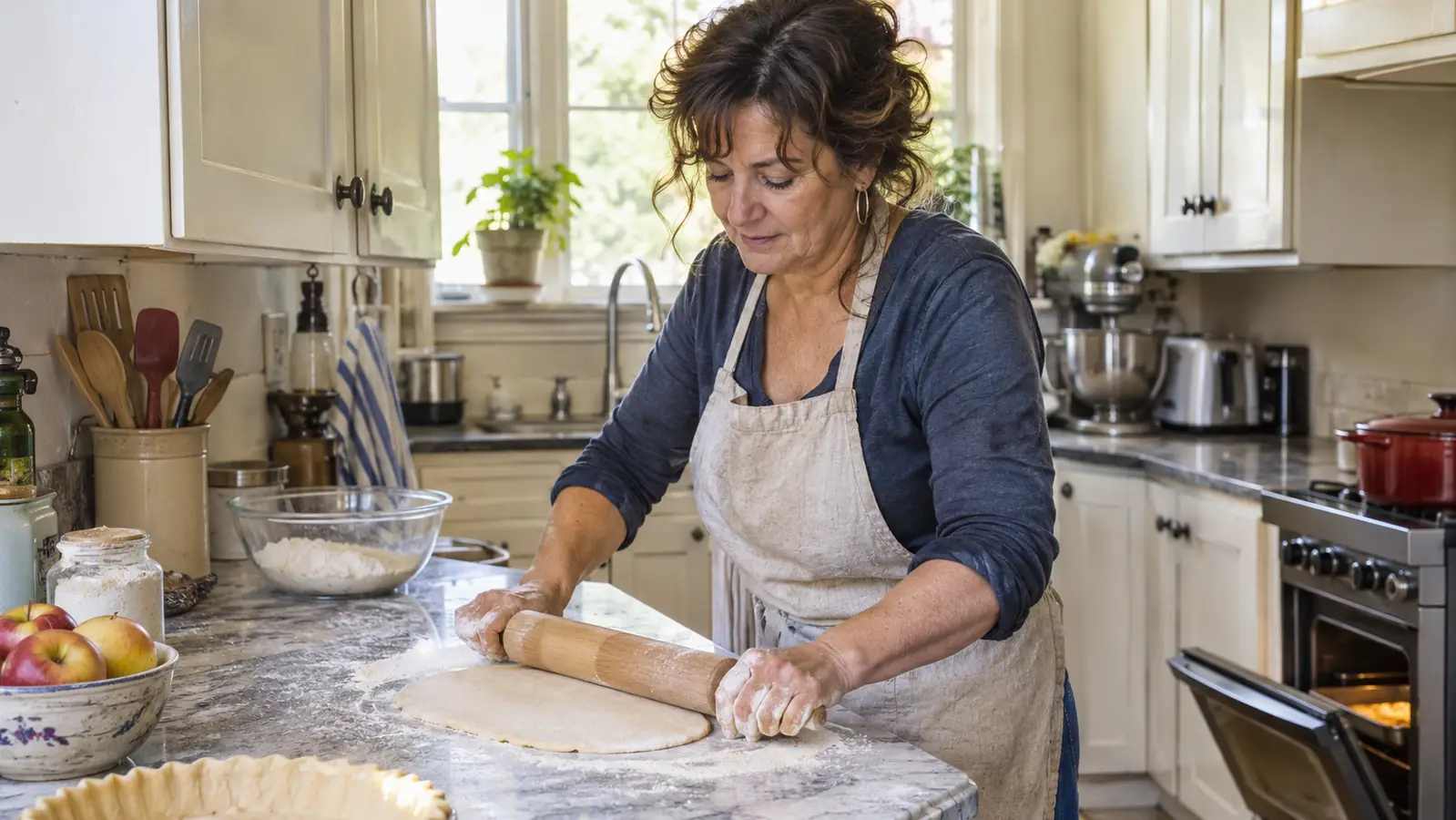
Nobody tells you that a rolling pin is a storage decision before it is a baking decision. I have six feet of counter in a Baltimore rowhouse galley kitchen, one 30-inch electric oven, and a drawer beneath that oven with roughly four inches of clearance. When my old pin cracked at the handle three years ago, I rolled pie dough with a wine bottle for a while. That works, right up until the moment it does not. I bought the Farberware classic wood rolling pin about ten months ago. The Farberware pin solved the immediate problem. It did not solve everything, and I want to be straight with you about which is which before you give up drawer space.
Here is the part most write-ups skip. A rolling pin does not make you better at pastry. Pastry is temperature, gluten and hydration, roughly in that order, and no piece of wood changes any of those three. What a pin does is remove friction from the process so your attention can go where it belongs. The Farberware pin removes friction well. It is not a shortcut and it will not cover for warm butter or an overworked dough. Buy it for the friction, not for a transformation.
The Quick Verdict
A light, well-balanced hardwood pin that does the plain job without drama. Excellent for pie crust and cutouts, less ideal if you want mass behind the roll or markings to measure against.
Amazon Check Today's Price →The pin I actually reach for on pie day
About 18 inches of moisture-resistant hardwood, one pound, balanced end to end. Nothing on it can strip or come loose the way my last pin's handle did.
Amazon Check Today's Price on Amazon →How I've Used It
Ten months, one full Thanksgiving, a Christmas of sugar cookie cutouts, two birthdays with layer cakes, and somewhere north of twenty ordinary weekends. My niece Maddie turned ten this year and requested the same chocolate cake she always does, and the pin had nothing to do with that one, which is the point. Pie is the real test in this house. I make an all-butter crust, I keep the water ice cold, and I roll on a lightly floured counter because I do not own a pastry cloth. The pin goes over the dough without grabbing. That sounds like a small thing until you have used a pin that drags, which lifts the top layer of flour and leaves you chasing a sticky edge.
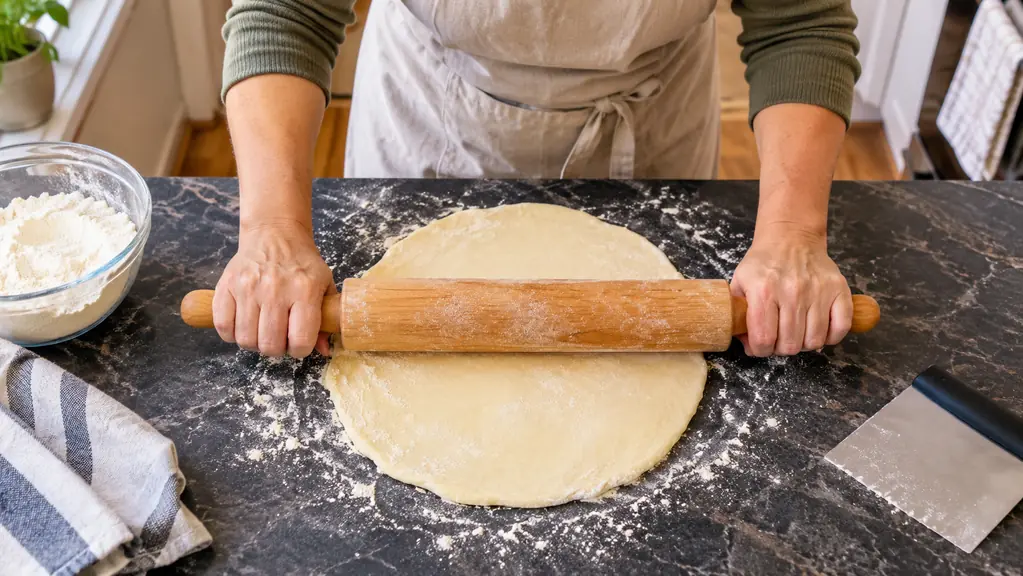
The place it earns its keep is a large disc of pie dough. Mine come out around twelve inches across, and an 18-inch pin spans that in one pass, so I am not patching and re-rolling. Every re-roll costs you flakiness. Fewer passes means a shorter gluten path means a crust that shatters instead of bending. This is the entire argument for a long pin, and it is the reason I would not go back to something shorter. My wine bottle was ten inches of glass with no handles, and I fought the dough every single time.
The Tuesday before Thanksgiving is the honest test, and I have now run it twice with this pin. I make four discs of crust at once, 300 grams of flour and 226 grams of butter per disc, cut together with the bench scraper, six tablespoons of ice water, then two hours in the fridge. On the day I pull one disc at a time and roll it cold. The first disc always fights me for about thirty seconds and then relaxes. With the wine bottle I never got past the fighting stage, because the glass had no handles and no length and I was pressing down to make up for both. The pin changed that in a way I did not expect. The dough relaxes because I am rolling evenly, not because I am stronger.
Cookie cutouts at Christmas are the opposite job. You want a light touch and a thin sheet, and one pound is light enough that I can feel the dough underneath the pin rather than pressing blind. I roll cutouts between two sheets of parchment, so the wood never touches the dough, and even then the length helps because I cover half a sheet pan in a single stroke. My sister Karen borrows the pin every December for her own cutouts, and she has said the same thing both years: it stays out of its own way.
The Specs, Translated Into Kitchen Terms
The listing calls it 18 inches. The dimensions read 17.5 inches long by 2.5 inches across. It weighs one pound. The material line says rosewood and the description says moisture-resistant hardwood, which is the part that matters more than the species name. Wood that takes on water swells, and a swollen barrel will not stay straight. I clean mine the way I was taught in the hotel kitchen, which is to wipe it with a damp cloth, dry it immediately, and never leave it soaking. Ten months in, it is still straight.
The handles are the part I did not expect to care about. They are shaped rather than plain round, and they flare slightly where the hand sits. In the hotel kitchen the pins were plain, and after a long session my grip would slide toward the barrel without my noticing. With this one my hands stay where I put them. I also did a crude straightness check when it arrived, the way you check a pool cue: I laid it on the flat of the counter and looked for light under the barrel. None. I repeat that check every few months now, because a pin that takes on water will bow, and a bowed pin rolls a crescent instead of a disc. So far it has stayed true.
Two and a half inches across is on the wide side of average for a home pin, and that shows up at the edges. A wider barrel gives you a longer contact patch with the dough, which means fewer passes but less fine control at the rim of a small tart. For a nine-inch pie plate I am rolling something close to twelve inches, so the width is a help. For a four-inch hand pie it is more pin than the job needs, and I find myself finishing the last inch with my fingertips instead.
Balanced end to end is a phrase from the listing and it is accurate here. Pick it up in the middle and it sits level. My old pin was handle-heavy and wanted to tip forward every time I set it down, which sounds trivial until you have chased a rolling pin across a counter with flour on your hands. The handles are shaped rather than plain round, and the shape gives my hands something to find without looking. My hands ache after a long session and I have not had a cramp from this one.
What I Liked
- Long enough to roll a twelve-inch pie disc in one pass
- One pound is light enough to feel the dough through the pin
- Balanced end to end, so it sits where you set it down
- The wood surface does not grab the way slicker materials can
- Nothing on it can strip or come loose, unlike my last pin
Where It Falls Short
- Needs wiping and immediate drying, never soaking
- No measurement markings, so exact rounds still need a ruler
- Two and a half inches wide is more pin than small hand pies need
- One pound is not enough mass for stiff, cold doughs
Where It Genuinely Falls Short
I have three real complaints and I want them on the record. First, wood needs attention that metal does not. If you are the kind of baker who rinses everything under the tap and walks away, this pin will not survive you, and that is not a defect in the pin. Second, there are no markings on it. When I want an exact ten-inch round for a tart shell I still reach for a ruler or a parchment template, because the barrel gives me nothing to measure against. A small annoyance, repeated every time.
Third, and this one surprised me, a light pin has limits. One pound does not do the work for you on a stiff dough. Roll out a firm cookie dough straight from the fridge and you will lean into it, and leaning into a light pin is how you roll unevenly. The heavier pin I used in the hotel kitchen years ago had heft that did the pressing for me. I did not expect to miss that at home. I miss it roughly twice a year, on the coldest doughs, and the rest of the time I do not think about it at all.
The stiff dough problem showed up in December, on a Sunday, with a batch of gingerbread for the church bake sale. I had chilled the dough overnight because the recipe says to, and it came out of the fridge hard enough to thump. I rolled the first quarter with the Farberware pin and it was work, real work, both hands and my shoulders, and the sheet came out uneven at the corners. What fixed it was not the pin. I let the dough sit on the counter for twelve minutes, cut it into smaller pieces, and rolled each one between parchment. The second batch was fine. The lesson is that a light pin wants the dough to meet it partway, and once I stopped asking it to do the pressing, the whole thing got easier.
And there is one more thing no listing mentions. Rolling pins do not come with a place to live. Mine goes in the drawer under the oven, which is why those four inches of clearance mattered so much. I measured the drawer the week the pin arrived, because I did not want to find out the hard way that it did not fit. Seventeen and a half inches end to end, handles included, and a divider running down the middle of the drawer that eats two more. So the pin goes in on a slight diagonal with the bench scraper alongside it. That is not a complaint, it is just what 18 inches means in a small kitchen. If your drawer is shallow or your counters are full, an 18-inch pin is a genuine commitment, and you should measure before you order rather than after it arrives.
I roll a twelve-inch pie disc in one pass, so I am not patching and re-rolling, and every re-roll costs flakiness.
The Weight Question Nobody Asks
When people ask me what pin to buy, they ask about material. Wood or marble or silicone or metal. The question that actually decides whether you will like the thing is weight, and it almost never comes up. A heavy pin presses the dough for you. A light pin asks you to press. Neither is better in the abstract. Heavy pins suit firm doughs, steady hands and generous counters. Light pins suit delicate pastry, thin sheets, and anyone whose wrists complain by the second tray of cookies.
At one pound, this Farberware pin sits clearly in the light camp. That is the right call for pie crust, for cutouts, and for anything where you want to feel the dough rather than flatten it. It is the wrong call if you make a lot of stiff gingerbread, or if you have shoulder trouble and want the tool to carry its own weight. Pie and cookies are most of what this house bakes, so I am content. I would not want it as my only pin if I rolled bread dough by hand, but I do not, because bread dough gets shaped.
Here is the number that made the weight question concrete for me. Christmas cutouts run about five dozen cookies in this house, rolled in four batches between two sheets of parchment. That is maybe forty minutes of continuous rolling. With the wine bottle my right forearm was finished by batch two. With this pin I get through all four and my hands are tired but not sore, mostly because the handles give me somewhere to hold that is not the barrel. When my wrist does start to complain I switch which hand leads, which is easy with a pin this light and much less easy with a heavy one that wants to go its own direction.
What I Do About Care
I wipe it with a damp cloth and dry it straight away. I do not soak it, I do not put it in the dishwasher, and I do not leave it leaning in a wet sink. Twice a year I rub it lightly with a food-safe oil and let it sit overnight before using it again. That is the whole routine. Ten months of that and the surface is still smooth and still not grabbing. The moisture-resistant claim is doing real work here, but no hardwood survives being left damp in a closed drawer, so the habit matters more than the wood.
One caution that comes from experience rather than from the listing. Do not cut on it. It is not a bench scraper and it is not a cutting board. I use my bench scraper for dividing dough and for lifting rolled pastry off the counter, and those two tools live in different places for a reason. Wood that gets scored by a knife holds flour in the cuts and never quite comes clean. Keep the pin for rolling and the blade for cutting and both will outlast your patience with them.
Who This Is For
This is for the home baker who rolls pie crust, cookie dough and the occasional hand pie, and who wants one plain tool that does the job with no learning curve. It suits a small kitchen because it is light and needs no stand or bracket. It suits someone replacing a pin with a cracked handle, which is exactly where I was. It suits anyone who has been rolling with a bottle and is tired of pretending that is fine. If you bake a few times a month and want a pin that will still be square in ten years, this is a reasonable place to land.
Who Should Skip It
Skip it if you want a heavy pin. Skip it if you roll large batches of stiff dough and you want the tool to do the pressing. Skip it if you cannot commit to wiping and drying, because a wooden pin left wet will fail, and it will fail in a way that looks like the product's fault when it is not. Skip it if you need measurement markings, since it has none. And skip it if your storage will not take an 18-inch length, because a pin you cannot put away is a pin you will stop using, and that is the worst outcome of all.
None of that is a knock on the Farberware pin. It is a plain hardwood pin doing a plain hardwood job, and it does that job for me most weekends without asking for anything. The honest version of this review is that I would buy it again, that I would measure my drawer first, and that I would still keep a ruler nearby for tart shells. If that sounds like your kitchen, you already know what to do next.
If your pin has a cracked handle, this is the replacement
18 inches of moisture-resistant hardwood, one pound, balanced end to end. Ten months of weekend baking and mine is still straight. Wipe it, dry it, put it back in the drawer.
Amazon Check Today's Price on Amazon →