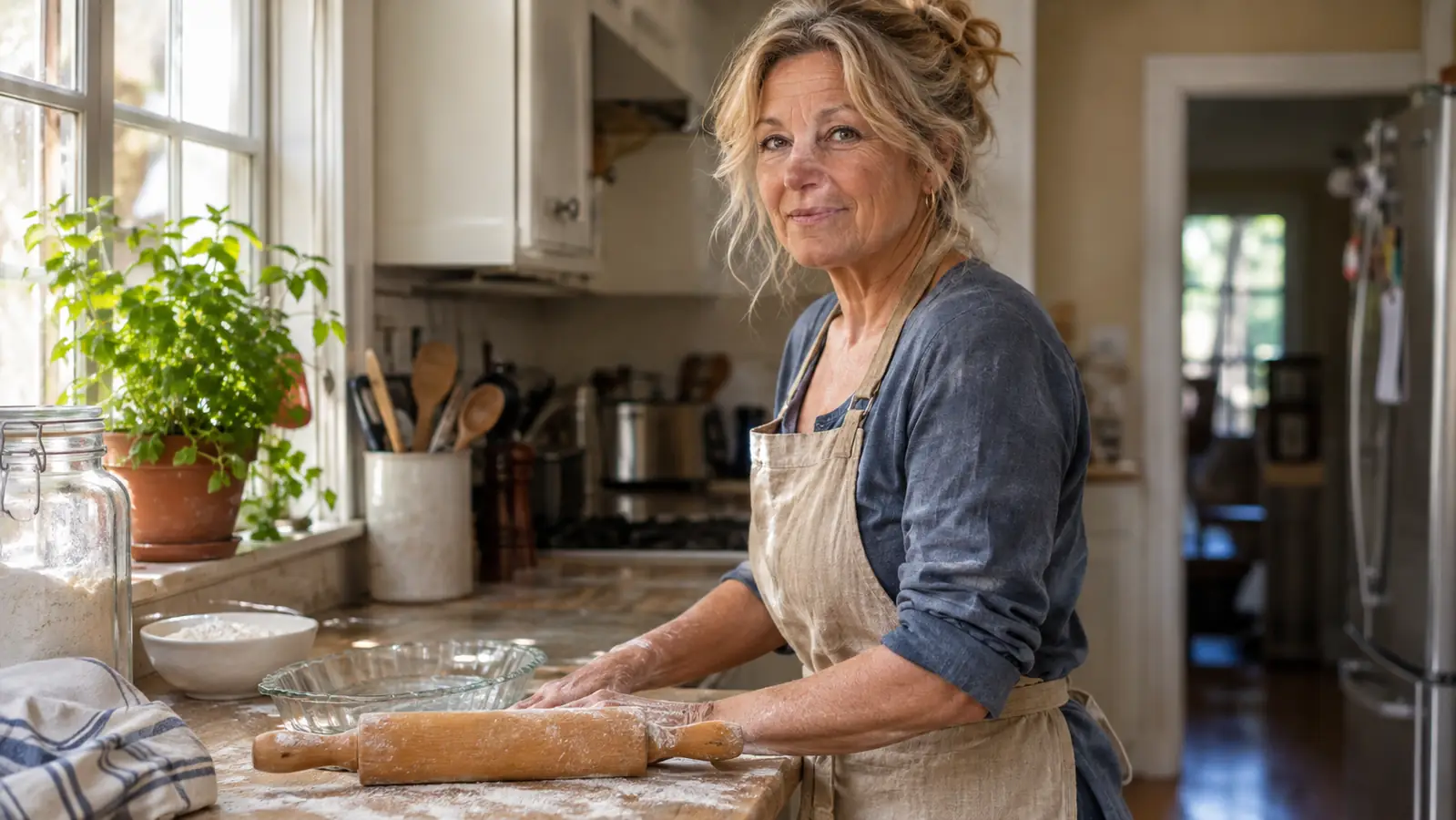
For three years, my rolling pin was a wine bottle. Not as a joke, and not as some charming story about making do. It was the honest state of my kitchen. The cheap pin I bought in my twenties had split at the handle, the split widened every time I leaned on it, and I never got around to replacing it. So I rolled pie dough with an empty bottle and told myself it worked fine. It did not work fine. The dough stuck. The pressure was uneven. My crusts came out tough in patches and thin enough to tear in others, and I blamed my flour, my butter, my technique, everything except the thing I was holding.
Ten months ago I finally bought a real one: the Farberware classic wood rolling pin, the 18-inch model with handles. I bake most weekends and a couple of weeknights, in a Baltimore rowhouse with a galley kitchen and about six feet of counter, and I trained in pastry before I ever had a kitchen of my own. So I am not neutral about rolling pins. I am also not easy to impress. In the ten months since it came out of the box, this pin has rolled pie crust, sugar cookie cutouts, hand pies and a good deal of pizza dough, and it has never once been the reason something went wrong.
The Quick Verdict
A plain, well-balanced wood pin that rolls level and does not fight you. Ten months of weekend baking and it has not warped, split or gone rough. If you already own a tapered French pin you like, you do not need it. If you own nothing worth rolling with, start here.
Amazon Check Today's Price →The pin that finally retired the wine bottle
17.5 inches of moisture-resistant hardwood, one pound, and handles that turn under your hands instead of making your wrists do the work. Ten months of my own weekend baking, still rolling true.
Amazon Check Today's Price on Amazon →How I've Used It
It lives in the drawer under the oven, which is the only drawer in my kitchen long enough to take it. That drawer also holds parchment, a roll of plastic wrap and a set of measuring spoons, and the pin fits with roughly an inch to spare. Getting it out is a two-second job, which matters more than it sounds. A tool you have to dig for is a tool you stop reaching for.
The first thing I rolled with it was a double crust apple pie for a Sunday dinner in early October, the weekend the weather finally turned. I had been using the bottle for so long that I had built compensations into my technique: rolling from the centre out in short bursts, lifting and turning constantly, dusting far more flour than I wanted to. With this pin I rolled the bottom crust in about four passes. Same dough, same butter, same ice water. The difference was that the pin did the spreading instead of me pressing. Paul, who does the dishes and therefore has opinions about flour on every surface, noticed the counter was cleaner.
Since then it has handled sugar cookie cutouts at Christmas, a batch of hand pies in February, several pizza doughs, and one very large round of pie dough that I froze flat and slid into a bag. Ten months in, the surface is still smooth and it has not gone fuzzy or raised a grain anywhere. Farberware describes the wood as moisture-resistant hardwood, and I have not tested that with anything dramatic. I have simply kept it dry, which is the whole of my care routine.
The pizza was the smaller surprise. I make a slack, wet dough that fights back on the counter, and with the bottle I used to end up with a lopsided oval that baked unevenly at the edges. Now I press the disc out with my fingertips, then take three or four passes with the pin and get something close to round. I do not need a perfect circle for a home oven. I need the middle and the rim to be roughly the same thickness so the whole thing bakes through at once, and that is what I get.
What 17.5 Inches and One Pound Actually Change
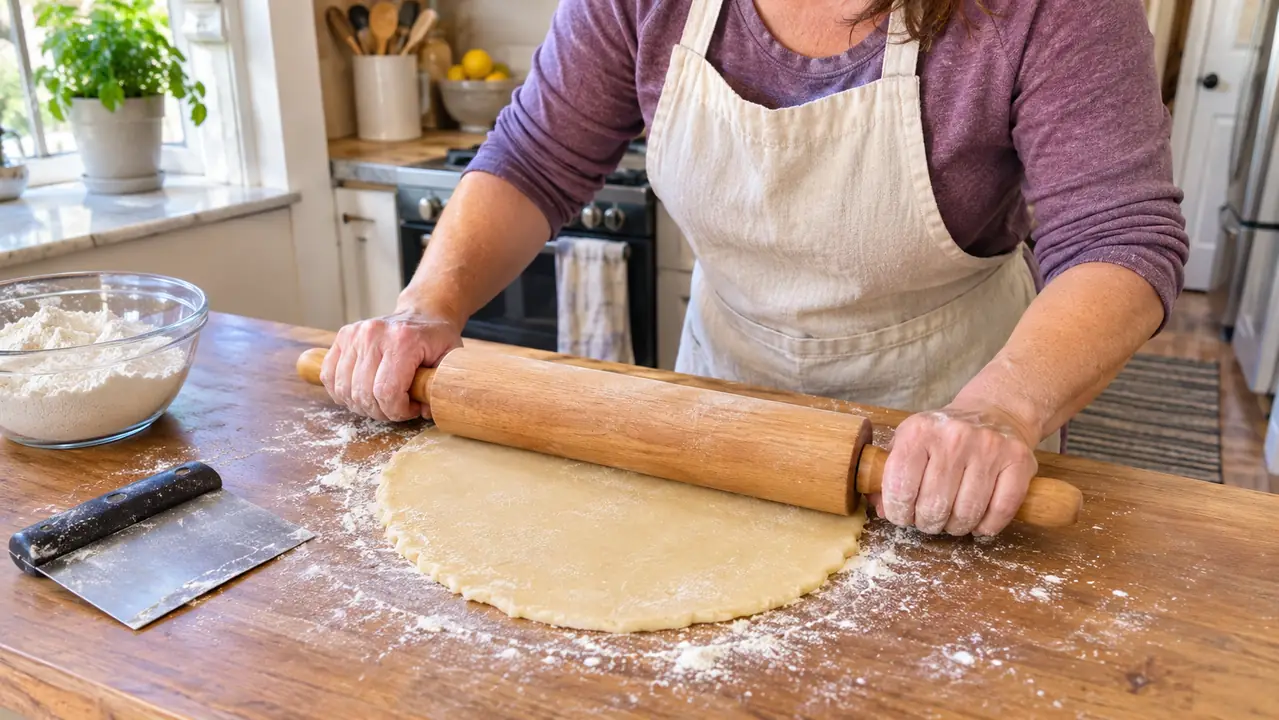
The listing gives the dimensions as 17.5 inches long and 2.5 inches wide, with a weight of one pound. Those numbers read like paperwork. They are not. Length is the number that decides whether you can keep both hands out on the handles through a full pass. On a short pin, your hands creep inward as you work and end up over the dough, and the moment your palms are over the dough you are pressing unevenly. At 17.5 inches I can keep both hands where they belong across the entire width of a pie crust and never touch the rolling surface.
Width matters for a duller reason: fewer passes. A 2.5 inch rolling surface spreads a wider band of dough per stroke, so you reach your thickness before the dough has time to warm up and go sticky. On a hot August afternoon in a kitchen with one small window, that is the difference between a crust that behaves and a crust that has to go back into the fridge twice. I tested this without meaning to last summer, when I made hand pies on the hottest day of the year and got the whole sheet rolled in under two minutes. Two years earlier, same recipe, same day on the calendar, same warm kitchen, I gave up and put the dough away.
The one pound weight is the part I had to relearn. My instinct, after years of a cheap light pin, was to push. This one does not need pushing. Its own weight does most of the flattening, and my job is to guide it and keep the pressure even from end to end. When I press hard, I get thin edges and a thick middle. When I let the pin's weight work, the round comes out level. That took me three pies to believe, and I still catch myself leaning on it when I am in a hurry.
The Handles, and What My Wrists Notice
The pin has handles at both ends that turn independently of the rolling surface, which is the entire point of the design. My hands stay still and the barrel rolls under them. Compare that to the tapered French pins I used for years in a hotel pastry kitchen: you drive those with your palms directly on the wood, and you feel every ridge and soft spot in the dough through your hands. French pins give you more information. Handled pins give you less fatigue. After a long shift of laminating, fatigue is what ruins your last tray, not lack of information.
Farberware says the handles are balanced end to end. I did not take that on faith. I laid the pin across the flat of my bench scraper, watched which way it tipped, and it sat level. It is a small test, but an unbalanced pin rolls a curve into your dough no matter how careful you are, and it is one of the few defects you can check for in ten seconds at the counter.
My hands are not large. I mention that because handle size is where a pin either fits you or does not, and I cannot tell you whether it will fit yours. What I can tell you is that after an hour of repetitive rolling for cutouts, my forearms are tired from standing at the counter, not sore from gripping. That was not true of the pin this one replaced.
One thing I did not expect: the handles change how I lift the pin between passes. With the bottle I was always lifting and setting down with my whole arm, because there was no good place to hold it. Here I can keep the pin down and just walk my hands back for the next stroke. Over four sheets of Christmas cutouts, that is a lot of motion I am no longer doing.
How It Handles the Doughs I Actually Bake
Pie crust is the test that matters to me. Cold butter, ice water, minimal handling, and the dough wants to fight back. This pin rolls it cold without dragging. The surface is smooth enough that I use noticeably less bench flour than I used to, and less bench flour means a more tender crust. That is the entire game with pie. If you take one thing from this review, take that: the tool changes how much raw flour ends up inside your dough.
Sugar cookie cutouts want the opposite thing. They want even thickness across a large sheet so that the small shapes and the big shapes bake at the same rate. This is where the length earns its keep. I roll a full sheet to a uniform eighth of an inch and cut the whole thing without re-rolling scraps, and re-rolled scraps are always the toughest cookies on the tray. At Christmas I do four sheets back to back and the pin never once needs a rest.
Hand pies and pizza are both about a round or a square that stays even out to the edge. This pin gets there, and it gets there faster than anything else I have used at home. It has one honest limitation: it rolls flat, so it cannot give me a round that is thicker in the middle and thin at the rim, which is exactly what a free-form tart wants. For that I shape the thickness by hand with my fingertips. I do not count that as a fault. It is the trade you make for the handles and the even pressure.
Care, Storage, and the Two Things I'd Change
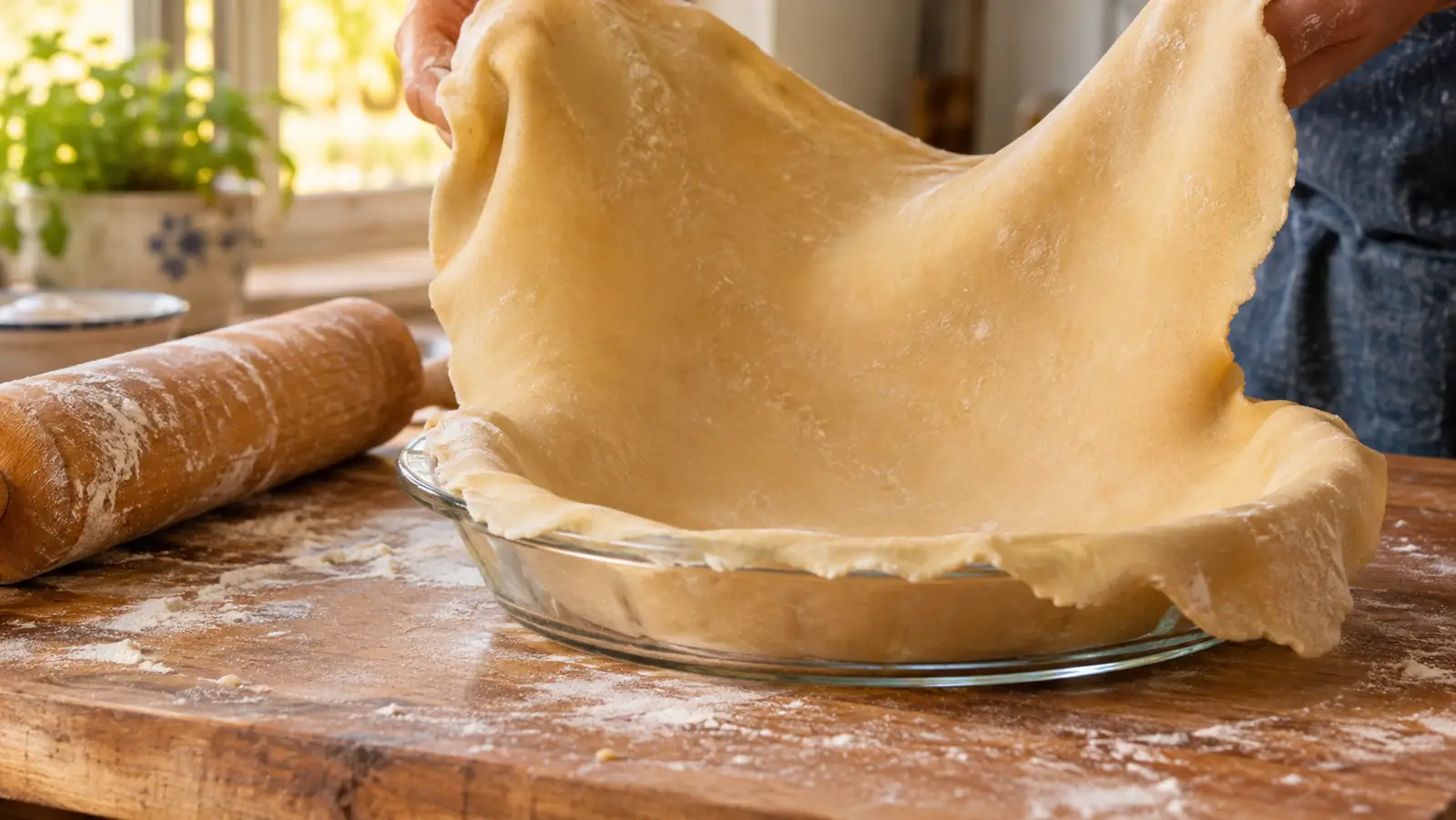
I wipe it with a damp cloth, dry it immediately, and put it back in the drawer. I never leave it standing in water and I never put it away wet. Wood that stays wet swells, and a swollen pin does not roll true. The moisture-resistant hardwood is doing real work, but it is not a licence to soak the thing overnight and hope.
The storage problem is mine, not Farberware's. At 17.5 inches it does not fit sideways in a standard drawer, and in a small kitchen that is a genuine constraint. If you have a deep drawer, a crock on the counter or a tall utensil bin, no issue at all. If your only drawer is 14 inches deep, measure before you buy, because this will not go in it.
The second thing is the absence of any markings. There are no thickness rings, no guides, nothing printed on the rolling surface. If you want consistent thickness you develop an eye for it, or you lay two dowels on either side of the dough and let the pin ride on them, which is what I do for cutouts. A pin with rings would be faster. It would also be a different product at a different price, and I would rather have the smooth surface.
The care habit took me about a week to build and one reminder to learn. I came home late from a weeknight of rolling out dough for a quiche, left the pin on the drying rack next to the sink, and found it the next morning with a dull patch where a splash had sat. It dried back to normal within a day, and I have not done it since. That is the whole risk with wood: not that it fails outright, but that small lapses accumulate.
What I Liked
- Rolls level and stays level after ten months of weekend use
- Handles turn freely, so the wrists do the guiding instead of the gripping
- The 17.5 inch length keeps both hands off the dough through a full pass
- One pound of weight means you steer the pin rather than press it
- Smooth surface needs less bench flour, which makes a more tender crust
- Wipes clean and has not gone rough, fuzzy or raised a grain
Where It Falls Short
- Too long for a shallow drawer, so measure before you buy
- No thickness markings on the rolling surface
- Rolls flat, so it cannot taper a tart shell for you
- Wood needs prompt drying, so it is not a leave-it-in-the-sink tool
Ten months, four pies, six batches of cutouts, and when I sight down the length of this pin it is still dead straight.
Who This Is For
You bake pies, tarts, cookies or pizza at home more than a few times a year, and you are rolling with something that was never designed for the job. A bottle. A glass. A short pin that walks sideways across the counter. This is the plain upgrade, and it is the one I would hand to a beginner without hedging, because a handled pin is more forgiving while you learn to let the tool carry its own weight instead of shoving it.
It also suits anyone whose hands or wrists complain after a session of rolling. The handles take the grip out of the work. My sister Karen has been rolling Christmas cutouts with a drinking glass for two years, and I have been quietly steering her toward this pin for most of them. She borrows mine every December, which tells you what she thinks of it.
Who Should Skip It
If you already own a tapered French pin and you like it, you do not need this one. You have a pin that gives you more feedback through your palms and can thin a tart shell at the rim, and the only thing you would gain here is less wrist fatigue. That is not enough reason to give up the drawer space. I keep saying that because it is true, not because I am being modest about a tool I clearly like.
Skip it too if your kitchen has nowhere to put a 17.5 inch tool, or if you make laminated doughs like croissants more than occasionally. Lamination wants a pin you drive with your palms, and handles slow that work down. And if you are the sort of baker who leaves tools in the sink until morning, buy something you can abuse instead. Wood rewards a thirty-second habit and punishes the lack of one.
Ten months in the drawer, still dead straight
If you are still rolling dough with a bottle or a glass, this is the cheapest real improvement you can make to your pastry. Measure your drawer first. Then stop compensating for your tools and start baking.
Amazon Check Today's Price on Amazon →