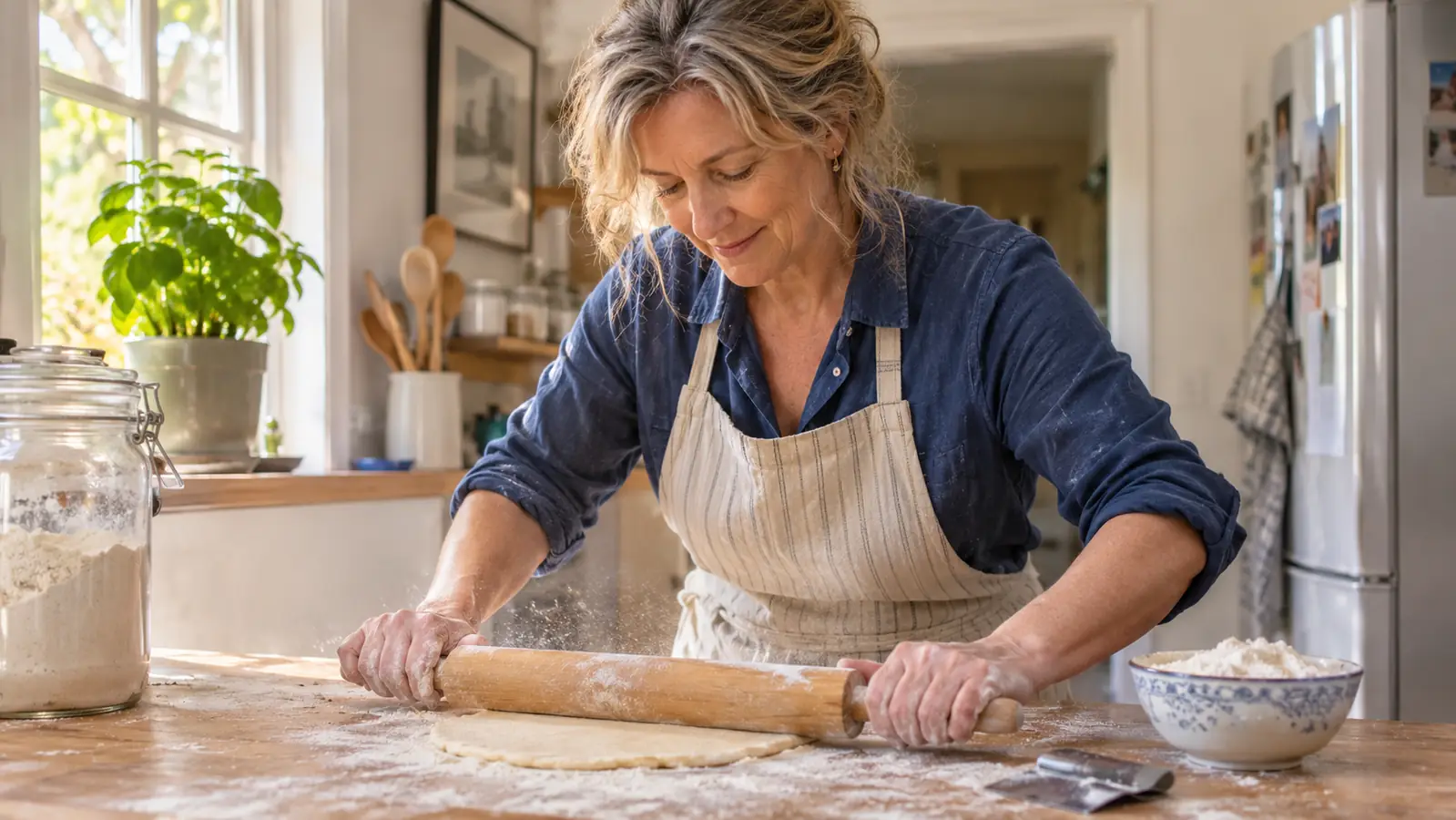
Short answer first: for the way most home bakers actually roll dough, the Farberware Classic Wood Rolling Pin is the easier tool to live with. It has handles, it is balanced end to end, and it does not ask you to relearn how your hands work. Mine has lived in the drawer under the oven for about ten months, and in that time it has rolled apple pie for Thanksgiving, sugar cookie cutouts at Christmas, and a long string of hand pies for the church bake sale. But I spent seven years in a hotel pastry kitchen rolling laminated dough on a French tapered pin, and I will not pretend the tapered pin is the lesser tool. It is a different tool, and the differences show up in specific places.
The two get framed as beginner versus professional, and that framing makes the choice harder than it needs to be. One pin is built around handles. The other is built around your palms sitting on bare wood. Almost everything else follows from that single design decision: the length, the way it cleans, the way it behaves when the dough has warmed up and gone soft. So rather than rank them, here is where each one earns its place on six feet of Baltimore counter.
| Farberware Classic Wood Rolling Pin | A French Tapered Pin | |
|---|---|---|
| Grip and hand fatigue | Two shaped handles, balanced end to end, so your hands stay relaxed on a long bake | No handles. Your palms ride the barrel and your wrists take more of the load |
| Feel for dough thickness | Handles put a layer between your hands and the work | Palms on the wood, close enough to feel a thick spot before you see it |
| Rolling surface | Moisture-resistant hardwood with a smooth, non-dragging face | One continuous piece of hardwood, no seam from end to end |
| Length and drawer fit | About 17.5 inches, which clears a standard kitchen drawer | Usually a longer one-piece barrel, awkward in a shallow drawer |
| Cleaning | The joint where each handle meets the barrel collects flour | Nothing to trap flour. A wipe and it is done |
| Learning curve | Familiar from the first pie. You press, it rolls | The taper wants you to work in arcs and use the ends deliberately |
| Cost | A common classic, easy to replace without a research project | One-piece hardwood pins generally run higher at the same length |
| Best for | Pie crust, cookies, hand pies, everyday weekday rolling | Laminated dough, pizza, bakers who work by feel |
How I Came to Compare Them
Before this one I rolled with a short cheap pin, the kind where a handle threads into the barrel. The handle cracked at the thread, and for about three years after that I rolled pie dough with a wine bottle, which works better than it sounds and worse than you would like. About ten months ago I bought the Farberware pin, mostly because it was the pin every home baker I know already owned and I wanted to stop improvising on Thanksgiving morning. The French pins I know from the other side. The hotel kitchen kept three of them, and every batch of croissant and danish dough went through those, never through anything with handles.
A French tapered pin is one piece of hardwood, thicker through the middle and tapering toward both ends, with no handles and no moving parts. You hold it with both palms flat on the barrel and you move your hands inward and outward as you work. After seven years of that it becomes automatic, the way a chef knife becomes automatic. At home, on a Tuesday night with one pie to get into the oven before bed, I wanted something that did not require a warm-up. That was the honest reason I chose the handled pin, and ten months later I still think it was the right call for my kitchen.
Where the Farberware Wins
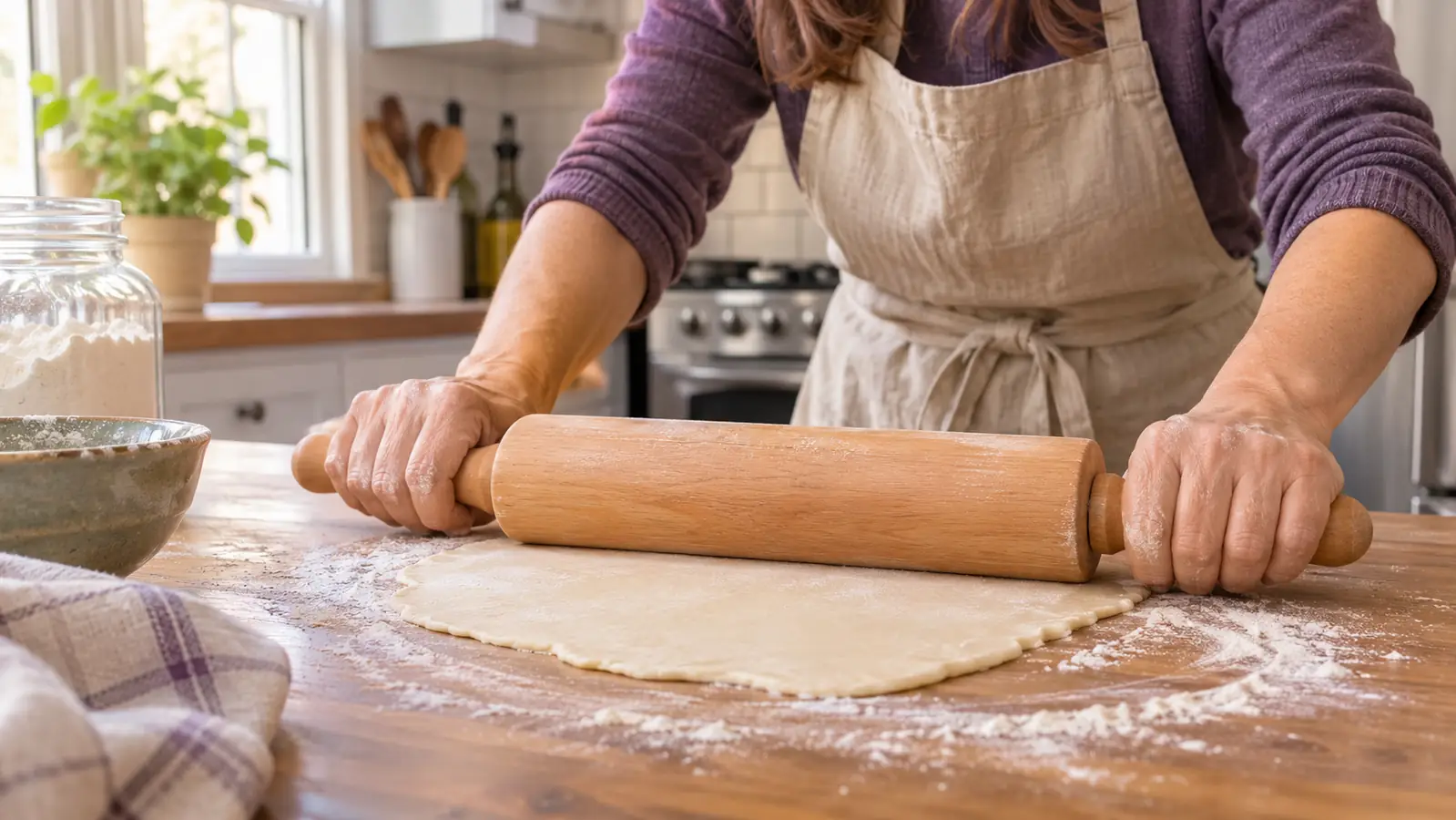
Handles sound like a small detail until you roll four dozen sugar cookies in one afternoon. The handles on this pin are shaped so your hands wrap them rather than pinch them, and because the pin is balanced end to end, the pressure stays even from the first sheet to the last. The old cracked pin had taught me what happens without that: my wrists did the work the tool should have been doing, and by the third tray my rolling had gone ragged at the edges. With this one I finish the batch and my hands are fine. That is not a luxurious claim, it is the whole reason a handled pin exists.
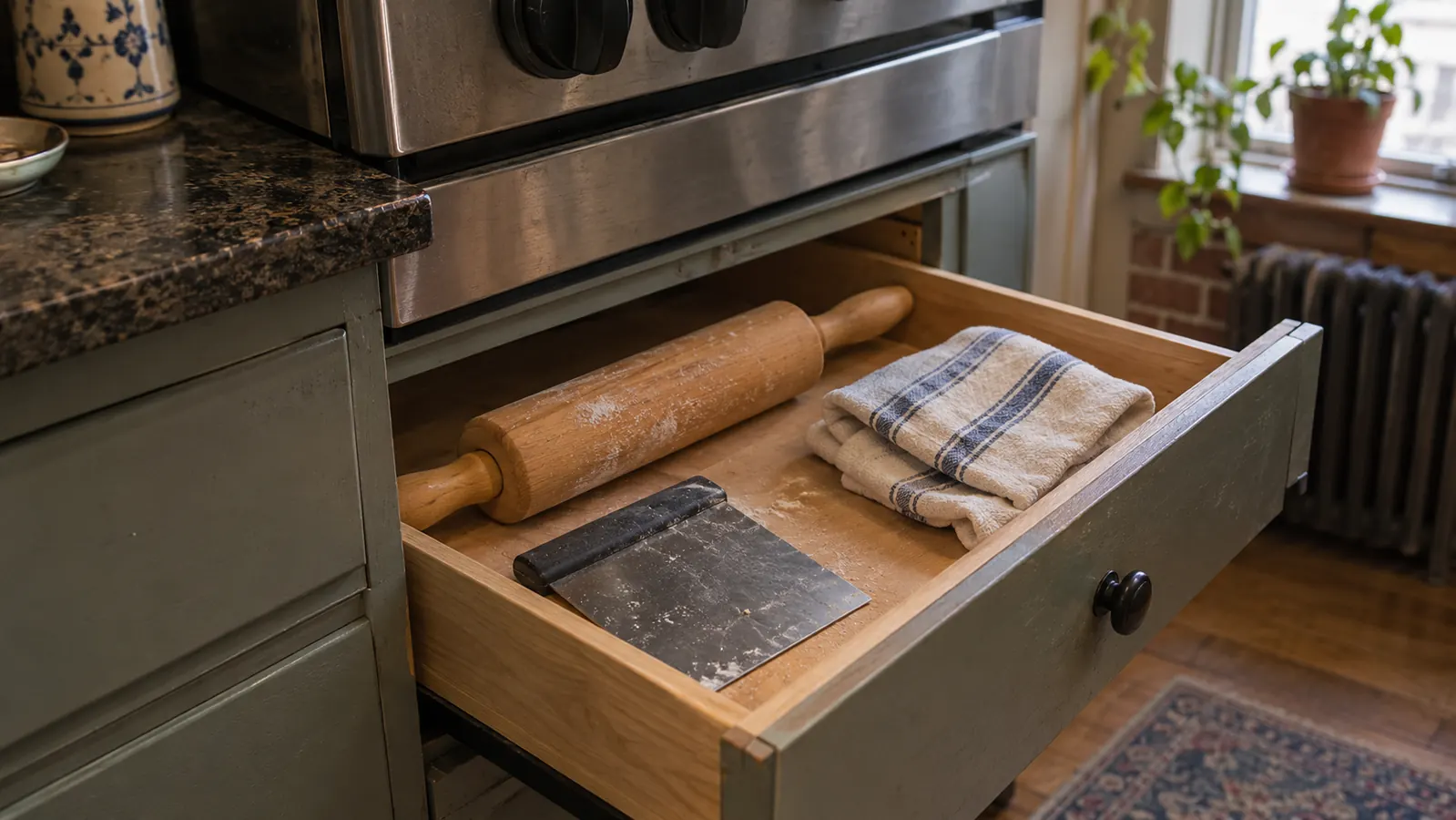
The second win is size. The pin runs about 17.5 inches including the handles with a barrel roughly 2.5 inches across, so it lies flat in the drawer under my oven with room for the scraper next to it. In a galley kitchen with one pantry cabinet and a single stretch of counter, a tool that stores without a negotiation is worth more than any line on a spec sheet. The third win is that it is an ordinary, widely sold classic. When a tool is that common, replacing it is not a project, and you can spend your attention on the dough instead.
Where a French Tapered Pin Wins
Feel. That is the entire argument, and it is a real one. With your palms on the barrel you are a fraction of an inch from the dough, and you can feel a thick spot in a pie crust before it turns into a tough patch. Under your hands, cold butter pieces announce themselves. With handles there is a layer between you and the work, and you learn about unevenness with your eyes instead of your palms. For laminated dough this is not a small edge. You are rolling cold butter between layers and you need to feel resistance building before the butter breaks through the dough, and the tapered pin tells you sooner.
Cleaning is the other honest win. One piece of wood has no joint for flour to settle into, so a dry wipe finishes it. The Farberware has a seam at each handle where the barrel meets the grip, and flour does collect there. A pastry brush takes care of it, but it is a step, and I notice it more in a week when I have baked three times. The taper earns its keep at the counter too: you push from the middle outward in arcs rather than bearing straight down, which keeps a round crust round and keeps you from stretching the gluten as you finish the edges. Roll a small circle of dough with the narrow end and you get control that a barrel the same width at both ends cannot give you.
Rolling with a wine bottle taught me what a bad pin actually costs you. The tool should do the pressing. When it cannot, your wrists do it, and the crust goes uneven around the edges.
The pin I reach for on an ordinary Tuesday night, not just at Thanksgiving
Handles, balanced end to end, a moisture-resistant hardwood face, and about 17.5 inches so it disappears into the drawer under the oven. Nearly 22,600 ratings and a 4.7 average, which is roughly what you would expect from a tool this plain and this common.
Amazon Check Today's Price on Amazon →What Each One Does to a Real Pie Crust
My pie dough is weighed, not scooped, because volume measurements of flour swing too far to trust. Once the butter is cut in cold and the ice water is in, the disc rests in the fridge for at least two hours, and the rolling happens on a lightly floured counter with the bench scraper within reach. That setup is the same no matter which pin is in my hand, and it is worth saying plainly: the pin does not make the crust. Cold butter, a rested dough and a light hand make the crust. The pin decides how much of that you can feel while you work.
With the Farberware I work from the center out with steady pressure and let the weight of the pin do most of it. The handles let me lean in with my body rather than squeeze with my fingers, which keeps the thickness even across a twelve inch round, and the smooth hardwood face releases cleanly with only a light dusting of flour. If I over-flour the counter the crust gets a little stiff and I feel it as drag rather than as resistance in my hands, which is the tradeoff. On a warm kitchen day the crust can go from right to slightly soft without much warning, and I have learned to check it with a fingertip rather than wait for the pin to tell me.
With a tapered pin I work in short arcs from the middle and rotate the dough a quarter turn between passes, and the dough stays rounder with less coaxing. I use less downward force because the motion is more sideways, and on a delicate crust that shows up as fewer thin spots near the edge. The tapered ends let me work a smaller piece, a hand pie or a scrap of trim, without dragging the full barrel across it. Either way the dough gets lifted with the bench scraper rather than pulled up with my hands, because pulled dough stretches and stretched dough shrinks back in the oven.
Care, and the Six Feet of Counter Problem
Neither pin wants water. I wipe the Farberware with a barely damp cloth after use, dry it immediately, and lay it in the drawer under the oven only once it is fully dry. It never goes in the sink and never near the dishwasher. The hardwood is moisture resistant, which is not the same as waterproof, and a pin that soaks up water will eventually rough up and start grabbing at dough. Every few months I rub a little food safe mineral oil into the barrel while I am already oiling the cutting boards, and that is the whole maintenance routine.
Storage is where the two styles genuinely part company in my kitchen. The 17.5 inch handled pin fits the drawer under the oven, which is the only wide drawer I have. A French pin of the same working length is longer overall, and the ones I used in the hotel kitchen were longer still, so a tapered pin would have to live on the top shelf of the pantry or hang on a hook. That is not a deal breaker, but in a rowhouse kitchen with one pantry cabinet it is a consideration I would have to solve before I bought one for myself.
What I Liked
- Handles reduce hand fatigue on long baking afternoons
- Balanced end to end, so pressure stays even across the round
- Moisture-resistant hardwood face releases dough with a light dusting of flour
- About 17.5 inches, so it fits a standard kitchen drawer
- Common and easy to replace, which keeps it a low risk purchase
Where It Falls Short
- The joints at each handle collect flour and need brushing out
- You feel less of the dough than you would with bare wood under your palms
- Not the better choice if you roll laminated dough every week
The One Case for Owning Both
If you bake laminated dough at home, croissants or danish or a proper puff pastry, the tapered pin is not a luxury, it is the correct tool, and you should own one for that reason alone. Most home bakers in my experience are not rolling lamination weekly. We are rolling pie crust a handful of times a year, cookie dough through December, and hand pies when the church bake sale comes around. A handled pin covers that whole list comfortably, and if a tapered pin later joins it in the drawer, the two are not fighting for the same job. One is for feel. One is for volume of work.
Who Should Buy Which
Buy the Farberware if you bake in ordinary home quantities, if your counter space is limited, if you have ever finished a batch of cookies with sore hands, or if you are replacing a pin that cracked and you want something plain that will outlast the recipe book you bought it for. It is the pin I would hand to my niece Maddie when she starts rolling dough for herself, and it is the one I would tell my sister Karen to buy without thinking about it further.
Buy a French tapered pin instead if you already know your way around dough and you want to feel it, if you roll pizza and laminated pastry more than you roll cookies, or if you have the drawer or hook space for a longer one-piece pin and you do not mind brushing flour off nothing but wood. If you are honestly in between, start with the handled pin, and add the tapered one later when a specific bake asks for it. That order costs you nothing and it keeps you baking while you decide.
Start with the pin that fits the drawer you actually have
Moisture-resistant hardwood, ergonomic handles, balanced end to end, about 17.5 inches. Mine has rolled ten months of pies, cutouts and hand pies without a wobble. Four point seven stars across more than twenty two thousand ratings.
Amazon Check Today's Price on Amazon →