

I baked with measuring cups for twenty years. Scoop, level with the back of a knife, into the bowl. The cookies were good, the pie crust was decent, and I did not think anything was broken. Then I spent seven years in a hotel pastry kitchen, and in my first week the chef moved the cups to a shelf I could not reach and put a scale where they had been. I did not understand yet that the cups were the reason two batches of the same cookie could come out different heights, or why my pie crust was tender in October and tough in January. I just thought baking was like that.
Here is the part that convinced me. A cup of all-purpose flour weighs somewhere between 120 and 145 grams, depending on whether you scoop it packed from the bag or spoon it in light. That is roughly a fifth of the flour in the bowl, and a fifth more or less flour is a different cookie, a different cake, a different crust. A scale takes that variable off the table entirely. The Etekcity digital kitchen scale has been the one on my counter for about two years now, and it is the first tool I would replace if it walked off.
Stop Guessing What One Cup of Flour Means
Weighs up to 11 pounds in 1 gram steps, tares back to zero between ingredients, and wipes clean with a damp cloth. Two years on my counter and it has never needed anything but batteries.
Amazon Check Today's Price on Amazon →Step 1: Give the Scale a Hard, Flat Home
A scale measures how hard gravity pulls on whatever sits on the platform. Put it on a soft or tilted surface and the platform flexes or leans, and the number drifts while you watch it. My kitchen is a Baltimore rowhouse galley with about six feet of counter, so every inch is spoken for, and the scale still gets a permanent flat spot beside the mixer. It is the one tool that never goes back in a drawer between bakes.
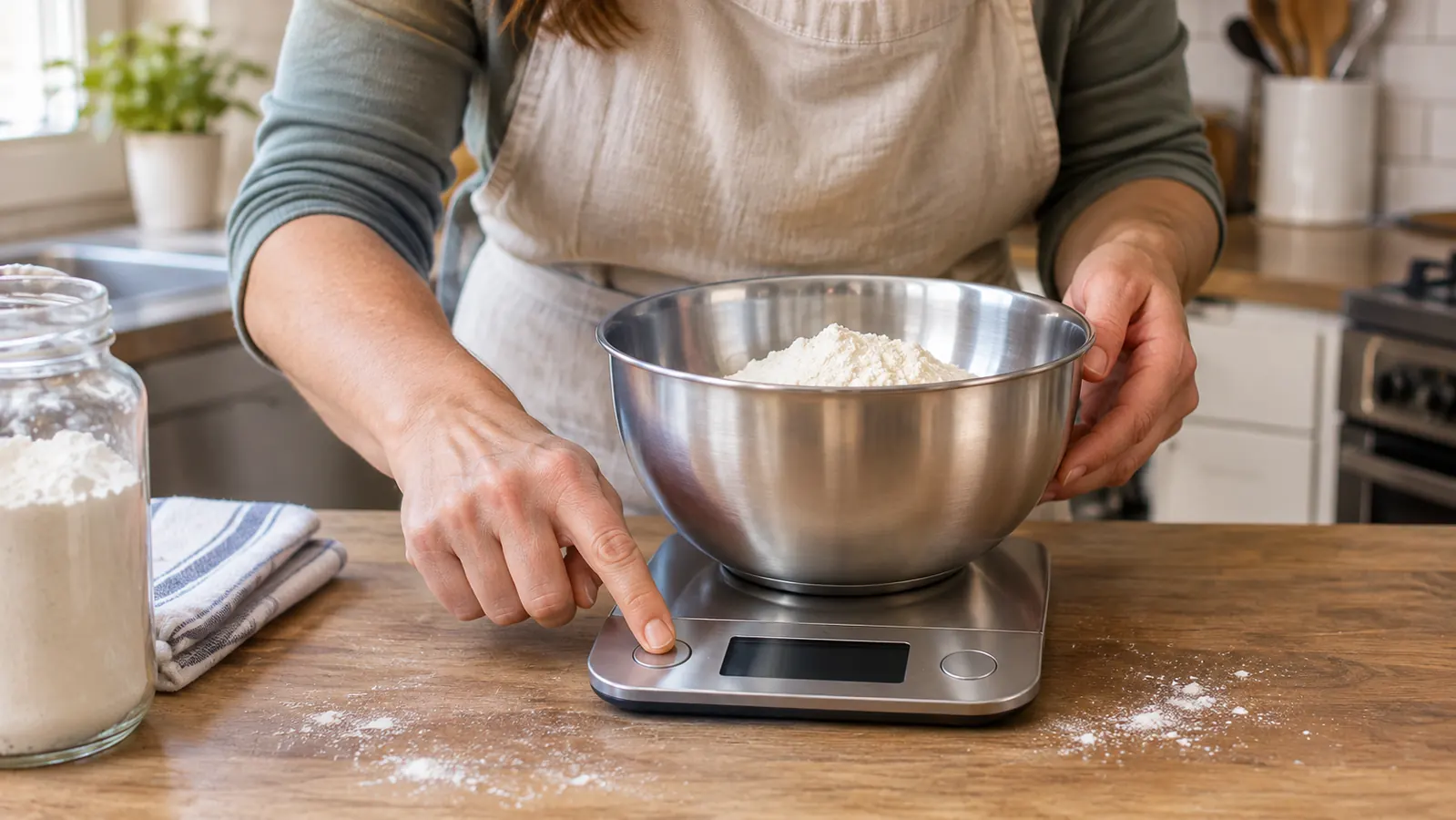
Turn it on and let it settle at zero before anything goes on. The backlit LCD reads easily at an angle, which matters once a bowl is sitting on the platform and you are looking down at it from the side rather than straight on. If the readout does not come back to zero on its own, press tare once and wait a beat. If it drifts while an empty bowl sits there, suspect the counter or the seam under the platform before you suspect the electronics.
For storage, the whole Etekcity scale weighs 200 grams and takes up less shelf than a dinner plate. Mine slides into the pantry cabinet in the gap behind the flour canister. That sounds like a small thing and it is not, because in a narrow kitchen a tool that has to be unpacked from a box every time does not get used on a Tuesday night when you are tired and the cookies are for tomorrow.
Step 2: Tare Between Every Ingredient, Not Just at the Start
The tare button sets whatever is on the platform back to zero, so you can keep building in one bowl. Bowl on, tare, flour, tare, sugar, tare, salt. Fewer bowls to wash, and one running record of exactly what went in. This is the habit that makes a scale faster than cups rather than slower, and it takes about three bakes to become automatic.
There is a limit worth knowing. The readout moves in 1 gram steps, so each tare carries a small rounding error, and errors stack across six or seven ingredients. For a batch of chocolate chip cookies I do not care. For a laminated dough, or a layer cake for my niece Maddie's birthday, I weigh the dry ingredients into one bowl, tare, then weigh the butter in a second bowl so the two big numbers stay clean and I am not chasing a few grams at the end.
Here is what the conversion actually looks like. A cookie dough written in cups reads 2 1/4 cups flour, 1 cup butter, 3/4 cup granulated sugar, 3/4 cup brown sugar, 2 eggs, 2 cups chocolate chips. Written in grams at 125 grams per cup of flour, the same dough reads 280 grams flour, 227 grams butter, 150 grams sugar, 165 grams brown sugar, about 100 grams of egg, 340 grams chocolate chips. Once it is in grams, doubling the recipe is arithmetic rather than interpretation.
Order matters for cleanup too. Dry things first, then fats, then anything sticky like honey or molasses last, so you are never scraping a sticky bowl to get at the flour. If you are portioning dough, skip the bowl: tare a sheet of parchment, drop dough balls onto it, and read the weight of each one as it lands. Even cookies bake evenly when they start at the same weight, and a tray where every ball is 30 grams browns in one pass instead of two.
Step 3: Weigh Liquids in Grams and Treat Milliliters as a Water Shortcut
The Etekcity reads in grams, ounces, pounds and ounces, fluid ounces and milliliters. I use grams for everything, liquids included, because a gram is a gram whether it is milk, water or honey. Fluid ounces and milliliters are volume wearing a weight costume, and that is where the confusion starts.
Milliliters on a scale assumes the density of water. Water is 1 gram per milliliter, so the shortcut is exact for water and close enough for milk and juice. Honey is closer to 1.4 grams per milliliter, which means a recipe asking for 200 milliliters of honey wants about 280 grams. Weighing in grams is the only way to know that, and it is why volume measurements of syrups go wrong so quietly. The dough looks fine and the bake comes out dense.
Bread is where this pays off most. One loaf of plain yeasted sandwich bread is roughly 500 grams of flour and 320 grams of water, and if you weigh both you can change the flour or the day's humidity and still know what you are working with. Weigh the water into the bowl first, tare, then the flour on top. Nothing sticks to the stainless steel surface anyway, so cleanup is a wipe with a damp cloth rather than a soak.
One habit that saves me every winter: write the water weight on the recipe card next to the flour weight. Humidity in Baltimore in July and Baltimore in January are not the same kitchen, and a dough that needed 320 grams in August may want 340 in February. If the numbers are already on the card, you adjust one thing instead of rebuilding the whole formula in your head.
Step 4: Pick One Flour Number and Write It Into Your Recipes
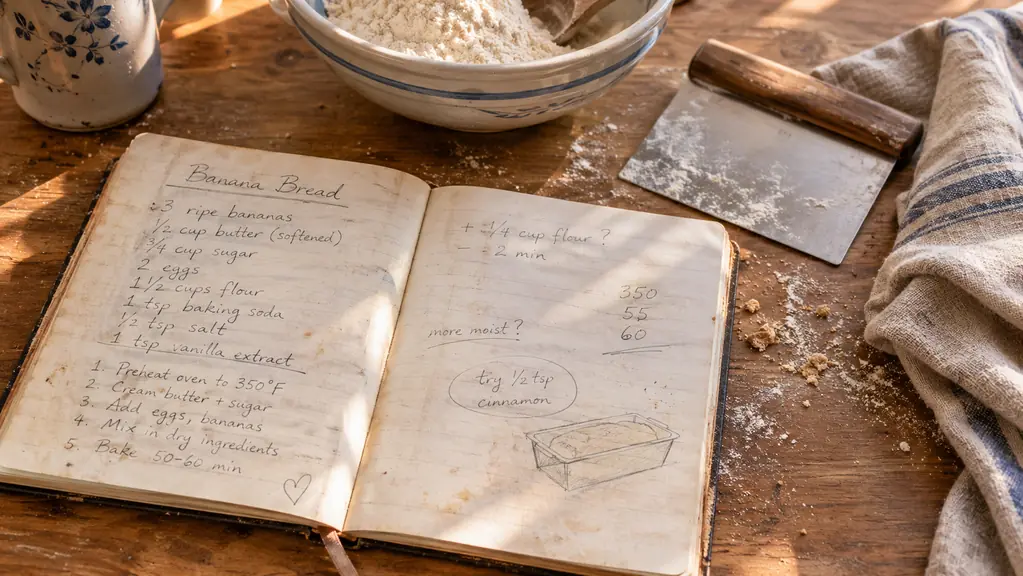
Convert once, deliberately, then stop converting. Flour is the ingredient that swings most by volume, and the common gram weights for one cup of all-purpose land at 120, 125 or 140 depending on which book you open. Pick one number, write it in the margin of your own recipe, and use it every time. Consistency matters more than which of those three you choose, because your oven and your ingredients are already tuned to your own hand.
Do this for the recipes you actually bake, not for a binder of forty. Mine are chocolate chip cookies, an apple pie at Thanksgiving, a plain yeasted sandwich bread, dinner rolls, sugar cookie cutouts in December and brownies for the church bake sale. Six recipes, a dozen numbers, one afternoon with a pencil. After that the scale becomes faster than the cups, because there is nothing to level, nothing to pack, and nothing extra to wash.
Weighing also lets you rescale a recipe without guessing. Compare the flour to everything else by weight, and you can cut a three-loaf formula down to two with a calculator instead of a prayer. That is the one habit from the professional kitchen I would keep if I could only keep one. It turns a recipe from a set of instructions into a ratio you can work with.
I still keep my measuring cups. They come out for rice and for a pot of water. They are not the villain of this story. They are just not precise enough for anything where the ratio between flour, fat and liquid decides the outcome.
The same cup, the same flour, the same hand can weigh 120 grams one morning and 145 the next. That is the whole argument for a scale.
Step 5: Know Where the Scale Stops Being the Right Tool
Two limits matter in a home kitchen. The first is small amounts. With a 1 gram readout, 3 grams of instant yeast or 2 grams of salt is partly a guess, and it is a guess in the one place where a gram changes the dough. For anything under about 5 grams I use a measuring spoon and accept the approximation, or I scale the recipe up until the small thing becomes weighable.
The second is the top end. The scale goes to 11 pounds. A double batch of bread dough for two loaves plus a tray of rolls gets close to that once the bowl is counted, and past the capacity the readout stops helping you. I portion dough by weight rather than weighing the whole batch at once, which is what I would be doing anyway to get even rolls and a loaf that rises the way I expect.
One more small trap: know which unit you are in before you start pouring. Cycling between grams and pounds mid-recipe is the easiest way to lose track of a number you already weighed. I stay in grams for the entire bake and only switch when I am portioning something large.
Batteries are the last thing to think about. Two AAA batteries come pre-installed in the Etekcity and I have changed them once in two years. When the display dims or the numbers get slow to settle, that is the sign, not a broken scale.
What Else Helps
A bench scraper earns its hook next to a scale. Dough and flour come off the platform and off the counter in one pass, and the 1-inch markings on the blade are useful when you are portioning. Keep a pencil in the pantry too. The first month with a scale is a lot of writing numbers down, and the second month is when you stop needing to.
Weigh nuts or chopped chocolate on a piece of parchment and lift the parchment straight into the mix. Keep the Etekcity out of the splash zone when the mixer is running. Wipe the platform after anything sticky rather than after everything. Small habits, but they are the difference between a tool that lives on the counter and one that lives in a drawer behind the bread knife.
Consistent pans help as much as consistent weights. My half sheet pans are the same size every time, so a tray of cookies browns in the same place at the same rate, and I can tell when something changed in the dough rather than in the equipment. Weighing removes one variable. It does not remove all of them, and knowing which ones are left is most of the skill.
One honest limit: a scale fixes ratios, not heat. If your oven runs 25 degrees hot, your cake will still catch on top, and no number of grams will save it. Weighing gets the recipe right. The oven still has to be right too.
Weigh It Once and You Will Not Want the Cups Back
Five units, a tare button that resets between every ingredient, 1 gram steps up to 11 pounds, and a stainless top that wipes clean. Batteries included, and two years in, mine is still the first thing I reach for.
Amazon Check Today's Price on Amazon →