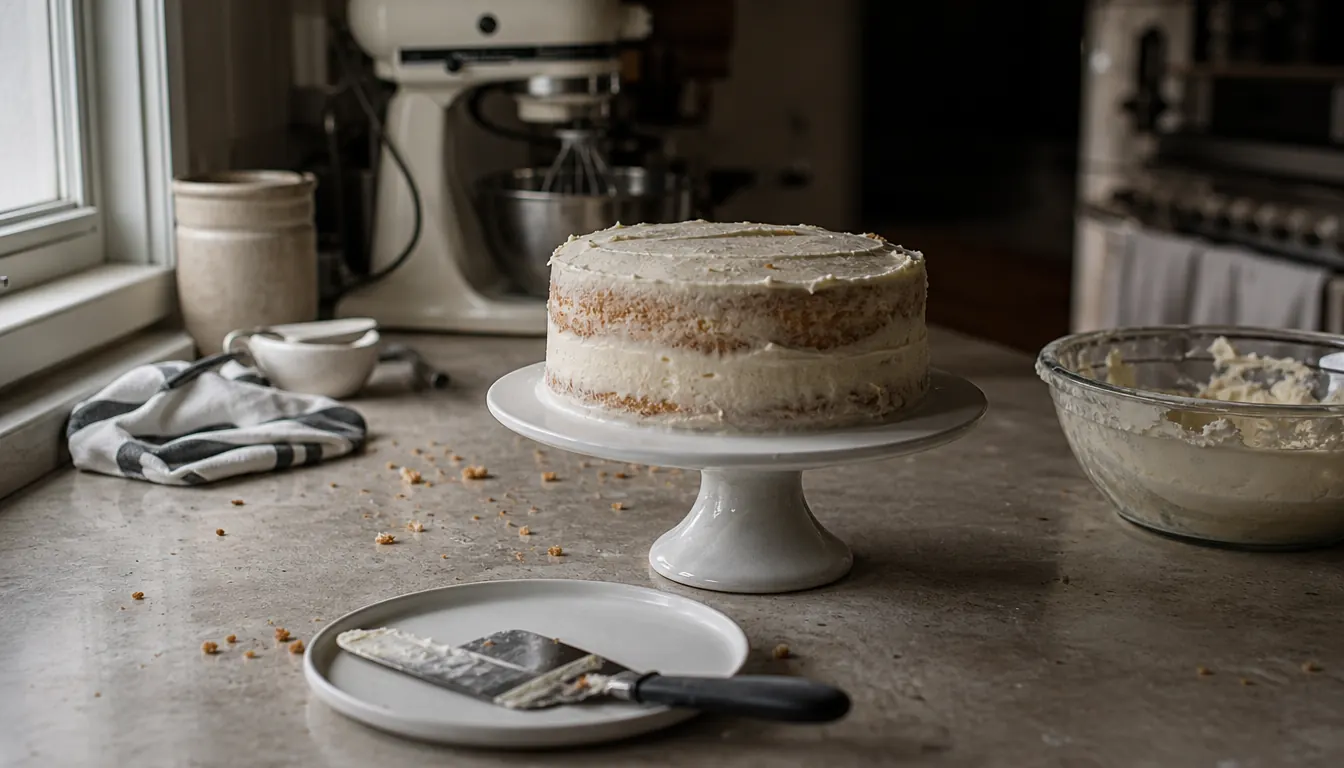
A year with the Kootek cake turntable has taught me something I did not expect, and it is the reason this is an honest review instead of a straight recommendation. The turntable does not make your frosting smoother. It cannot. What it does is remove the two things that were actually wrecking my cakes: walking in circles around the counter, and trying to smooth a side of the cake I could not see head on.
I trained in a pastry kitchen and worked there seven years before I moved into design, and every station in that kitchen had a turntable bolted to the bench. When I started baking at home in a Baltimore rowhouse with a narrow galley kitchen and six feet of counter, I reverted. I frosted cakes on a flat dinner plate, holding the plate with my left hand and turning it a quarter turn at a time. It worked, in the sense that the cake got frosted. It was also slow, it made my wrist ache, and the cakes looked like they had been frosted by someone turning a plate a quarter turn at a time. I bought the Kootek before my niece Maddie's ninth birthday and I have used it most months since, which is long enough to know exactly what it does and what it does not.
The Quick Verdict
A heavy, stable, genuinely 12-inch round stand that spins both directions and stays where you put it. Worth it for the size, the weight and the rubber feet, not for any feature you will never think about again.
Amazon Check Today's Price →If you frost more than two cakes a year, this is the one to get
12 inches across, 2.36 kg, 3.77 inches tall, rubber feet, a full 360 degrees of rotation in either direction. The specifications that matter here are the boring ones.
Amazon Check Today's Price on Amazon →How I've Used This Turntable for a Year
My cakes are not showpieces. They are a birthday cake for Maddie, a layer cake for my sister Karen, whatever the church bake sale asks for, and a few practice runs when I am testing a new buttercream. Call it eight to twelve frosted cakes a year. Every one of those went on this stand, and so did a handful of cakes I frosted badly on purpose to see where the tool stopped helping.
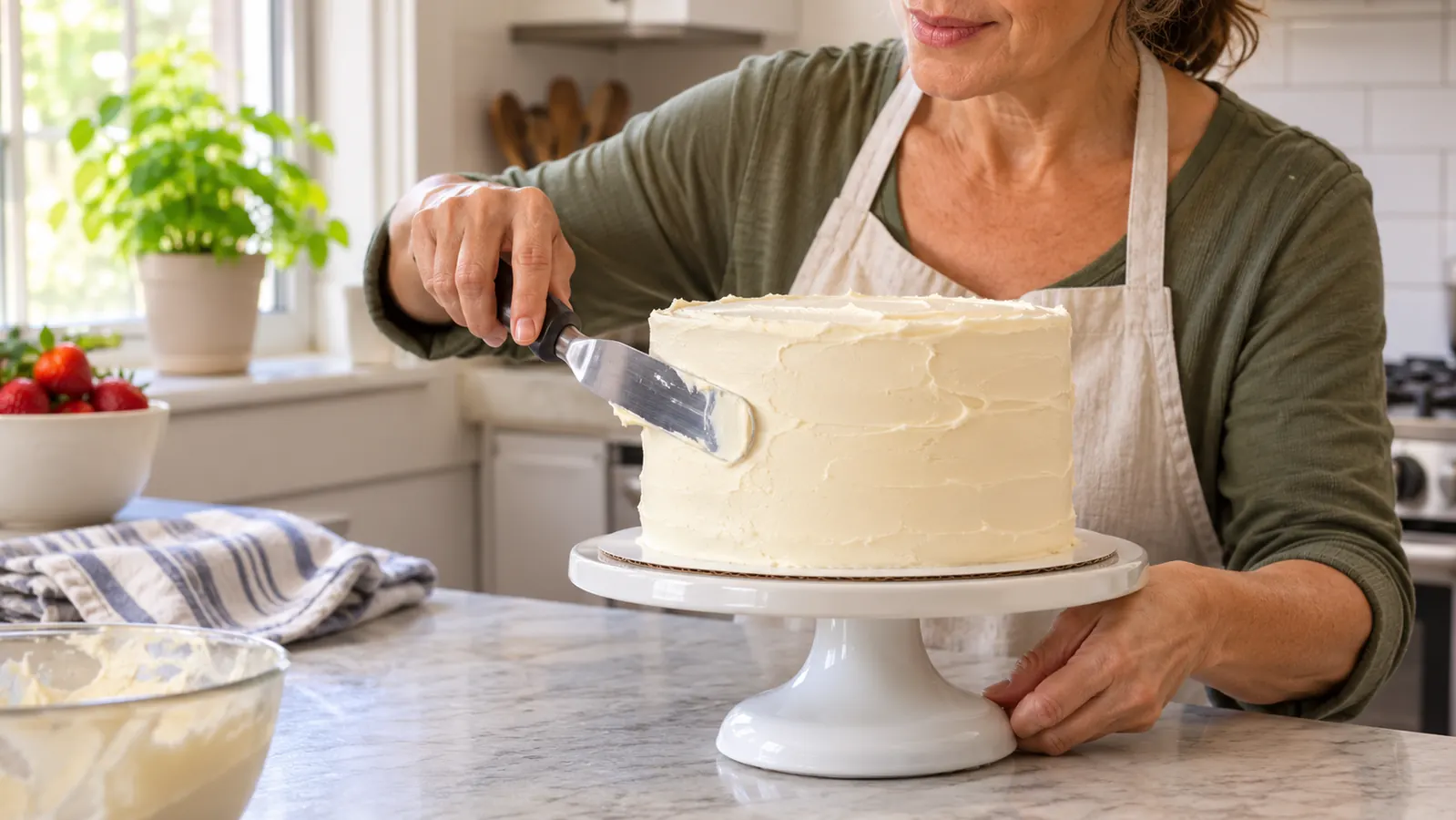
The routine is the same each time. The layers get stacked on a stiff cardboard board, the board goes on the turntable, and I turn the base with my left hand while my right hand holds the spatula at one fixed angle. That is the entire technique. The stand does the moving, my arm does the holding still, and the frosting comes out even because my hand is not travelling anywhere.
Two of those cakes stand out for me. The first was Maddie's tenth birthday in March, a two-layer chocolate cake on an 8-inch board with a plain vanilla buttercream, and it was the first cake I have made where the sides came out genuinely vertical instead of sloping in at the bottom. The Kootek did not shift once while I worked, even with my forearm leaning on the top to steady my wrist. The second was a cake for the church bake sale in October, where I had to frost, chill, and finish in a single evening after work. The stand is what made that possible, because I could move between the fridge and the counter and set the cake back down without re-centering anything.
The first thing that surprised me was the height. The pedestal puts the working surface 3.77 inches above the counter, and that changes your posture more than you would guess. On a plate I was leaning over and looking down at the cake. On the stand the top of the cake sits closer to eye level, so I can sight along the side while it turns. If you have ever wondered why your sides look fine from above and slightly sloped from across the room, it is usually because you have been frosting from above.
The second thing was stability. The stand weighs 2.36 kg, a little over five pounds, and it has rubber feet. Mine sits on a laminate counter that is not perfectly level, and in a year it has never crept, walked toward the edge, or tipped when I leaned into the side of a cake. That sounds like a low bar. It is not a low bar. The plastic stand my sister keeps in her cupboard skates across her counter when she presses on it, and she has caught it mid-slide more than once.
What Nobody Tells You Before You Buy One
Here is the part that gets left out of almost every decorating tutorial. A turntable does not decorate anything. It is a passive tool. It holds the cake and it turns, and that is the entire job description. If your buttercream is too warm, the stand will turn the cake while the buttercream slides off it. If your crumb coat is patchy, the stand will turn the cake while you stare at the patch. What it gives you is a fixed reference point and a free hand, and those two things are what let you actually build the skill.
The second thing nobody mentions is that the size of the top matters more than anything printed on a box. This one is 12 inches across and round. A standard 8-inch cake board sits inside that with roughly two inches of clearance all around, and a 10-inch board still fits with room to work. When a board overhangs the stand, your spatula catches the overhang on every rotation and the bottom edge of your frosting gets chewed up. Among home bakers, an undersized stand is a far more common mistake than an undersized mixer.
The third thing is that weight cuts both ways. A heavy stand is a stable stand, which is exactly what you want while your hand is on it. It is also a five-pound disc that has to live somewhere. Mine sits on the top shelf of the pantry cabinet, above the mixer bowl, and I can lift it down with one hand. I would not want to be pulling it off a high shelf every week with sore shoulders. Decide where it goes before you buy it, not after it arrives.
And one more small thing, since nobody says it plainly: you will want a supply of stiff cardboard cake boards. The stand grips a board well. It does not replace one. A bare layer set directly on the surface has nothing to hold onto, and a soft cake will shift under a spatula. Boards are the difference between a tool that feels solid and a tool that feels fiddly.
A 12-inch top and a 2.36 kg base do more for a finished cake than any feature on the box, because the stand does not move while you work.
The Details That Hold Up
The rotation is a full 360 degrees and it goes both ways. That reads like a specification written by a marketing department, but it is the detail I would miss most if it disappeared. I am right-handed, so I turn counter-clockwise and work the near side. My sister is left-handed and turns the other way without thinking about it. There is no correct direction and nothing on the stand pushing you into one.
The non-slip surface works better with a board than without. Set a cardboard cake circle down and the surface grips it well enough that the board stays put while you turn the base. A bare layer is a different story, because there is nothing for the surface to grab and a soft cake will drift if you press. Use a board. It is how the tool is meant to be used and it makes the whole process more predictable.
The base is a pedestal rather than a flat disc, so the stand narrows under the top and there is a gap you can get your fingers into when you lift it. On a crowded pantry shelf, that gap is the difference between picking it up cleanly and fumbling it against the shelf above. It also means nothing comes apart for cleaning, which I have decided is a fair trade for a surface that wipes down in seconds.
Chocolate buttercream is the real test of that surface. It sets up within a few minutes and it does not want to come off with a dry paper towel, and the first time I made a dark chocolate cake I assumed I had ruined the finish. A damp cloth and about thirty seconds handled it, and I have never had to scrape. The one thing I do not do is leave a frosted cake sitting on it overnight, because the board traps crumbs underneath and those crumbs go stale, and then the wipe takes twice as long the next morning.
How I Actually Work With It
The workflow that finally made my cakes look deliberate is not complicated. Level the layers, stack them on a board, press on a thin crumb coat, put the cake in the fridge for about twenty minutes, then bring it back to the stand for the second coat. The stand matters most at that second coat. Going around in one uninterrupted pass keeps the thickness of the frosting even. Going around twice with a stop and a restart leaves a ridge exactly where you paused. On a plate you cannot make a full pass without repositioning your feet, so you are always stopping.
My first attempt with it was a genuine mess, and the reason is worth repeating. I had a buttercream that was too warm, and I stood there turning the base and watching the frosting slide down the side of the cake in a slow sheet. I blamed the stand for about ten minutes. Then I put the bowl back in the fridge for fifteen minutes, rewhipped it, and the same cake came out clean on the same stand. Nothing about the equipment changed. The buttercream did.
The other place it earns its keep is the top edge. With the cake turning under a steady spatula, you can drag the frosting from the middle out toward the rim in a spiral, get a flat top, and then stand the spatula upright and pull the excess down the side in one motion. I learned that in the hotel kitchen and it took me years to reproduce at home. The only thing that changed was the stand.
Piping is faster and more even too. A border piped while the cake rotates comes out with consistent spacing and consistent pressure, because your hand is doing one job and the stand is doing the other. I am not a natural piper. On a plate I could get six inches of border that looked right before it started to wobble. On the stand the whole circumference is that same good six inches, repeated.
Where the Kootek Turntable Falls Short
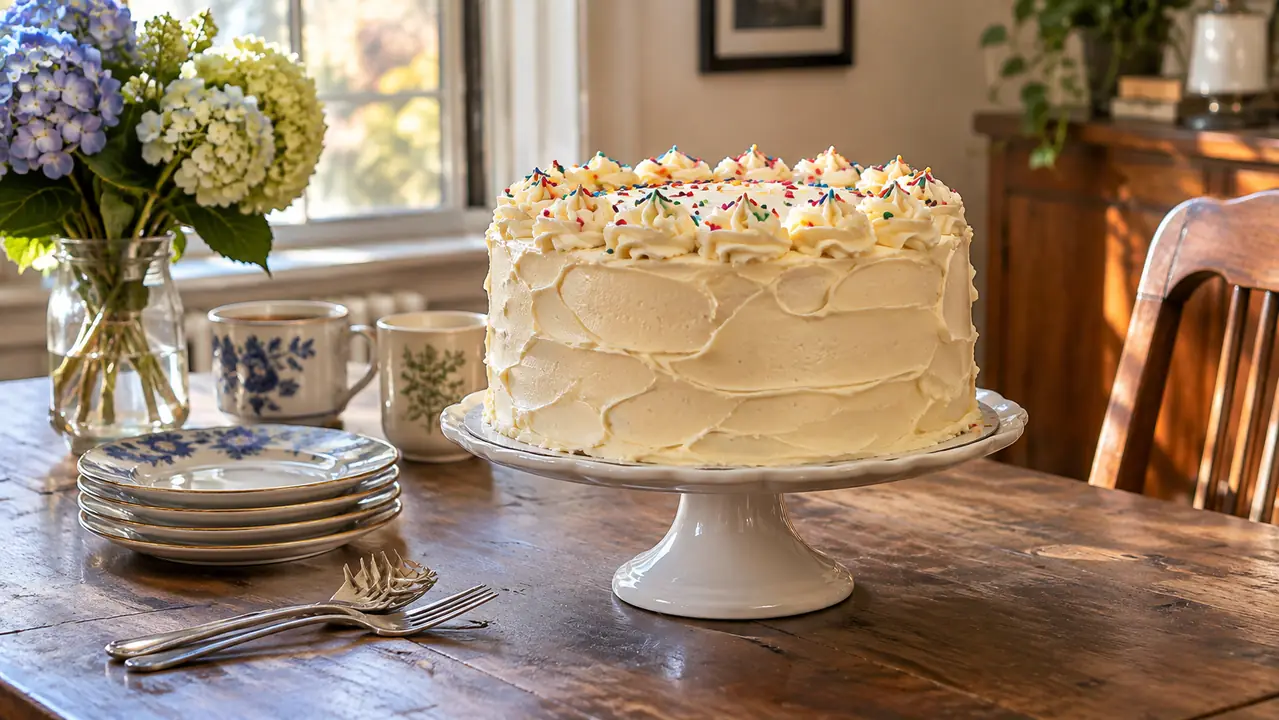
The top turns freely at all times. That is the point of a turntable, but it has a cost. If you press hard with a bench scraper to true up a side, the cake rotates under your hand whether you wanted it to or not. There is no way to hold the top still short of putting your other hand on the cake board, and that puts a thumbprint exactly where you least want one. For sharp-edged finishes I still work in short strokes with light pressure, and I suspect I always will.
I tried it once on a cake I wanted genuinely squared edges on, the kind you see in photographs of competition work. I got about a third of the way around before the pressure I was using started spinning the top faster than I was moving the scraper, and the edge went wavy right where my hand had been heaviest. Now I do that finish in strokes of four or five inches at a time and lift the scraper between each one. Slower, but predictable. The stand is not built for that job and I have stopped asking it to do that job.
Second, the surface is plain. Nothing on the top helps you center the cake, so centering is a judgement call every single time. On a 12-inch top, an 8-inch cake can sit half an inch off center without you noticing until the frosting is already on. My fix is to set the board down, step back, look, and nudge. It takes four seconds and it has saved a lopsided cake more than once.
Third, storage. It is 12 inches across and 3.77 inches tall, and it does not nest with anything. In a kitchen with six feet of counter and one pantry cabinet, that is a real commitment. Mine earns its shelf because I use it often enough to justify it. If you frost two cakes a year, it will spend three hundred and fifty days being slightly in the way, and I would rather you know that now than discover it in March.
What I Liked
- A full 12 inches of working surface, so a 10-inch cake board does not overhang and chew up your bottom edge
- 2.36 kg of weight plus rubber feet: it stays put, even on a counter that is not perfectly level
- Spins a full 360 degrees in either direction, which matters if you are left-handed or turn cakes the other way
- The 3.77-inch pedestal brings the cake up to a working height you can sight along
- Wipes clean with a damp cloth, no disassembly, nothing to lose
Where It Falls Short
- The top turns freely at all times, so heavy scraper work rotates the cake whether you want it to or not
- 12 inches across and 3.77 inches tall is a genuine shelf-space commitment in a small kitchen
- Nothing on the surface helps you center the cake, so that is eyeballed every time
- It will not fix a warm kitchen, a domed layer, or a patchy crumb coat
Who This Is For
This is for the home baker who frosts layer cakes often enough to be irritated by the plate method. If you make birthday cakes for family, a cake for the bake sale, or the occasional cake for a neighbor, a stable 12-inch stand will do more for your finish than another piping tip ever will. It suits a right-handed and a left-handed decorator equally, and it handles a small cake just as comfortably as a 10-inch one.
It is also a sensible first turntable if you have been putting off buying one for years. There is no learning curve, no assembly, and nothing to break or lose. You set a cake on it and it turns, and the first cake you frost on it will look better than the last one you frosted on a plate, mostly because your hand finally stopped moving.
Who Should Skip It
Skip it if you decorate once or twice a year and your counter space is already spoken for. A plate and a steady hand genuinely are enough at that volume, and I would rather tell you that than sell you a shelf ornament. Skip it too if you bake mostly sheet cakes, loaf cakes or brownies, because a turntable only earns its place when the cake is round and the sides need finishing.
And skip it if you were quietly hoping a stand would solve uneven sides. It will not, and neither will any other stand. The fix there is a level cake, a chilled crumb coat, and a scraper held at one consistent angle. That is a skill, not a purchase, and no amount of equipment removes the practice it takes to get there.
The stand that made the plate method feel silly in hindsight
12 inches round, 2.36 kg, rubber feet, a full 360 degrees either direction. It removes the one variable you cannot control, which is where the cake is while your hand is working.
Amazon Check Today's Price on Amazon →